

Let me ask you something real quick.
If your car broke down tomorrow, your water heater went out, or you had an unexpected medical bill show up — could you cover it without pulling out a credit card or calling somebody for help?
If the answer is no, or even "I'm not sure," this article is for you.
Here's the truth nobody's telling you: most Americans are one emergency away from financial chaos. Not because they're irresponsible. Not because they don't work hard. But because nobody ever sat them down and said, "Here's exactly how much you need in savings — and here's how to get there."
That's what I'm doing today.
No fluff. No complicated charts. Just a clear, step-by-step breakdown of how much you should have saved based on where you actually are right now.
Let's get to work.
Why "The Average American" Is the Wrong Benchmark
The first mistake people make is comparing their savings to national averages. They Google it, see a number, feel behind, and either panic or give up.
Family, stop doing that.
The average American is also carrying thousands in credit card debt, living paycheck to paycheck, and one missed check away from a crisis. That is not the standard you want to measure yourself against.
Your savings goal should be based on your life, your expenses, and your current financial situation — not a statistic.
So let's figure out your number.
The Right Way to Think About Savings
Before we get into the steps, I need you to understand something.
Savings isn't just a number. It's peace. It's margin. It's the ability to handle life without going into debt every time something unexpected happens.
And here's the thing — unexpected things will happen. That's not pessimism. That's just life. The question is whether you're ready when it does.
The goal is to build your savings in the right order, at the right time. Not all at once. One step at a time.
Step 1: Start With $1,000 — No Matter What
If you don't have $1,000 saved right now, this is your only financial priority.
Not investing. Not saving for a vacation. Not anything else.
One thousand dollars.
This is your starter emergency fund. It's not meant to cover every possible emergency in life. It's meant to keep you from reaching for a credit card the next time life throws something at you — and it will.
A flat tire. A doctor's visit. A broken appliance. These things happen, and without $1,000 in the bank, they become debt.
Here's how to get there fast:
- Cut subscriptions you're not using
- Pick up extra hours or a side hustle
- Sell things around the house you no longer need
- Do a no-spend challenge for 30 days
Get that $1,000 saved as fast as you possibly can. That's your foundation.
Step 2: If You Have Debt, Stay at $1,000 and Attack It
Once you hit $1,000, the next question is simple: Do you have debt?
If yes — credit cards, car loans, student loans, personal loans — your savings goal stays at $1,000 while you go to war with that debt.
I know that feels uncomfortable. You want more cushion. I understand.
But here's the reality: debt is costing you more than your savings is earning you. Credit card interest rates are sitting at record highs right now. Every dollar you leave sitting in savings while carrying high-interest debt is actually working against you.
Use the debt snowball method:
- List all your debts from smallest to largest balance
- Pay minimums on everything
- Throw every extra dollar at the smallest debt first
- When it's gone, roll that payment to the next one
One win at a time. That momentum is real, and it works.
Step 3: Once You're Debt-Free, Build Your Full Emergency Fund
This is where things start to feel different.
Once the debt is gone, it's time to build a fully funded emergency fund — and that means 3 to 6 months of your actual living expenses saved up.
Not your income. Your expenses. What does it actually cost you to live each month? Rent or mortgage, utilities, groceries, transportation, insurance — add it all up. That's your number.
How do you know if you need 3 months or 6?
Go with 3 months if:
- You're single with no dependents and have stable income
- You and your spouse both have steady, reliable jobs
Go with 6 months if:
- You're a single parent
- Your household runs on one income
- You're self-employed or your income varies month to month
- Someone in your home has ongoing health needs
Real example: If your monthly expenses are $3,500, your fully funded emergency fund should be somewhere between $10,500 and $21,000. Keep it in a high-yield savings account where it earns interest but stays accessible when you need it.
This fund is not for vacations. Not for sales. Not for "good deals." It is for emergencies only.
Step 4: Save for Big Purchases With Sinking Funds
Got a wedding coming up? Want to buy a car in cash? Planning a family vacation? Saving for a down payment on a house?
This is where sinking funds come in — and they are one of the most underrated savings tools out there.
A sinking fund is simple:
- Pick a goal
- Decide how much you need
- Divide it by the number of months you have
- Save that amount every month
Example: You want to take a $2,400 family vacation in 12 months. That's $200 a month. Set it aside, don't touch it, and show up to that trip without a single dollar of debt attached to it.
Keep your sinking funds in a separate savings account — labeled clearly — so you always know what the money is for.
This is what it looks like to enjoy life and stay financially free at the same time. Beans and rice for a season, then enjoy the fruit of your discipline.
Step 5: Invest 15% of Your Income for Retirement
Once your emergency fund is fully funded, it's time to start building real, generational wealth.
The goal is to invest 15% of your gross household income into retirement accounts every single month.
Here's the order to follow:
- Contribute to your 401(k) up to your employer match — that is free money. Do not leave it on the table.
- Open a Roth IRA and max it out. This is one of the best wealth-building tools available to everyday Americans.
- If you still haven't hit 15%, go back and increase your 401(k) contributions until you get there.
Example: If your household income is $70,000 a year, 15% means you're putting away $10,500 annually — about $875 a month — toward your future.
Your children's children's children will thank you for the decision you make today.
Where Should You Actually Keep Your Savings?
This matters more than most people think.
Emergency fund — Keep it in a high-yield savings account (HYSA). You'll earn more interest than a traditional savings account, and the money stays accessible when you truly need it. Just make sure it's not so easy to access that you're dipping into it for non-emergencies.
Sinking funds — A separate savings account works perfectly. Label it by purpose so you always know what it's for.
What to avoid: Keeping your savings mixed in with your everyday checking account. When it's all in one place, it all looks spendable — and it will get spent.
How to Save More Starting This Week
You don't need a raise to start saving more. You need a plan.
Increase your income. Your income is your most powerful wealth-building tool. A side hustle, freelance work, overtime, or selling unused items can add real money to your savings fast.
Cut your expenses. Meal prep instead of eating out. Cancel subscriptions you forgot you had. Buy generic. Small cuts made consistently add up to big results.
Kill the debt. Every debt payment you eliminate is money freed up to build your future. The faster you get out of debt, the faster you can save.
Budget every single dollar. You cannot save what you don't track. A zero-based budget gives every dollar a job — including the dollars going into savings. If it's not in the budget, it doesn't happen.
Conclusion
Family, let me bring it home.
How much you should have in savings is not about what the average American has. It's not about your age or your income bracket. It's about your next step — and taking it.
Here's your roadmap one more time:
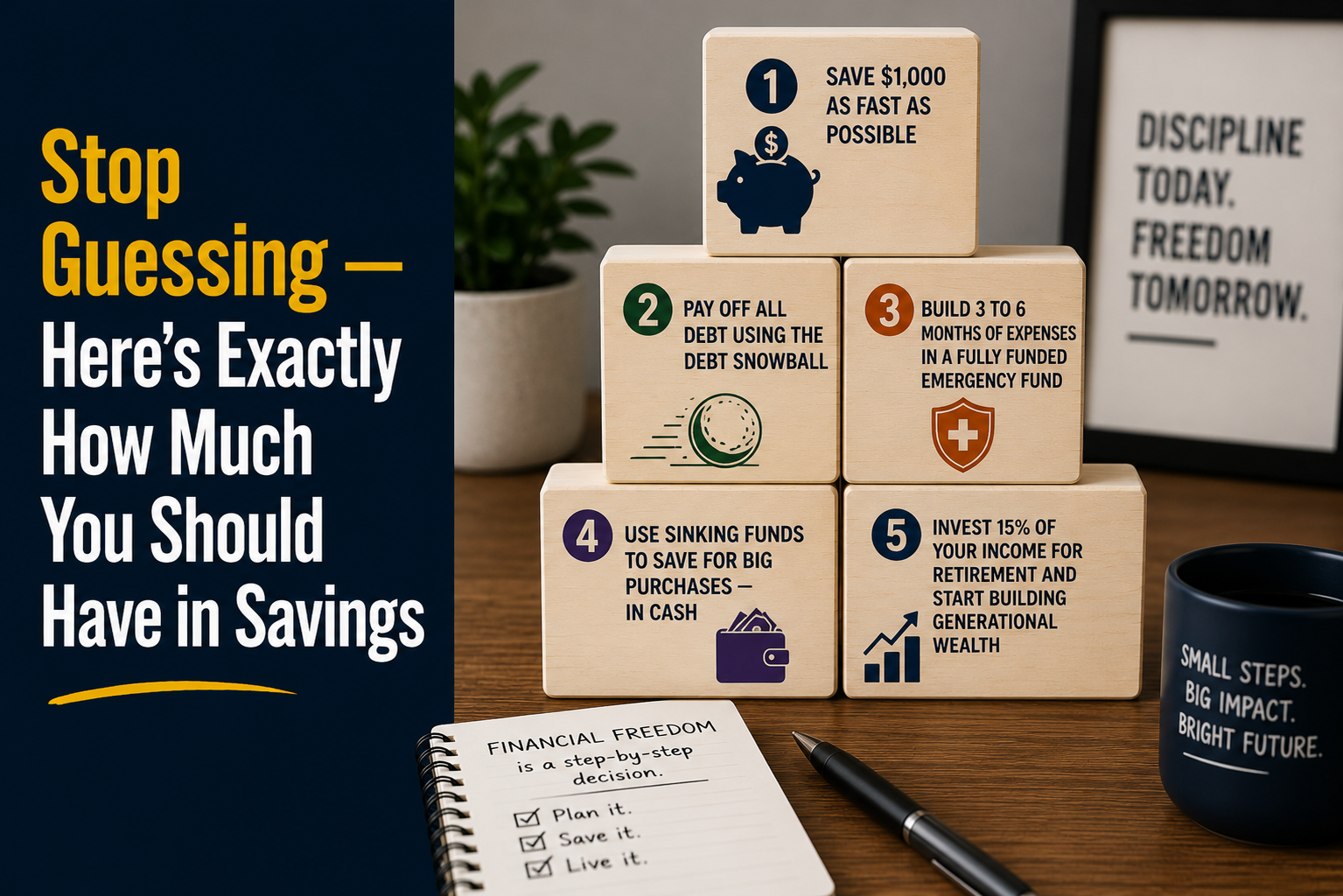
- Save $1,000 as fast as possible
- Pay off all debt using the debt snowball
- Build 3 to 6 months of expenses in a fully funded emergency fund
- Use sinking funds to save for big purchases — in cash
- Invest 15% of your income for retirement and start building generational wealth
You are not too far behind. You are not too broke to start. You are one decision away from a completely different financial story.
Your move this week: Open your bank app right now. Check your savings balance. Figure out which step you're on — and take one action toward the next one today.
Now I want to hear from you: Which step are you on right now, and what's the one thing holding you back? Drop it in the comments below. Let's build together.
Keep building.

Anthony O'Neal is a bestselling author, speaker and personal finance educator. He teaches families how to get out of debt and build real wealth on any income through The Escape Plan, his show The Table with AO, and the In the Black app.