

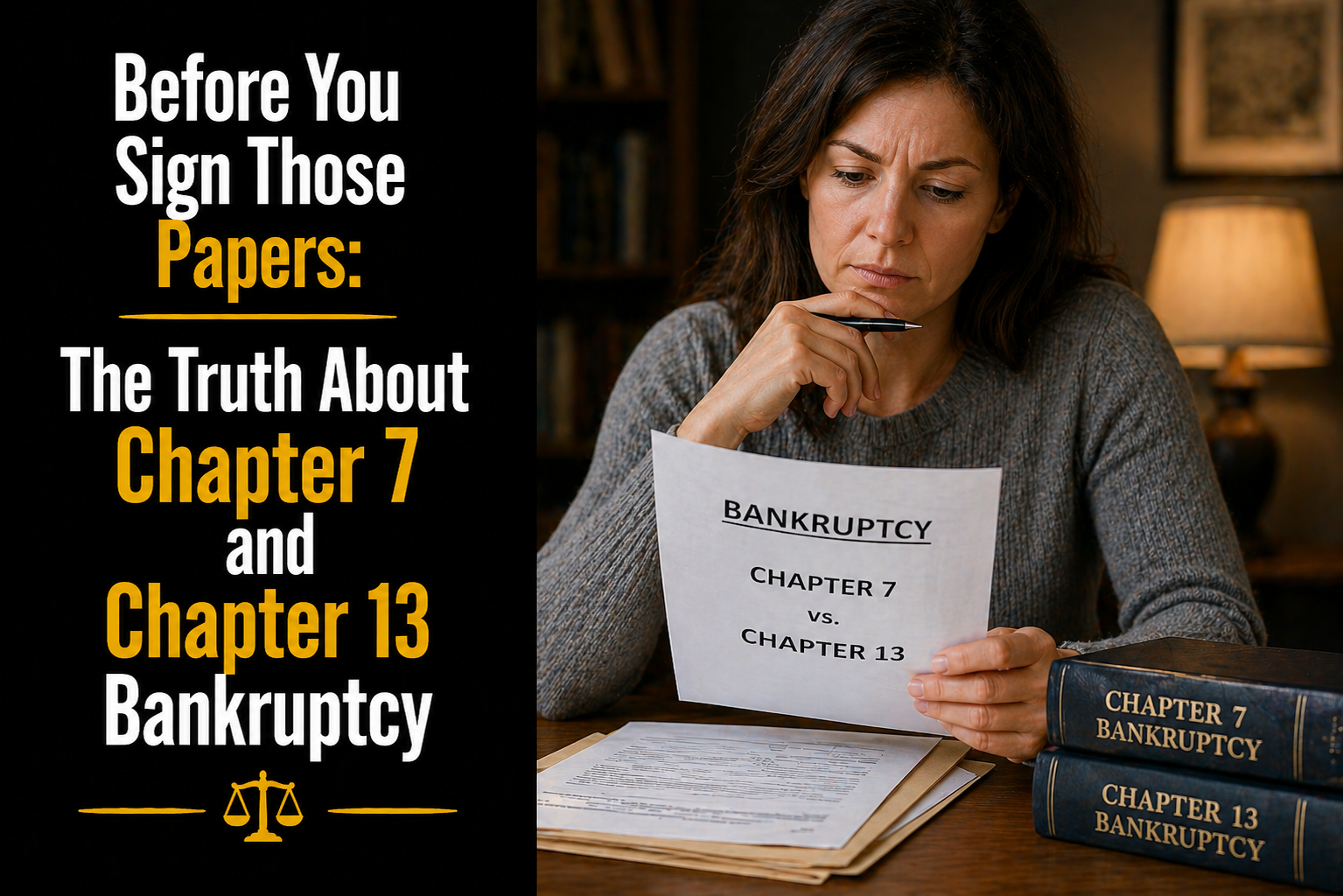
Family, let's have an honest conversation today.
If you're sitting at your kitchen table, staring at a pile of bills you can't pay, and someone told you that bankruptcy might be your answer — I hear you. I see you. And I'm not here to shame you for even considering it.
But I am here to make sure you understand exactly what you're walking into before you sign anything.
Because bankruptcy isn't just a legal filing. It's a decision that will follow you for the next 7 to 10 years. And you deserve to know the full picture before you take that step.
So today, we're breaking it all down — what Chapter 7 and Chapter 13 bankruptcy actually are, how they work, and what you need to do if this is truly the path forward for your situation.
Let's get to work.
First — Is Bankruptcy Actually Your Only Option?
Real talk: most people who consider bankruptcy haven't exhausted every option yet.
Before we go any further, I need you to ask yourself these questions:
- Have you built a real, written budget and stuck to it?
- Have you sold anything — furniture, electronics, a second car — to pay down debt?
- Have you called your creditors and tried to negotiate a lower rate or payment plan?
- Have you looked into nonprofit credit counseling?
- Have you tried increasing your income, even temporarily?
If the answer to any of those is no, start there first.
Bankruptcy should be the last door you open — not the first one.
That said, I know some of you have already tried everything. You've done the work, and you're still underwater. If that's you, keep reading. This is for you.
What Is Bankruptcy?
Bankruptcy is a federal legal process that gives individuals and businesses a way to get relief from debts they genuinely cannot repay. It's overseen by federal courts, and it's designed to give people a structured path forward when they're truly stuck.
Here's what bankruptcy can do:
- Temporarily stop debt collectors from contacting you
- Pause wage garnishments and foreclosures
- Eliminate certain types of unsecured debt
Here's what bankruptcy cannot do:
- Erase student loans (in almost every case)
- Wipe out child support or alimony
- Clear most tax debts
- Remove the record from your credit report for 7 to 10 years
That last point matters. A bankruptcy filing doesn't disappear quietly. It shows up every time you apply for a job, a mortgage, a car loan, or even an apartment. That's the cost you need to weigh carefully.
Chapter 7 vs. Chapter 13: The Real Difference
There are two types of bankruptcy most individuals file. Let me break them both down — cookie jar on the bottom shelf.
Chapter 7 Bankruptcy: The Liquidation Option
Chapter 7 is the most common type of personal bankruptcy. Here's how it works:
A court-appointed trustee reviews your assets and sells your non-exempt property to pay back your creditors. Once that's done, most of your remaining unsecured debt — credit cards, medical bills, personal loans — is discharged, meaning legally wiped out.
What you need to qualify:
You must pass what's called a means test. This is the court's way of determining whether your income is low enough to file Chapter 7. If you earn too much, you'll be directed toward Chapter 13 instead.
How long it takes:
Chapter 7 moves relatively fast — most cases are resolved in 3 to 6 months.
What you could lose:
This is where people get caught off guard. Depending on your state's exemption laws, you could be required to give up:
- A second vehicle
- Investment accounts
- Valuable personal property
- Real estate beyond your primary home
If you want to keep a secured asset — like your car — you may need to reaffirm that debt, which means agreeing to keep making payments on it even after bankruptcy.
Bottom line on Chapter 7:
It's faster, but it comes with real sacrifice. You may walk away with less than you started with.
Chapter 13 Bankruptcy: The Repayment Option
Chapter 13 works differently. Instead of liquidating your assets, you get to keep your property — but you're placed on a strict, court-approved repayment plan that lasts 3 to 5 years.
Think of it like this: the court looks at your income, your expenses, and your debts — and then tells you exactly how much you have to pay each month and to whom. You follow that plan to the letter, and at the end, any remaining eligible debt is discharged.
What you need to qualify:
Your total debt must be under $2,750,000. You also need to have a regular income — because the whole plan is built around your ability to make consistent payments.
How long it takes:
3 to 5 years. This is not a quick process.
What happens if you miss payments:
Your case gets dismissed. That means you lose the protection of bankruptcy and you're right back where you started — except now you've lost years and still have the debt.
Bottom line on Chapter 13:
It protects your assets and gives you a structured path forward. But it requires serious discipline and commitment for years.
Chapter 7 vs. Chapter 13 — Side by Side
Chapter 7
Also Called: Liquidation Bankruptcy
Timeline: 3–6 months
Keep Your Assets? Not always
Income Requirement: Must pass means test
Debt Limit: None
Best For: Low income, few assets
Credit Report Impact: 10 years
Chapter 13
Also Called: Reorganization Bankruptcy
Timeline: 3–5 years
Keep Your Assets? Yes
Income Requirement: Must have regular income
Debt Limit: Under $2,750,000
Best For: Regular income, want to keep property
Credit Report Impact: 7 years
How to File for Bankruptcy: Step by Step
If you've made the decision that bankruptcy is truly your path forward, here's exactly what the process looks like.
Step 1: Consult a Bankruptcy Attorney
Do not do this alone. A qualified bankruptcy attorney has seen hundreds of cases like yours and can help you avoid costly mistakes, fill out paperwork correctly, and represent you if anything gets complicated.
Yes, attorneys cost money. But the cost of doing this wrong is far greater.
You can find a bankruptcy attorney through the American Bar Association's Legal Help website or the Legal Services Corporation. If you truly cannot afford an attorney, ask about free legal aid in your area.
Step 2: Gather Your Financial Documents
Before you can file anything, you need to get organized. Here's what you'll need:
Debt Records:
- Credit reports from all three bureaus (Experian, TransUnion, Equifax)
- Credit card statements
- Medical bills
- Personal loan records
- Any documentation of money you owe
Income Records:
- Tax returns from the last 2 years
- Pay stubs from the last 6 months
- Bank statements from the last 6 months
- Investment and retirement account statements
Asset Records:
- Mortgage statements and real estate documents
- Vehicle registration
- Estimated value of personal property
- Receipts for major purchases in the last year
Other Documents:
- Government-issued ID and Social Security card
- Any communication with creditors
- Insurance policies
- A detailed list of your monthly living expenses
Get a folder. Label it. Keep everything in one place. Your financial life is about to be examined closely.
Step 3: Complete a Required Credit Counseling Course
This is not optional — it's the law. Before you can file for bankruptcy, you must complete a credit counseling course approved by the U.S. Department of Justice.
Here's what you need to know:
- Must be completed within 180 days before filing
- Takes about 1 hour
- Can be done in person, online, or by phone
- Costs 10–50 (fees can be waived if you qualify)
- You'll receive a certificate of completion — keep it, you'll need it
Step 4: Fill Out Your Bankruptcy Forms
This is the most detailed step in the process. You'll complete over 70 pages of federal forms that cover your income, expenses, debts, assets, and financial history. All forms are free to download at uscourts.gov.
This is where having an attorney is invaluable. One mistake on these forms can delay or derail your entire case.
If you can't afford an attorney, look into bankruptcy software that walks you through the forms step by step.
Step 5: File Your Forms at the Bankruptcy Court
Take your completed forms, your credit counseling certificate, and your filing fee to your local federal bankruptcy court.
Filing fees:
- Chapter 7: $335
- Chapter 13: $310
Payment must be made in exact change. If you can't afford the fee, you can request a payment plan (up to 4 payments over 120 days) or apply for a fee waiver.
Once your forms are accepted, the clerk will give you:
- Your bankruptcy case number
- The name of your assigned trustee
- The date and location of your creditors meeting
At this point, your case is officially filed — and the automatic stay goes into effect immediately. That means debt collectors must stop contacting you, wage garnishments are paused, and foreclosures are temporarily halted.
Step 6: Send Documents to Your Bankruptcy Trustee
Your trustee — appointed by the court to oversee your case — will request specific documents from you. This typically includes tax returns, pay stubs, and bank statements.
Watch your mail. Respond promptly. Do everything your trustee asks.
Step 7: Attend the Meeting of Creditors (341 Meeting)
About 20 to 40 days after filing, you'll attend what's called the 341 meeting — named after Section 341 of the Bankruptcy Code.
This is a meeting between you, your trustee, and any creditors who choose to attend. You'll be under oath, so honesty is non-negotiable.
Bring:
- Your government-issued photo ID
- Your Social Security card
The trustee will verify your information, ask questions about your filing, and confirm there are no discrepancies. Creditors may attend to ask about assets or reaffirmed debts — but many don't show up at all.
This is also your opportunity to ask questions and raise any objections if a creditor has claimed a debt that isn't accurate.
Step 8: Complete the Debtor Education Course
While your case is being processed, you must complete a second required course — a debtor education course focused on financial management.
- Must be completed within 60 days of your 341 meeting
- Takes at least 2 hours
- Costs 10–50 (waivers available)
This course exists for a reason. Bankruptcy is not something you want to go through twice. Use this time to genuinely learn and reset your financial habits.
Step 9: Wait for Your Discharge
If you filed Chapter 7:
Once your trustee has liquidated non-exempt assets and paid creditors, your remaining eligible debts are discharged. This typically happens within a few months of filing.
If you filed Chapter 13:
You must complete your full repayment plan — every payment, on time, for 3 to 5 years. Once the plan is complete, your remaining eligible debts are discharged.
When your case is closed, you'll receive a discharge letter in the mail. Keep that letter. It's your legal proof that those debts no longer exist.
What Happens After Bankruptcy?
Family, this is where the real work begins.
A discharge doesn't automatically fix your finances. It gives you a cleared slate on certain debts — but the habits, the mindset, and the plan going forward are entirely up to you.
Here's what I want you to do after bankruptcy:
- Build a starter emergency fund — $1,000 minimum, as fast as possible
- Start a written budget — every dollar needs a name, every month
- Begin rebuilding your credit — responsibly, slowly, and intentionally
- Attack any remaining debt using the debt snowball method
- Get connected to a financial coach or community — you don't have to do this alone
Scripture reminds us in Proverbs 22:7 that the borrower is servant to the lender. The goal has always been freedom. And freedom is still available to you — no matter what your credit report says right now.
Conclusion
Look, family — bankruptcy is not the end of your story. But it is a serious chapter that deserves serious attention.
Here's what we covered today:
- Chapter 7 liquidates assets to clear unsecured debt — faster, but you may lose property
- Chapter 13 lets you keep assets but requires a 3–5 year repayment plan
- You must complete credit counseling before filing and debtor education after
- The process involves attorneys, trustees, court filings, and formal meetings
- Bankruptcy stays on your credit report for 7 to 10 years — plan accordingly
Here's your move: Before you file anything, talk to a nonprofit credit counselor and a qualified bankruptcy attorney. Make sure you've explored every option. And if bankruptcy is truly the right path, go in with your eyes open and a plan for what comes next.
You are not your debt. You are not your credit score. And you are not too far gone.
One decision. One step. One new chapter.
Keep building,

Lorem ipsum dolor sit amet, consectetur adipiscing elit. Suspendisse varius enim in eros elementum tristique. Duis cursus, mi quis viverra ornare, eros dolor interdum nulla, ut commodo diam libero vitae erat. Aenean faucibus nibh et justo cursus id rutrum lorem imperdiet. Nunc ut sem vitae risus tristique posuere.