
Key Takeaways
- A Roth IRA is one of the most powerful retirement tools available — you invest after-tax dollars today and never pay taxes on that money again.
- Before you open one, make sure you're debt-free (except your mortgage) and have a fully funded emergency fund.
- The IRS has income limits — make sure you qualify before you start.
- You don't need a lot of money to get started. Some accounts let you begin with as little as $50.
- Always work with a trusted investment professional to help you choose the right funds.
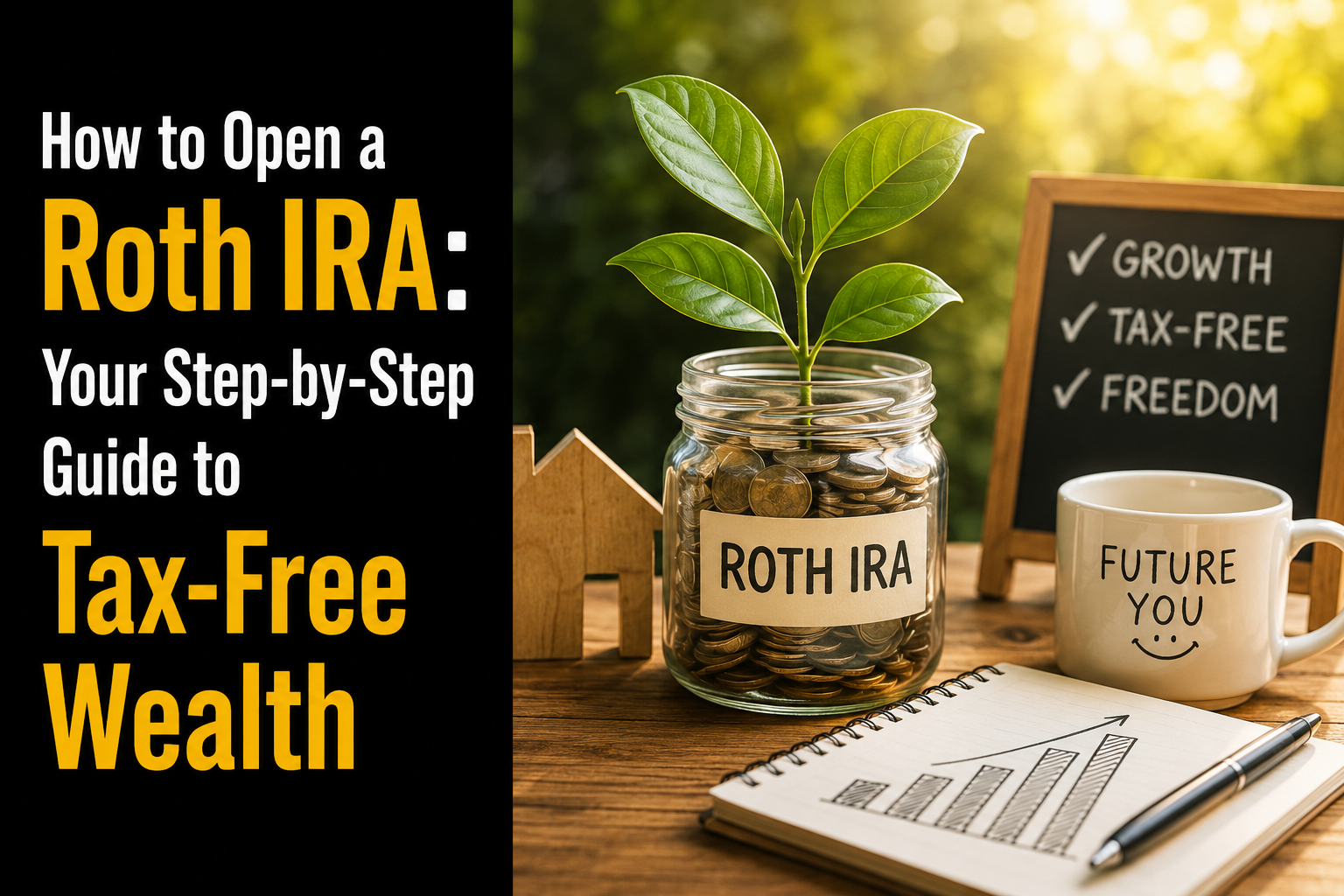
Opening a Roth IRA might be one of the best financial decisions you ever make for your future. Real talk — this account is built for people who want to stop trading time for money and start building something that lasts.
Here's what makes it special: You put in money you've already paid taxes on, and from that point forward? The government can't touch it. Your money grows tax-free. Your withdrawals in retirement are tax-free. That's not a loophole — that's the system working for you for once.
And unlike other retirement accounts, a Roth IRA doesn't force you to start pulling money out at a certain age. You can let it keep growing until you actually need it.
This is the kind of tool your children's children's children will thank you for. Let's get to work.
Step 1: Make Sure You're Ready
Before you open a Roth IRA, I need you to be honest with yourself about where you are financially. Because investing while you're drowning in debt is like trying to fill a bucket with a hole in the bottom.
Here's the order that works:
First — get out of debt. If you have consumer debt — credit cards, car loans, personal loans — pay that off first using the debt snowball method. One debt at a time, smallest to largest. Build momentum. Get free.
Second — build your emergency fund. You need 3 to 6 months of expenses saved in a high-yield savings account before you start investing. This is your financial foundation. Without it, one unexpected bill will wipe out your progress.
Third — grab your employer match. If your job offers a 401(k) match, take every dollar of it before you open a Roth IRA. That's free money. Don't leave it on the table.
Once those three things are in place? You're ready. Let's move.
Step 2: Check If You Qualify
The IRS sets income limits on who can contribute to a Roth IRA. This is important — don't skip this step.
For 2026, here's what you need to know:
If you're a single filer, you can contribute the full amount if your adjusted gross income (AGI) is under $150,000. Between $150,000 and $165,000, your contribution gets reduced. Above $165,000, you can't contribute directly.
If you're married filing jointly, the full contribution is available under $236,000. It phases out between $236,000 and $246,000. Above that, direct contributions aren't allowed.
And the contribution limit for 2026? $7,500 per year — or $8,600 if you're 50 or older and need to catch up.
If your income is above the limit, don't panic. There's a strategy called a backdoor Roth IRA. Talk to a financial advisor about whether that's right for your situation.
Step 3: Decide Who Will Help You Manage It
Here's where a lot of people go wrong — they try to do this alone.
Family, I'm not saying you're not smart enough. I'm saying this is too important to wing it. A good investment professional will help you set up the account correctly, choose the right funds, and stay on track when the market gets shaky.
You have two options:
DIY (Do It Yourself): You open the account through a brokerage, pick your own investments, and manage everything yourself. This works if you're financially disciplined and educated — but most people aren't there yet, and that's okay.
Work With a Pro: A financial advisor or investment professional walks you through the process, helps you choose funds with a strong track record, and keeps you accountable. This is the route I recommend for most people.
Either way — get some guidance. The cost of a good advisor is nothing compared to the cost of making the wrong moves with your retirement money.
Step 4: Open the Account and Fill Out the Paperwork
Once you've decided how you'll manage it, it's time to actually open the account. Whether you go online or sit down with a pro, you'll need a few things ready:
- A government-issued photo ID (driver's license or passport)
- Your Social Security number
- Your bank's routing number and your checking or savings account number
- Your employer's name and address
You'll also choose a beneficiary — the person who inherits your Roth IRA when you're gone. This is part of building legacy. Don't skip it. You'll need their name, Social Security number, and date of birth.
The process is straightforward. Most accounts can be opened in under 30 minutes.
Step 5: Choose What to Invest In
Here's something people don't always understand — your Roth IRA is not an investment by itself. It's a container. A tax-protected wrapper that holds your actual investments.
So what should you put inside it?
Mutual funds. That's the recommendation I stand behind. Here's why:
Mutual funds spread your money across dozens or even hundreds of companies. That's called diversification, and it protects you from putting all your eggs in one basket. Single stocks and crypto? Too risky for your retirement money.
The stock market has historically returned an average of 10 to 12% annually over the long term. Mutual funds let you capture that growth without betting everything on one company.
For a well-balanced portfolio, spread your investments across four types of mutual funds:
- Growth funds — companies expected to grow faster than average
- Growth and income funds — a mix of growth and dividend-paying stocks
- Aggressive growth funds — higher risk, higher potential reward
- International funds — companies outside the U.S. for global diversification
25% in each category. Simple. Balanced. Built for the long game.
Step 6: Set Up Automatic Contributions
This is the step that separates people who build wealth from people who just talk about it.
Set up automatic contributions to your Roth IRA every month. When the money moves before you see it, you won't miss it — and you won't spend it.
The goal is to invest 15% of your gross income toward retirement. If you're maxing out your employer's 401(k) match first, put the rest into your Roth IRA until you hit the annual limit.
For 2026, that's $7,500 per year — or about $625 per month. If you can't hit that right away, start with what you can. $100 a month is better than nothing. Build the habit first, then increase it over time.
The key is consistency. Don't pull your money out when the market dips. Don't panic. Stay the course. The people who become millionaires through investing aren't the ones who timed the market perfectly — they're the ones who stayed in it.
What This Means For You
A Roth IRA isn't just a retirement account. It's a declaration that you're done letting the system win. It's you saying — I'm going to build something that lasts beyond me.
You don't need to be rich to start. You don't need to have it all figured out. You just need to take the next step.
Get out of debt. Build your emergency fund. Open the account. Choose your funds. Set up automatic contributions. And then let time do what time does.
Your future self — and your children's children's children — will thank you.
Frequently Asked Questions
How does a Roth IRA actually work?
You contribute money you've already paid taxes on. That money grows inside the account tax-free. When you withdraw it in retirement (after age 59½ and after holding the account for at least 5 years), you pay zero taxes on it — including all the growth.
How much money do I need to open one?
The IRS has no minimum. Most brokerages let you start with as little as $50. There's no reason to wait.
Can my spouse open one even if they don't work?
Yes. If you file taxes jointly and at least one of you has earned income, your non-working spouse can open a spousal Roth IRA in their own name and contribute up to the annual limit.
What if my income is too high?
Look into a backdoor Roth IRA conversion. It's a legal strategy that allows higher earners to still take advantage of Roth benefits. Talk to a financial advisor to see if it's right for you.
Should I choose a Roth IRA or a traditional IRA?
For most people, especially those earlier in their careers, the Roth wins. You pay taxes now at a lower rate and enjoy tax-free growth for decades. The traditional IRA gives you a tax break today but you'll pay taxes on withdrawals later.
Conclusion
Look, family — this isn't complicated. A Roth IRA is one of the most powerful tools available to everyday Americans who want to build real, lasting wealth.
Here's your recap:
- Get out of debt and build your emergency fund first
- Check your income eligibility
- Decide how you'll manage the account
- Open it and fill out the paperwork
- Choose diversified mutual funds
- Set up automatic monthly contributions
You're not too late. You're not too broke. You're one decision away from a new story.
Your move: Start today. Even if it's just researching your options or talking to a financial advisor this week — take one step forward.
Now I want to hear from you — what's been holding you back from opening a Roth IRA? Drop it in the comments. Let's figure it out together.
Keep building,

Lorem ipsum dolor sit amet, consectetur adipiscing elit. Suspendisse varius enim in eros elementum tristique. Duis cursus, mi quis viverra ornare, eros dolor interdum nulla, ut commodo diam libero vitae erat. Aenean faucibus nibh et justo cursus id rutrum lorem imperdiet. Nunc ut sem vitae risus tristique posuere.