

Key Takeaways
- An auto loan is money you borrow to purchase a vehicle — but the lender owns the car until it's paid off in full.
- Your car note is the monthly payment you make on your auto loan, which includes principal, interest, and fees.
- The average car payment is $734 for a new car and $525 for a used car.
- Your monthly payment is determined by your loan amount, interest rate, loan term, down payment, and trade-in value.
- There is a better way — and I'm going to show you exactly what it looks like.
Let me ask you something, family.
When was the last time you sat down and actually looked at how much your car is really costing you?
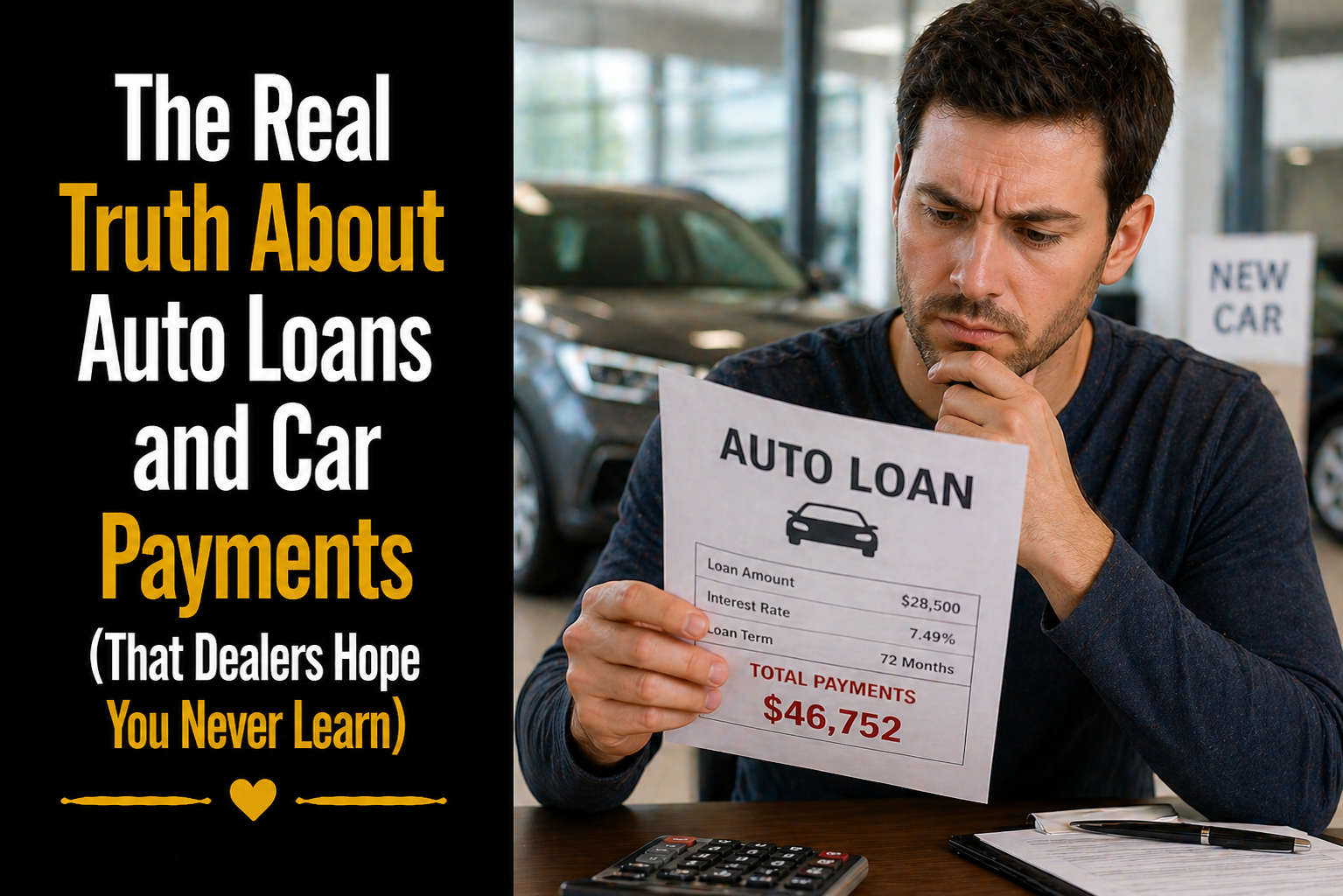
Not just the monthly payment. The total cost. The interest. The depreciation. The years of your life you're spending paying a lender for a vehicle that's losing value every single day it sits in your driveway.
Most people never do that math. And the dealerships? They're counting on it.
Today, we're pulling back the curtain on how auto loans and car payments actually work — because the more you understand the system, the harder it is for the system to use you.
Let's get to work.
What Is a Car Loan?
An auto loan — also called a car loan — is money you borrow from a lender to purchase a vehicle.
Most people take out a car loan because they don't have the cash to buy a car outright. And I get it. Cars are expensive. But here's what the dealer won't tell you when they're handing you those keys:
You don't own that car. The lender does.
Until you make your final payment and receive the title, the bank holds ownership of your vehicle. You're driving their car. And if you miss enough payments? They will come and take it back — no questions asked.
That's not freedom, family. That's a leash.
What Is a Car Note?
Your car note is the monthly payment you make on your auto loan.
It sounds simple, but there's more inside that payment than most people realize. Every month when you make that payment, you're covering:
- Principal — the original amount you borrowed
- Interest — the fee the lender charges you for letting you borrow their money
- Fees — any additional costs that were rolled into the loan at signing
Here's the thing about interest: in the early months of your loan, the majority of your payment goes toward interest — not the actual car. The lender gets paid first. You build equity last.
The higher your loan amount or interest rate, the more of your hard-earned money goes straight into someone else's pocket.
What Is the Average Car Payment Right Now?
Let's talk real numbers, because this is where it gets eye-opening.
New Car
Monthly Payment: $734
Loan Amount: $40,927
Interest Rate: 6.84%
Loan Term: ~68 months
Avg. Credit Score: 753
Used Car
Monthly Payment: $525
Loan Amount: $26,248
Interest Rate: 12.01%
Loan Term: ~67 months
Avg. Credit Score: 689
Family, look at that used car interest rate. 12.01%. That means if your credit isn't strong, you're paying a premium just to drive a car that's already been driven.
And that loan term? Nearly 67 months — that's almost 6 years of payments on a used vehicle.
Six years. Think about what else you could do with $525 a month over six years. That's over $37,000 — money that could have gone toward a down payment on a home, an investment account, or your children's future.
Instead, it went to a lender.
How Are Car Payments Calculated?
Your monthly car payment is determined by five key factors:
1. Loan Amount (Principal)
This is the total amount you're borrowing. The more you borrow, the higher your payment.
2. Interest Rate
This is the percentage the lender charges you for borrowing their money. Your credit score plays a big role here — the lower your score, the higher your rate.
3. Loan Term
This is how many months you have to pay back the loan. Longer terms mean lower monthly payments — but you pay far more in interest over time.
4. Down Payment
The more you put down upfront, the less you have to borrow — and the lower your monthly payment.
5. Trade-In Value
If you're trading in your current vehicle, that value gets applied to the purchase price, reducing your loan amount.
Here's a simple example of how it all comes together:
You buy a car for $33,000. You trade in your old car for $8,000, leaving you with a $25,000 loan at 6.84% interest over 60 months. Your monthly payment comes out to roughly $493/month. By the time you make your last payment, you've paid over $29,500 — more than $4,500 in interest on top of the car's price.
And that car you paid $29,500 for? It'll be worth around $13,000 in five years.
That's the math they don't show you on the lot.
How Do Car Loans Actually Work?
When you're ready to buy a car, you have two main financing routes:
Direct Financing
You go directly to a bank, credit union, or online lender before you go to the dealership. You get pre-approved for a loan amount, then you shop with that number in mind. This is the smarter approach — you know your budget before you fall in love with a car.
Indirect Financing (Dealer Financing)
You go to the dealership, pick out a car, and then work with their in-house finance team to get a loan. Here's the problem with this route: you're emotionally attached to the car before you know what it's going to cost you. Dealers know this — and they use it.
Either way, once you're approved and you sign the paperwork, you're locked into monthly payments until the loan is paid in full. Miss payments, and you risk defaulting on the loan — which can lead to your car being repossessed and serious damage to your credit.
What About Leasing?
Real talk — leasing is the most expensive way to drive a car, full stop.
Yes, the monthly payments are lower. But you don't own anything at the end. You're essentially renting a car with strict mileage limits and wear-and-tear rules. When the lease is up, you hand the keys back and start all over again — often with another payment.
Leasing keeps you in a permanent cycle of payments. Steer clear.
The Real Cost of a Car Payment
Let me show you what a car payment is actually costing you — not just in dollars, but in opportunity.
Say you take out a $25,000 auto loan at 6.84% over 60 months. Your payment is $493/month.
Over the life of that loan, you'll pay:
- $29,500+ total (including interest)
- $4,500+ in interest alone
- And you'll own a car worth roughly $13,000 when it's paid off
But here's the part that really hits different:
What if instead of making that $493 car payment, you invested that same amount every month for 5 years at an 8% average return?
You'd have over $36,000 — and that's money working for you, not against you.
That's the real cost of a car payment. It's not just what you pay. It's what you lose.
How to Lower Your Car Payment — Or Eliminate It Completely
Buy Used, Not New
A brand-new car loses a significant chunk of its value the moment you drive it off the lot. A car that's 2–3 years old has already taken that depreciation hit — and you can get it for thousands less. Don't let culture pressure you into a new car you can't afford.
Make a Larger Down Payment
Every dollar you put down is a dollar you don't pay interest on. If you can delay your purchase by a few months to save a larger down payment, do it. The math will thank you.
Sell Your Car Privately Instead of Trading It In
Dealerships lowball trade-ins — that's their business model. Sell your current car privately, get what it's actually worth, and use that money to reduce what you need to borrow.
Shorten Your Loan Term
A longer loan term lowers your monthly payment but costs you more in interest over time. If you can handle a higher monthly payment on a shorter term, you'll save significantly in the long run.
Pay Cash
I know this sounds radical. But hear me out.
What if you bought a reliable used car for 5,000–8,000 cash right now — just to get around — while you saved aggressively for something better? Take that $493 you would have paid in car payments and put it in a dedicated savings account every month. In 12 months, you've got nearly $6,000 saved. Keep going, and you can upgrade your car every year — paying cash every time — until you're driving exactly what you want with zero payments.
No lender. No interest. No leash.
That's freedom.
If You Already Have a Car Payment — Here's Your Plan
You're not stuck. But you do need to move with intention.
Step 1: Know your exact payoff amount. Call your lender or log into your account today.
Step 2: Add your car to your debt snowball. Attack it aggressively — extra income, side hustles, cutting expenses, selling things you don't need.
Step 3: The moment it's paid off, keep making that "payment" — but into your own savings account. You're building your cash car fund.
Step 4: When it's time for your next car, buy it in cash. No exceptions.
One decision at a time. One payment at a time. That's how you break the cycle.
Conclusion
Family, here's the bottom line:
Auto loans and car payments are one of the biggest wealth destroyers in the average American household. The system is designed to keep you comfortable with debt — to make $734 a month feel normal. But normal is broke.
Here's what we covered today:
- A car loan means the bank owns your car — not you
- The average American pays $734/month for a new car, with thousands lost to interest
- Your payment is shaped by loan amount, interest rate, term, down payment, and trade-in value
- Leasing is the most expensive way to drive — avoid it
- Paying cash is possible — and it's the goal
Here's your next step: Write down exactly what you owe on your car right now. Then head to anthonyoneal.com and use the free tools there to build your debt payoff plan. You don't have to keep feeding a lender every month.
You're one decision away from a different story.
Now I want to hear from you — are you currently in a car payment? What's your plan to get free? Drop it in the comments. Let's build together.
Keep building,

Lorem ipsum dolor sit amet, consectetur adipiscing elit. Suspendisse varius enim in eros elementum tristique. Duis cursus, mi quis viverra ornare, eros dolor interdum nulla, ut commodo diam libero vitae erat. Aenean faucibus nibh et justo cursus id rutrum lorem imperdiet. Nunc ut sem vitae risus tristique posuere.