

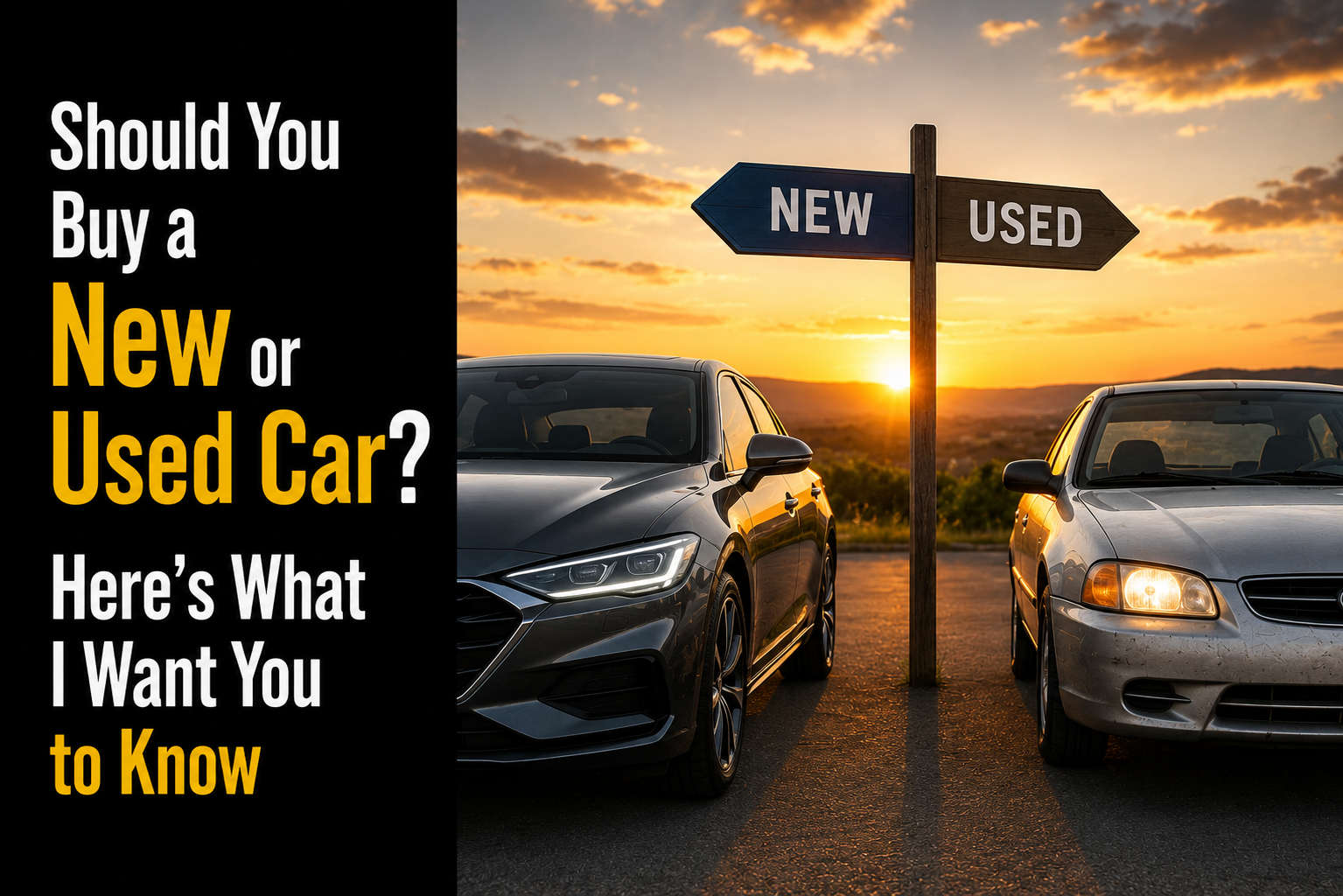
Let me be real with you, family.
The moment you step onto a car lot and smell that new car smell, something happens to your brain. The shiny rims, the spotless interior, the latest tech — it all starts whispering, "You deserve this."
And maybe you do. But here's the question nobody's asking: Can you actually afford it?
Because here's the truth — most people buying brand-new cars aren't building wealth. They're building car payments. And there's a big difference between those two things.
Today, I'm breaking down the new car vs. used car debate so you can make a decision that moves you forward — not one that keeps you stuck.
Let's get to work.
The Real Cost of Driving Off That Lot
Here's something the dealership will never tell you.
The moment you drive a brand-new car off the lot, it loses a significant chunk of its value. Not next year. Not next month. The moment you leave.
By the time you've had that car for a year, it's worth even less. And after five years? You could be looking at a car worth a fraction of what you paid for it.
That's called depreciation — and it's one of the biggest wealth killers hiding in plain sight.
When you buy used, you let someone else absorb that hit. You step in after the steepest drop in value, which means your money goes further and your investment holds up better over time.
That's not a small thing. That's the difference between a smart financial move and an expensive mistake.
New vs. Used: A Tale of Two Buyers
Let me paint you a picture.
Marcus and Darius are both in the market for a vehicle. Same income. Same goals. But they make very different choices.
Marcus walks into the dealership and drives off in a brand-new truck. He finances it, locks in a monthly payment, and tells himself he'll pay it off early. Sound familiar?
Darius does his research, finds a reliable four-year-old sedan with low mileage, and pays cash. No payment. No interest. No stress.
Fast forward five years.
Marcus has paid thousands of dollars in interest on top of the original price. His truck is worth a fraction of what he paid. And he's still making payments.
Darius? He's been stacking the money he would have spent on car payments. He's already saved enough to upgrade to a nicer vehicle — in cash — and he still has money left over to invest.
Same income. Completely different outcomes.
The car you choose isn't just a transportation decision. It's a wealth decision.
Why Used Cars Win — Every Single Time
1. You Pay Less From the Start
This one is simple. Used cars cost significantly less than new ones. And when you're trying to build wealth, every dollar you don't spend on a car is a dollar you can put toward your future.
The goal isn't to look like you have money. The goal is to actually have money.
2. Depreciation Works in Your Favor
With a used car, the steepest depreciation has already happened. The previous owner took that loss — not you. That means the car you're buying holds its value better over the time you own it.
You're not just saving money upfront. You're protecting your investment long-term.
3. Insurance Costs Less
A lot of people forget about this one until they get the bill.
New cars cost more to insure. Period. They're more expensive to repair, more expensive to replace, and insurance companies price their premiums accordingly.
With a used car, your monthly insurance costs are typically lower — which means more money staying in your pocket every single month.
4. Reliability Isn't Guaranteed With New Cars
Here's something that might surprise you.
New doesn't always mean better. In fact, brand-new models — especially in their first year of production — can come with more problems than a well-maintained used car.
Faulty technology. Recall notices. Bugs that haven't been worked out yet.
With a used car, you have a track record to look at. You can pull a vehicle history report. You can read reviews from real drivers. You can make an informed decision based on actual data — not just a shiny brochure.
Stick to reliable brands with proven track records. Do your homework. And don't let fear of the unknown push you into a new car you can't afford.
The Loan Trap Nobody Talks About
Real talk — the most expensive way to buy a car is with a loan.
When you finance a vehicle, you're not just paying for the car. You're paying for the car plus interest. And that interest adds up fast.
Most people focus on the monthly payment. "I can afford $500 a month," they say. But they never stop to calculate how much they're actually paying over the life of that loan.
By the time you're done, you've paid thousands more than the car was ever worth — for a vehicle that's been losing value the entire time.
The best way to buy a car is with cash. I know that sounds impossible right now. But I promise you, it's more achievable than you think — and I'll show you how in a minute.
So When Is It Okay to Buy New?
I'll be straight with you.
If you're still working on your debt snowball, a new car is not the move. If you're living paycheck to paycheck, a new car is not the move. If a new car payment would stretch your budget or put you in a tough spot, it is not the move.
As a general rule, the total value of everything with a motor that you own should never be more than half of your annual household income. That's the guardrail.
And here's what's wild — most millionaires don't even buy new cars. They buy used. They understand that wealth isn't built by spending money on things that lose value. It's built by being intentional with every dollar.
How to Save Up and Buy Your Car in Cash
Here's the part I love most — because this is where the real freedom starts.
Step 1: Know your number.
Figure out what a reliable used car costs in your area. That's your target.
Step 2: Open a dedicated savings account.
Don't mix your car fund with your regular savings. Keep it separate so you can see it grow.
Step 3: Set a monthly savings goal.
Even if it's $200 or $300 a month, consistency is what gets you there. Every month you save is a month closer to driving off that lot debt-free.
Step 4: Sell your current car if you can.
If you have a vehicle with equity, that's a head start on your next purchase. Use it.
Step 5: Be patient.
This is the hardest part. But I promise you — the feeling of paying cash for a car and owning it outright is something you can't put a price on.
Beans and rice for a season, family. Then you enjoy the ride — for real.
Conclusion
Look, I'm not here to tell you what kind of car to drive. That's your call.
But I am here to tell you the truth — and the truth is that new cars are one of the fastest ways to slow down your wealth-building journey.
Used cars cost less. They hold their value better. They're cheaper to insure. And when you buy one with cash, you own it completely. No payments. No interest. No stress.
Here's your move: Start a car fund today. Even if it's small. Open a high-yield savings account, set up an automatic transfer, and let it grow. You'll be amazed at how fast it adds up when you're intentional.
And if you're not sure where to start with your overall budget, that's exactly what I help people with every single day.
Now I want to hear from you — are you currently driving a car you financed, or have you ever paid cash for a vehicle? Drop it in the comments. Let's talk about it.
Keep building,

Lorem ipsum dolor sit amet, consectetur adipiscing elit. Suspendisse varius enim in eros elementum tristique. Duis cursus, mi quis viverra ornare, eros dolor interdum nulla, ut commodo diam libero vitae erat. Aenean faucibus nibh et justo cursus id rutrum lorem imperdiet. Nunc ut sem vitae risus tristique posuere.