
Car insurance
The easiest bill you’ll ever cut
Most people haven’t compared car insurance rates in years — and insurance companies quietly raise the price on the customers who stay. Ten minutes here can be worth hundreds of dollars a year, every year, for as long as you drive.
30-second gut check
Three questions before you do anything
Tap the ones that are true for you. Nobody sees this but you — it just tells you whether it’s worth your time to look.
Tap the ones that are true
Even one yes usually means you are paying more than you have to.
Your turn
Compare your rate in about 60 seconds
Enter your ZIP code, answer a few quick questions, and see what real companies would charge you today. You are never obligated to switch — plenty of people run this, find out they already have a good rate, and move on with peace of mind.
Your information is used to pull your quotes, not to run a hard credit check. This comparison tool is provided by a partner, and I may earn a commission if you buy a policy through it — it costs you nothing extra, and I would not put it here if I did not use it myself.
Coverage, in plain English
What you should actually be carrying
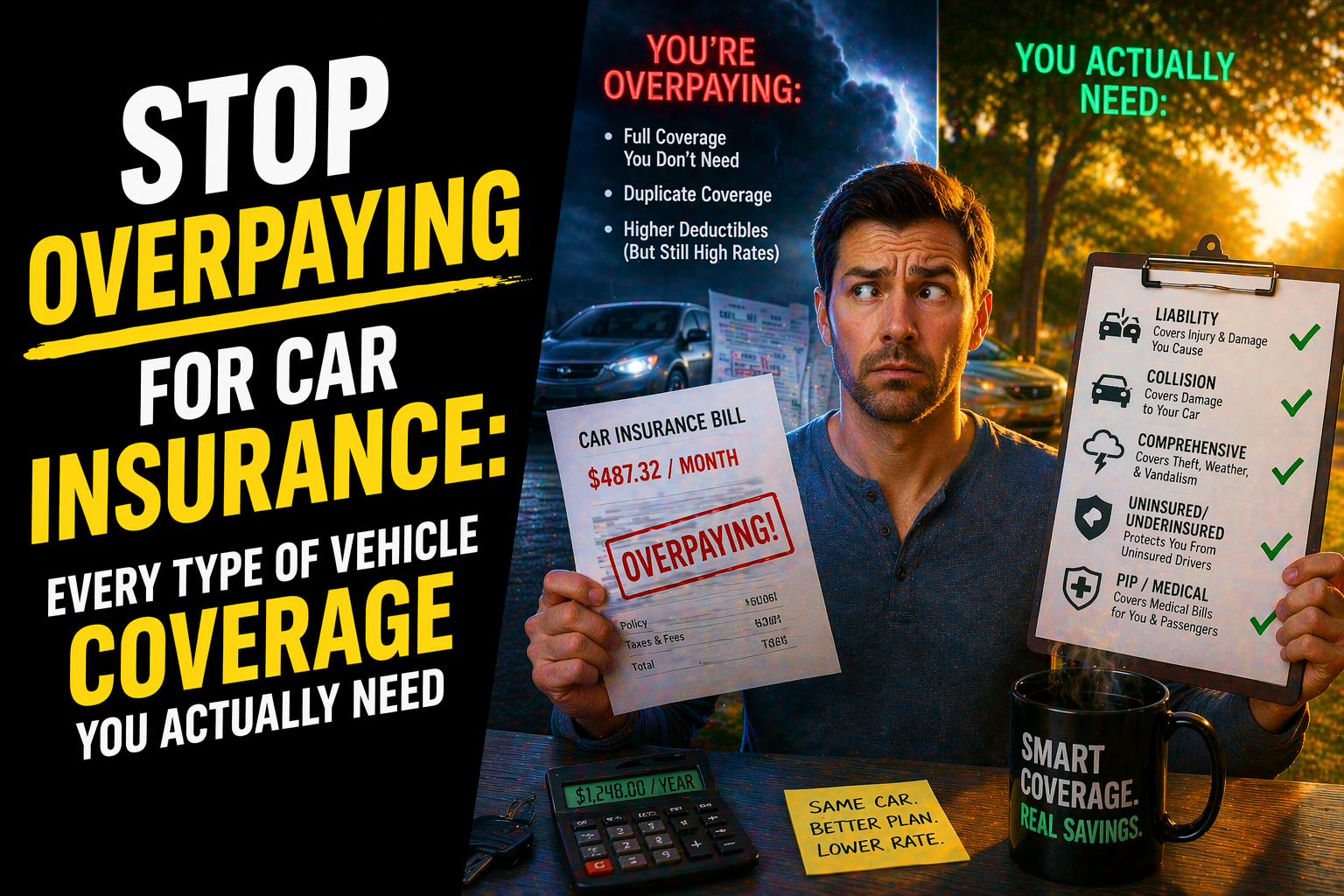
Cheap is not the goal. Right is the goal. Here is the difference between a policy that protects what you have built and one that just keeps you legal.
Liability: 100 / 300 / 100
This is the part that protects everything you have worked for. Plenty of states still let you drive with as little as $25,000 of bodily-injury coverage per person. One serious hospital stay blows through that in a day — and the rest comes out of your paycheck, your savings, and sometimes your house. Carry $100,000 per person, $300,000 per accident, $100,000 property damage.
Uninsured & underinsured motorist
A lot of people on the road right now are driving with no insurance at all, or the bare state minimum. This is the coverage that pays when the person who hit you cannot. It is usually one of the cheapest lines on the entire policy and one of the most important.
Comprehensive & collision
Required as long as you still owe on the car. Once it is paid off, do the math: if a year of comp and collision costs more than about 10% of what the car is worth, you are paying a lot to insure a little. Drop it and send that money to your emergency fund instead.
“I am not trying to talk you into more insurance. I am trying to keep one bad afternoon from undoing five years of work. Get the liability right first — then go cut everything else.”
Anthony O’Neal
Keep the coverage, cut the cost
Six ways to lower the bill without cutting corners
You do not have to choose between being protected and being broke. Most people are overpaying for reasons that have nothing to do with coverage.
Raise your deductible — after the emergency fund
Moving from a $500 to a $1,000 deductible usually drops the premium noticeably. Only do it once that $1,000 is actually sitting in savings. Otherwise you have not saved money, you have just moved the risk onto a credit card.
Ask for every discount by name
Bundling, paperless billing, paying in full, autopay, defensive driving, good student, low mileage, safety features, employer and alumni affiliations. They rarely volunteer these. You have to ask for them one at a time.
Pay in full, or at least every six months
Monthly installment fees are quiet money leaving your account. Paying the term up front usually takes a few percent off the total, and it is the same coverage either way.
Fix the mileage on your policy
If you changed jobs, started working from home, or just stopped commuting, the mileage on file may be years out of date. Lower verified mileage, lower price. This one takes a phone call.
Your credit affects your rate in most states
The same work you are doing to get out of debt is quietly lowering this bill too. That is one more reason to re-shop after your credit improves, not before.
Stop paying twice for the same thing
Roadside assistance, rental reimbursement and medical payments are often already covered by your credit card, your auto club or your health plan. Check what you already have before you buy it again.
Put it on the calendar. Every 12 months.
Car insurance is not a set-it-and-forget-it bill. Rates move, your life moves, and the company you are with is counting on you not noticing. Pick a month, make it the same month every year, and spend ten minutes comparing. That one habit will out-earn almost every coupon you ever clip.
Before you switch
Four rules that save people real money
Switching is simple, but there are four ways people turn a win into an expensive mistake. Do not be one of them.
Never cancel the old policy until the new one is active
Even a one-day gap gets recorded as a lapse in coverage, and a lapse raises your price with almost every company for years afterward. Start the new policy first, then cancel.
Compare the same coverage, not just the price
A cheaper quote with lower liability limits is not a better deal. It is less protection wearing a nicer number. Line the limits up side by side before you decide anything.
Look at how they pay claims, not just what they charge
The cheapest company in the world is expensive if it fights you on the day you actually need it. Spend five minutes on claims reviews before you sign.
If you are still financing, check the lender’s requirements
Your loan contract sets a minimum for comprehensive and collision. Dropping below it can technically put you in default on the car loan — an expensive way to save $12 a month.
Straight answers
The questions people actually ask
Will this hurt my credit?
No. Pulling insurance quotes uses a soft inquiry, which does not affect your credit score. The hard inquiry — the kind that can ding you — is for borrowing money, not for comparing insurance.
Is this legit, or am I about to get spammed?
It is a comparison tool from a partner I checked out before putting it on my site. You control how much you share and how far you take it, and you are never required to buy anything. If you would rather not give a phone number, you can still see what is out there.
Do I have to switch right now?
No. Plenty of people run this, find out they already have a competitive rate, and close the tab. That is a win too — now you know instead of wondering.
What information will I need?
Your ZIP code to start. After that, the basics most people know by heart: who drives, what you drive, roughly how much you drive, and your current coverage if you have it handy. Your declarations page makes it faster, but you do not need it to begin.
How much can I actually expect to save?
I am not going to hand you a number, because anybody who does is guessing. Here is the honest version: your savings are the gap between what you pay now and what the market would charge you today, and that gap grows the longer you go without checking. If it has been several years, the gap is usually real.
Do you make money if I use this?
Yes. If you buy a policy through the tool, I earn a commission from the partner at no extra cost to you. That is how a free resource stays free, and it does not change a word of what I taught you above: get your liability right, cut what is wasteful, and keep the difference.
Read more
Read this before you sign anything.

Where this fits
This is Phase 1 and Phase 2 money.
Cutting a bill you were paying anyway is the cheapest raise you will ever get. Put what you free up into your starter emergency fund, then into the debt snowball.
Protect what you're building.
Weekly money tips, real stories, and my free Wealth Checklist.
Free. Unsubscribe anytime.