
30 Days to More Money: How to Crush a No-Spend Challenge and Come Out Winning

3 min read
Key Takeaways
- A no-spend challenge is a 30-day commitment to cut all non-essential spending and redirect that money toward your goals.
- It's not about suffering — it's about building the discipline muscle that creates lasting financial freedom.
- The families who win this challenge have one thing in common: a plan before they start.
Let me ask you something, family.
If I told you that you could find an extra $300, $500, maybe even $800 this month — without getting a second job, without a raise, without doing anything crazy — would you do it?
Because that money is already in your budget. You're just spending it on things that aren't moving you forward.
That's exactly what a no-spend challenge is designed to expose. And when you do it right, it doesn't just save you money this month — it rewires the way you think about spending for good.
I've seen it happen. Real people. Real results. Let's break it down.
What Is a No-Spend Challenge?
A no-spend challenge is exactly what it sounds like: for a set period of time — usually 30 days — you commit to spending money only on what you truly need and nothing more.
You're not going off the grid. You're not starving. You're still covering your essentials:
- Food (groceries — not DoorDash)
- Utilities
- Housing (rent or mortgage)
- Transportation (gas to get to work — not Ubers for a night out)
Everything outside of that? Paused.
No restaurants. No online shopping. No "it was on sale" justifications. No subscriptions you forgot you had. Just 30 days of intentional, purposeful living.
Think of it as a financial fast. You're not giving up forever — you're pressing pause so you can get clear on where your money is actually going.
The Rules of a No-Spend Challenge
Here's the thing — you set the rules. But if you want to win, here's the framework that works:
- Needs are in. Wants are out. Get brutally honest with yourself about the difference. Groceries = need. A new outfit = want.
- Keep your bills current. Debt payments, insurance, utilities — those don't stop. Honor your commitments.
- Give yourself an emergency exit. If your car breaks down or a medical bill shows up, handle it. Life happens. Pause the challenge, deal with it, and restart.
- No guilt trips. This isn't about shame. It's about building a new relationship with your money.
The Benefits of a No-Spend Challenge
Real talk — this works. Here's what 30 days of intentional spending can do for you:
- Save you real, tangible money — fast
- Expose your emotional spending triggers
- Break the cycle of impulse buying
- Help you find margin you didn't know existed
- Build the discipline that wealth requires
- Accelerate your debt snowball payoff
- Teach your children what stewardship looks like in real life
- Give you a reset that carries into the months ahead
Scripture reminds us that the borrower is servant to the lender. A no-spend challenge is one of the most practical ways to start taking that seriously.
10 Tips to Actually Win Your No-Spend Challenge
1. Set a Goal That Means Something to You
A no-spend challenge without a goal is just suffering. You need a why.
Are you trying to knock out a credit card? Build your starter emergency fund? Save for a down payment? Pay off a medical bill?
Write it down. Make it specific. "I want to save $600 this month to put toward my debt snowball" is a goal. "I want to save money" is a wish. Know the difference.
When the temptation hits — and it will — your goal is what keeps you grounded.
2. Choose the Right Month
Timing matters. Don't set yourself up to fail before you even start.
If you've got a wedding, a birthday trip, or a major family event this month — pick a different month. Look at your calendar and find a 30-day window where you have the best shot at staying committed.
A lot of people love doing a no-spend January to reset after the holidays. Others do a no-spend September when summer spending slows down. Find what works for your life.
3. Build Your Budget Before Day One
You cannot win this challenge without a budget. I'll say it again — you cannot win without a budget.
Before the month starts, sit down and map out every essential expense. Then go line by line through your non-essentials and cut them. Subscriptions you forgot about? Gone. Eating out budget? Zero. Impulse shopping category? Eliminated.
A budget is just a plan for your money. And you need a plan.
4. Track Your Progress Every Day
What gets measured gets managed. Don't just set the goal and hope for the best — track it daily.
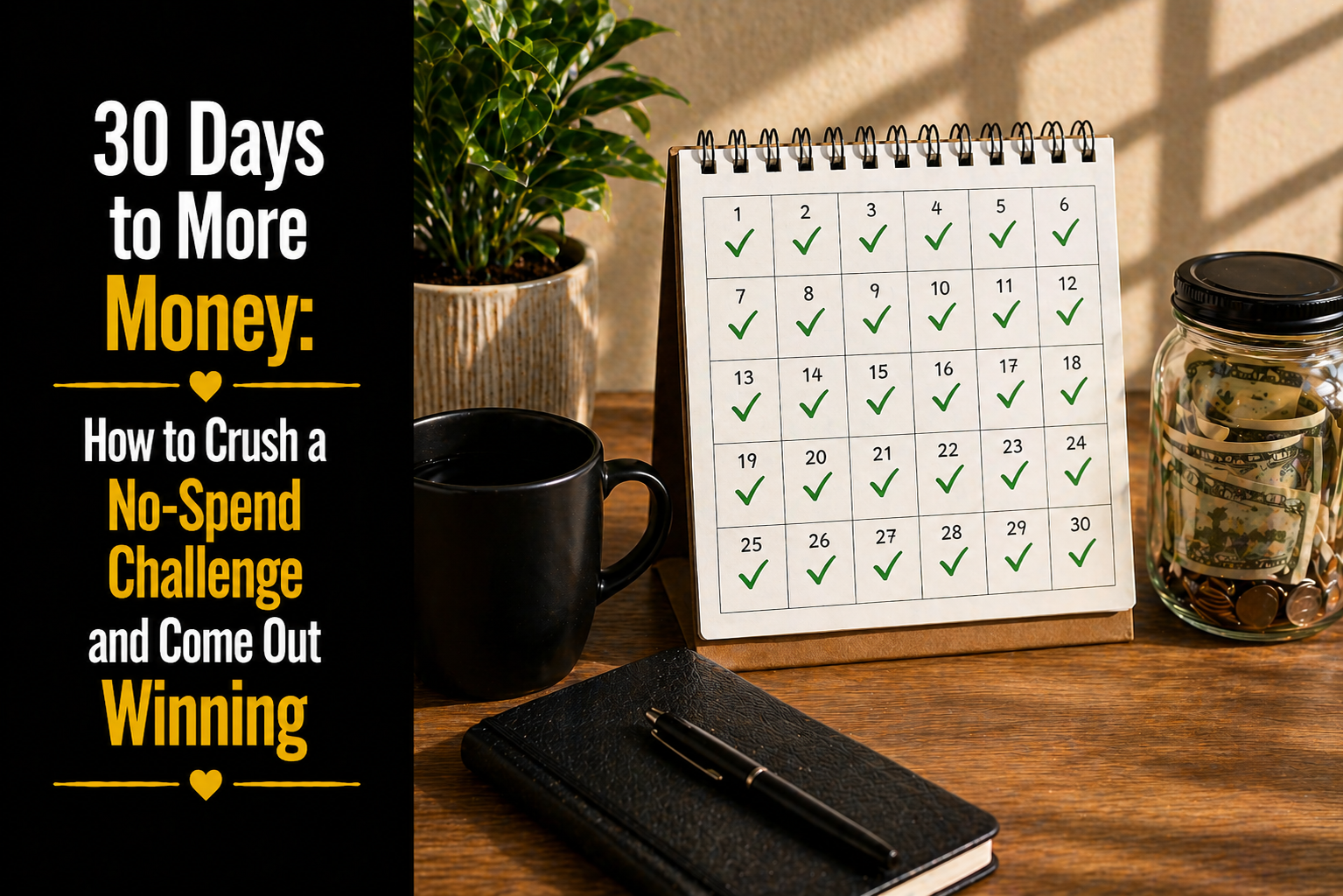
Create a simple calendar and mark off every day you stay on track. There's something powerful about seeing that streak grow. It builds momentum. And momentum is what carries you through the hard days.
5. Meal Plan Like Your Future Depends on It
Because honestly? It does.
Food is one of the biggest budget leaks for most families. Before the month starts, open your pantry and fridge, see what you already have, and build your meals around it. Then make a grocery list — and stick to it when you get to the store.
Meal prepping saves money and time. Cook in bulk. Freeze what you can. Bring your lunch to work. This one habit alone can save you $200–$400 in a single month.
6. Remove Every Temptation You Can
You can't fight what you keep inviting in.
Delete shopping apps off your phone. Remove your saved card info from Amazon and Target. Unfollow accounts that make you feel like you need to spend money to keep up. Avoid the stores where you know you can't walk out empty-handed.
This isn't weakness — it's wisdom. Set your environment up for success.
7. Make a "Later List"
See something you want during the challenge? Don't buy it. Write it down.
Keep a running list of everything you would have bought. Then, when the 30 days are over, go back and look at that list. I promise — most of it won't matter anymore.
That pause between desire and purchase is where discipline is built. And discipline is the foundation of wealth.
8. Use What You Already Have
Gift cards in your wallet you forgot about? Use them. Food in the freezer you've been ignoring? Cook it. Books on your shelf you haven't read? Read them.
Part of a no-spend challenge is learning to be grateful for what you already have. Contentment is a superpower — and most of us have never practiced it.
9. Find Free Ways to Enjoy Life
A no-spend month doesn't have to be a miserable month. There is so much life to live that doesn't cost a dime.
Hit the library. Find free events in your community. Cook a new recipe at home. Take a hike. Have a game night with your family. Watch a movie you already own.
Some of the best memories are made when money isn't in the equation.
10. Tell Someone and Get Accountable
This is the step most people skip — and it's the one that makes the biggest difference.
Tell your spouse. Tell a friend. Tell your small group. Post about it on social media. Find someone who will check in on you, encourage you, and not invite you to happy hour every Friday.
Accountability is not weakness. It's wisdom. We were not designed to do hard things alone.
The Real Key to Winning: A Budget That Lasts Beyond 30 Days
A no-spend challenge is a sprint. But financial freedom is a marathon.
The goal isn't just to save money this month — it's to build habits that stick. And that starts with having a budget every single month, not just when you're doing a challenge.
If you don't have a budget yet, that's your first step. Head to anthonyoneal.com to get the tools and resources to build one that actually works for your life and your goals.
You've already taken the first step by reading this. Now it's time to act.
Conclusion
Look, family — a no-spend challenge isn't about punishment. It's about purpose.
You're not saying no to fun. You're saying yes to freedom. You're choosing your future over your feelings. And that is one of the most powerful decisions you can make.
Here's what we covered:
- Set a goal that means something
- Pick the right month
- Build your budget first
- Track your progress daily
- Meal plan intentionally
- Remove temptations
- Make a "later list"
- Use what you already have
- Find free ways to live
- Get accountable
Here's your move: Pick your start date. Write down your goal. Build your budget. And commit to 30 days of living with intention.
You've got this. One month. One decision. One step closer to the life God designed for you.
Now I want to hear from you — have you ever tried a no-spend challenge? What was the hardest part? Drop it in the comments. Let's build together.
Keep building,

Lorem ipsum dolor sit amet, consectetur adipiscing elit. Suspendisse varius enim in eros elementum tristique. Duis cursus, mi quis viverra ornare, eros dolor interdum nulla, ut commodo diam libero vitae erat. Aenean faucibus nibh et justo cursus id rutrum lorem imperdiet. Nunc ut sem vitae risus tristique posuere.
like what you’ve just read?
Make sure to share it with your tribe!
.webp)
like what you’ve just read?
Make sure to share it with your tribe!


