

Key Takeaways
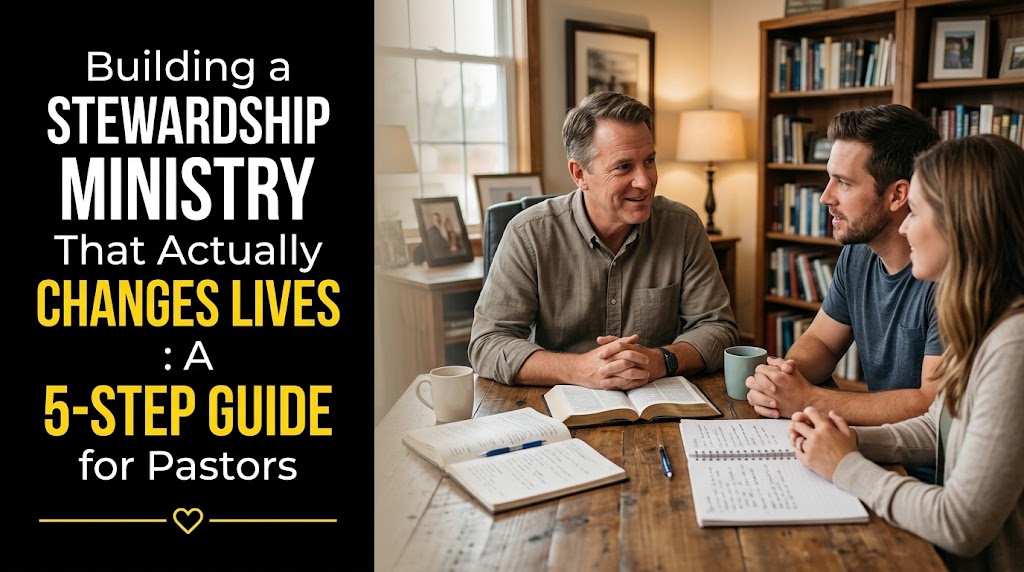
Stewardship isn't just about the offering plate — it's about helping people manage everything God's entrusted them with. A real stewardship ministry starts with a clear vision, sets measurable goals, builds a strategy around where people actually are financially, forms a team that lives it out, and launches with a plan to keep evaluating and adjusting.
Here's something I've seen in church after church: a pastor stands up, talks about giving, and half the room shuts down. Not because they don't love God. Because they're drowning, and the message feels like pressure instead of help.
That's the problem with how most churches approach stewardship. It gets reduced to a giving campaign instead of what it actually is — discipleship around everything God has given us. Not just money. Time. Resources. Capacity.
If you're a pastor or ministry leader wanting to build something real — not another budget class nobody finishes — here's a five-step framework that works.
Step 1: Get Clear on the Vision Before You Build Anything
Before you launch a single class or program, your leadership team needs to agree on one thing: why are we doing this?
Genesis 1:28 tells us God blessed Adam and Eve and gave them responsibility over creation — not ownership, responsibility. That's the foundation. Everything your congregation has belongs to God. Your ministry's job is to help people manage it well.
So ask your team these questions directly:
Why are we teaching on money in this church?
What do we want people to walk away feeling and doing?
How does this connect to our larger mission as a church?
Your vision should center on freedom, not fundraising. If the underlying goal is "increase giving," people will feel that, and they'll disengage. If the goal is "help people live with open hands because they trust God with what they have," that's a vision people can get behind.
Write it down in one or two sentences. Everything else you build should trace back to it.
Step 2: Set Goals You Can Actually Measure
A vision gives you direction. Goals give you a way to know if you're getting there.
Keep your goals specific and realistic:
Help a defined number of families become consistent givers this year
Walk a group of members through getting out of debt using the debt snowball method
Teach what Scripture actually says about money — not in generalities, but through specific passages like Proverbs 22:7 and Proverbs 13:22
Build an emergency fund culture so families aren't one car repair away from crisis
Create a saving and planning rhythm that gives people margin instead of panic
Vague goals like "grow in generosity" sound nice but can't be measured. Specific goals give your ministry something to check progress against every quarter.
Step 3: Build a Strategy That Matches Where Your People Actually Are
This is where most stewardship ministries fail. They build one program and expect it to fit everyone.
Your congregation isn't one financial reality. Some families are barely making it to the next paycheck. Some are stable but have never been taught to give with intention. Some have real wealth and need guidance on stewarding it without pride creeping in.
Your strategy has to account for all three groups. That might mean:
A foundational class for people in financial crisis, focused on budgeting and getting out of debt
A mid-level track for stable families ready to build margin and give consistently
One-on-one coaching or small groups for people managing larger resources who need discipleship, not just information
Decide on the practical details too — where you'll meet, how often, and whether you'll use small groups, one-on-one coaching, or a structured class like Financial Peace University. And don't assume people will sign up because there's a link on your website. Talk about it from the stage. Share real testimonies. Mention it in Sunday school. People need to hear it more than once before they trust it enough to show up.
Step 4: Build a Team That Lives This Out, Not Just Teaches It
One person cannot carry a stewardship ministry. You need a team — and that team has to be walking this out in their own lives, not just presenting information.
Think through the roles you'll need: people to facilitate classes or groups, mentors for one-on-one coaching, and someone to handle logistics like registration and communication.
Here's the filter for who belongs on this team: would you trust this person's own financial life as an example? You're not looking for perfection. You're looking for integrity — people who've either walked through the fire themselves or are currently doing the work, not just talking about it.
You don't need a finance background to lead. You need a willingness to be honest about your own journey and a heart to walk alongside others.
Step 5: Launch It and Keep Checking the Plan
At some point, the planning has to stop and the ministry has to start. Pick a date. Announce it. Begin.
Then build in regular checkpoints — monthly or quarterly — where your team asks honestly: are we hitting the goals we set in Step 2? Some seasons will focus more on personal discipleship. Others might shift toward outreach, like rallying resources for a local need or a mission trip.
The win isn't a perfectly executed program. The win is watching someone who was drowning in debt eighteen months ago now giving generously and teaching someone else how to do the same. That's stewardship working the way it's supposed to.
What This Means for Your Church
A stewardship ministry done right isn't a line item in your church budget. It's a discipleship pathway. It teaches people that managing money well isn't about restriction — it's about freedom, peace, and leaving something behind for the next generation.
Conclusion
Here's what we covered:
Get clear on your vision before building any program
Set specific, measurable goals your team can track
Build a strategy that matches the real financial reality of your congregation
Form a team that lives this out, not just teaches it
Launch the ministry and keep evaluating as you go
You don't need a perfect plan to start. You need a clear vision and a willingness to begin.
Your next step: Sit down with your leadership team this week and write your one-sentence vision for why your church is building this ministry. Everything else follows from there.
What's the biggest obstacle you're facing in starting this at your church? I'd like to hear it.
Keep Building.

Anthony O'Neal is a bestselling author, speaker and personal finance educator. He teaches families how to get out of debt and build real wealth on any income through The Escape Plan, his show The Table with AO, and the In the Black app.
more articles
Money Tips
October 22, 2026
A Smarter Way to Make Extra Money This Christmas Season
Money Tips
October 21, 2026
Extra Work Won't Save You If It Burns You Out First
Money Tips
October 21, 2026
15 Passive Income Streams You Can Actually Build in 2026 (Ranked by Effort)
Money Tips
October 20, 2026
Five Families, Five Different Paths to an Extra $1,000
Money Tips
October 20, 2026
Extra Income for Parents: How to Build Margin Without Sacrificing Family Time
Money Tips
October 16, 2026
The Monthly Paycheck Trap (And How to Beat It Every Single Time)
Where this fits
The Escape Plan
Five phases, one plan. Find where you are, then take the next step.
In The Black
A coach in your pocket
Daily money assignments and real accountability, built around the Escape Plan. Know your next step every single day.
$59.99 a quarter or $179.99 a year
Get In The Black →Get the plan in your inbox.
Weekly money tips, real stories, and my free Wealth Checklist.
Free. Unsubscribe anytime.