

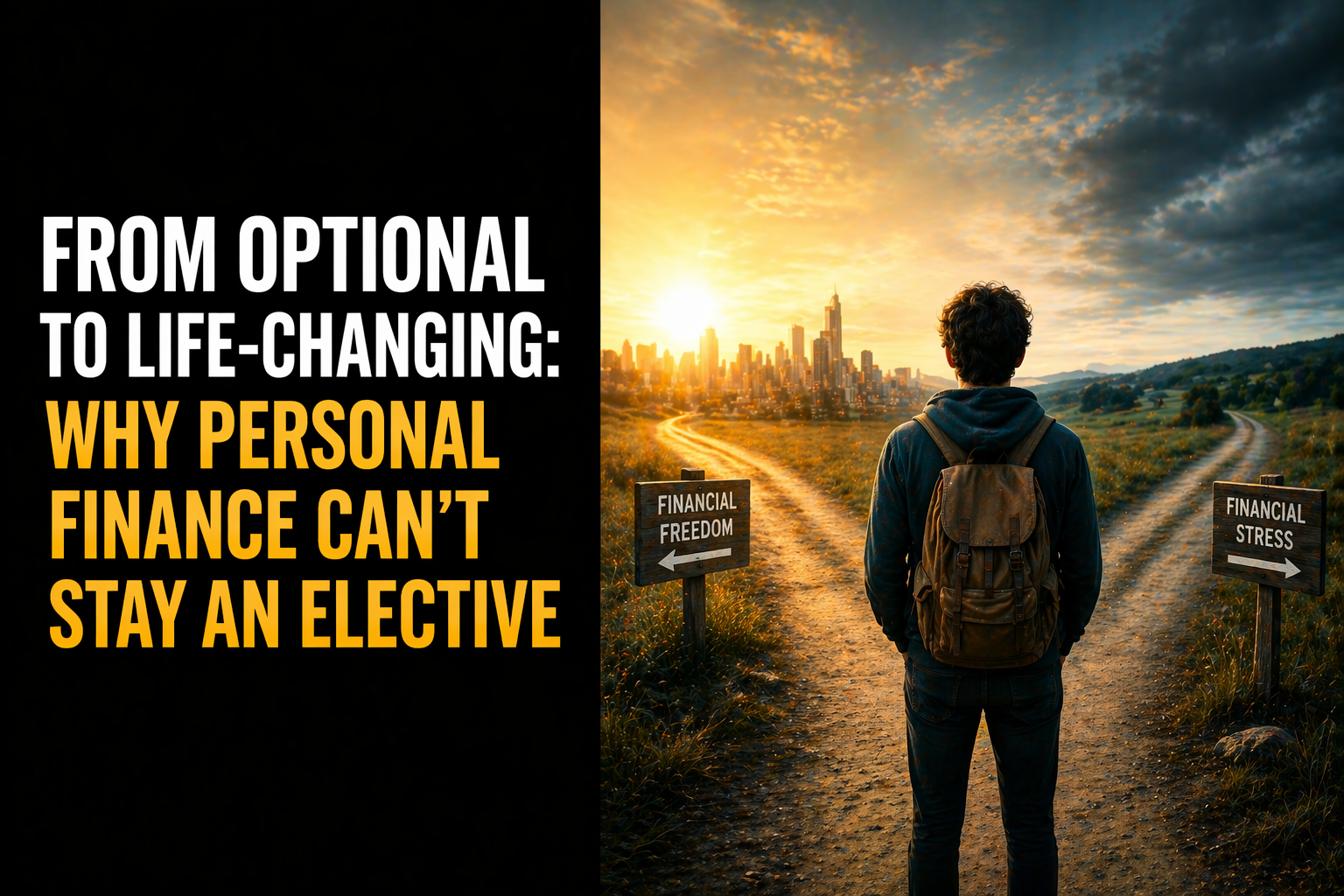
What if the most important class your child could take in high school isn't even required?
Let that sit for a second. We require algebra. We require history. We require PE. But the one subject that every single student will use the moment they step into the real world — how to manage money — is still treated like an afterthought in most schools across America.
That's a problem. And it's one I take personally.
The Gap Nobody Wants to Talk About
Here's a stat that should make every parent, teacher, and school board member uncomfortable. According to the Council for Economic Education, only 26 states require high school students to take a personal finance course before graduation. That means in nearly half the country, a student can walk across that stage with a diploma and not know how to budget, how interest works, or what a 401(k) even is.
And then we wonder why 60% of Americans are living paycheck to paycheck.
We wonder why student loan debt has crossed $1.7 trillion.
We wonder why families are one emergency away from financial disaster.
Real talk — the system was never designed to teach us this. So we have to fight for it.
Why This Is Personal for Me
Listen, family. Nobody taught me about money growing up. Not in school. Not at home. I learned the hard way — broke, homeless, and sleeping in my car at 25 years old. That wasn't because I was lazy. It wasn't because I didn't care. It was because nobody sat me down and said, "Here's how money actually works."
That experience broke me. But it also built me.
Today, I'm a Professor of Consumer Economics at Virginia Union University. I hold a Bachelor of Science in Finance and Banking. I'm working on my doctoral degree. And every single week, I sit in front of a camera and teach millions of people the lessons I wish someone had taught me when I was 16.
But here's what keeps me up at night. I shouldn't have to be the one filling this gap. Schools should be doing this.
What Happens When Students Actually Learn Money
I recently had the honor of returning to Fayetteville, North Carolina — the city that raised me — to support an organization called Money Box Academy. They're doing something I wish existed when I was in school. They're teaching financial literacy in middle and high schools, showing the next generation that freedom is possible long before they graduate.
And the results speak for themselves.
When young people learn how to budget, something shifts. When they understand compound interest at 15 instead of 35, the trajectory of their entire life changes. When a teenager learns the difference between a need and a want, between an asset and a liability, they start making decisions that their 40-year-old self will thank them for.
I've seen it firsthand in my own classroom. Students walk in on day one thinking wealth is for other people. By week three, they're asking about index funds. By the end of the semester, they're teaching their parents.
That's not just education. That's generational transformation.
The Ripple Effect Is Real
Here's what people don't understand about financial literacy education. It doesn't stay in the classroom. It goes home.
Students start asking their parents questions. "Do we have a budget?" "Are we saving for retirement?" "What's our plan?" Those conversations weren't happening before. And for many families, especially in the Black community, money was never discussed openly. It was stressful. It was shameful. It was avoided.
But when a 16-year-old comes home excited about what they learned in class, it opens a door that fear kept shut for years.
I've had people reach out to me years after watching one of my videos or attending one of my events. They'll say, "Anthony, I finally paid off my car in cash." Or, "My family just hit our first $10,000 in savings." Or, "I started tithing and I can't explain it, but doors keep opening."
That's the ripple effect. One lesson. One conversation. One decision. And it echoes through generations.
Why Schools Keep Getting This Wrong
So if financial literacy is this powerful, why isn't it required everywhere?
A few reasons. And none of them are good enough.
Curriculum is crowded. Schools argue there's no room. But if there's room for electives that students will never use after graduation, there's room for a class that will impact every single day of their adult life.
Teachers aren't trained for it. Many educators weren't taught personal finance themselves. That's not their fault. But it means we need to invest in training and resources so teachers feel equipped to deliver this content with confidence.
It's not prioritized by policymakers. Financial literacy doesn't make headlines. It doesn't win elections. But it builds families. It builds communities. It builds nations. And that should matter more than politics.
The graduation model in most states is outdated. We're preparing students for a world that no longer exists while ignoring the skills they'll need the moment they step into the one that does.
What Needs to Change
I'm not just talking about this. I'm doing something about it.
This year, my company partnered with Ghana to launch a Christian Financial Literacy School. We're investing in financial education not just here in America, but globally. Because this isn't just an American problem. It's a human problem.
But here at home, the mission is clear. Personal finance needs to move from elective to essential in every state. Every school. Every district.
Here's what that looks like practically:
- State legislatures need to pass requirements making personal finance a graduation standard. Not a suggestion. A standard.
- School districts need to adopt proven curricula that teach budgeting, saving, investing, and debt avoidance in language students actually understand. Cookie jar on the bottom shelf.
- Teachers need training, resources, and support. They can't teach what they were never taught.
- Parents need to start the conversation at home. Don't wait for the school to do it. Talk to your kids about money. Be honest about your journey. Let them see you budget. Let them see you win.
- Communities need to invest in organizations like Money Box Academy that are already doing this work on the ground.
This Is Bigger Than Money
Family, I need you to hear me on this. Financial literacy isn't just about dollars and cents. It's about freedom. It's about dignity. It's about breaking cycles that have held families hostage for generations.
When a young person learns how money works, they don't just avoid debt. They avoid the stress, the arguments, the sleepless nights, the broken relationships, and the stolen dreams that come with financial bondage.
Scripture reminds us in Proverbs 22:6 — "Train up a child in the way he should go, and when he is old, he will not depart from it."
That includes how they handle money. That includes how they steward what God gives them. That includes how they build a legacy for their children's children's children.
We can't keep leaving this to chance. We can't keep hoping kids figure it out on their own. Because I tried that. And it almost cost me everything.
Conclusion
Look, family — this isn't about politics. This isn't about curriculum debates. This is about our kids. Our families. Our future.
We covered a lot today:
- Only half the states in America require personal finance education
- The gap is costing families generationally
- When students learn money skills early, the ripple effect transforms entire households
- Schools, policymakers, parents, and communities all have a role to play
- This is a freedom issue, not just a finance issue
The truth is, life doesn't treat money as optional. Bills don't care if you took the class or not. Debt doesn't care if nobody taught you. So why are we still treating the education like it's a nice-to-have?
Here's your move: Talk to your kids about money this week. If they're in school, ask if personal finance is offered. If it's not, ask why. And if you're a teacher, a principal, or a school board member reading this — you have the power to change the trajectory of every student who walks through your doors.
Now I want to hear from you: Did your school teach you about money? And if it didn't, how did that affect your life? Drop it in the comments — let's build together.
Keep building,

Anthony O'Neal is a bestselling author, speaker and personal finance educator. He teaches families how to get out of debt and build real wealth on any income through The Escape Plan, his show The Table with AO, and the In the Black app.