
Index Funds Explained: What They Are, How They Work, and Whether You Should Invest in One

3 min read
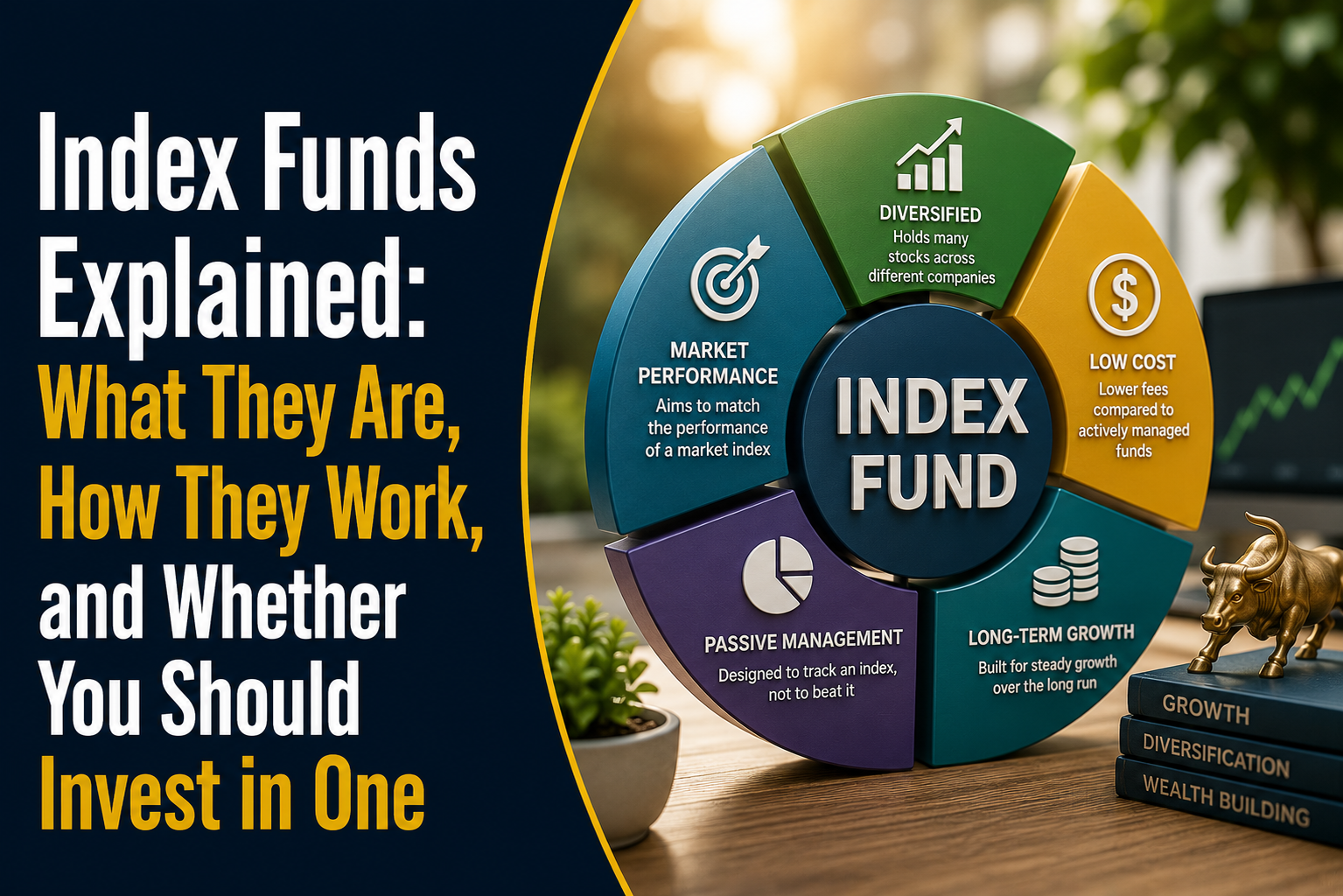
What if there was a way to invest in hundreds of companies at once — without needing to pick a single stock, hire a financial advisor, or have a finance degree?
That's exactly what an index fund does. And family, if you've been sitting on the sidelines of investing because it feels too complicated or too risky — this might be the conversation that changes everything for you.
I'm not here to hype you up. I'm here to break it down, cookie jar on the bottom shelf, so you can make a smart, informed decision about your money.
Let's get to work.
So What Exactly Is an Index Fund?
An index fund is a type of investment that automatically mirrors a specific section of the stock market.
Think of the stock market like a city. Inside that city, there are hundreds of neighborhoods — tech companies, healthcare companies, retail stores, banks. An index is basically a map that tracks how a specific neighborhood is performing.
The most famous index is the S&P 500 — a list of the 500 largest companies in the U.S., including names like Apple, Amazon, and Google. An S&P 500 index fund simply buys a small piece of every company on that list.
So when you invest in an index fund, you're not betting on one company. You're investing in a whole neighborhood at once.
How Does an Index Fund Actually Work?
Here's where it gets simple — and that's the point.
Most investments are actively managed. That means a team of professionals is constantly buying and selling stocks, trying to beat the market and earn you higher returns. Sounds great, right? The problem is, that team costs money — and those fees eat into your returns.
An index fund is passively managed. There's no team making daily decisions. The fund just follows the index it's based on. If the S&P 500 goes up, your fund goes up. If it goes down, your fund goes down.
No guessing. No gambling. Just steady, long-term growth that mirrors the market.
Real talk — that simplicity is exactly why index funds have become one of the most popular investment tools in America.
The Real Benefits of Index Funds
You Get Built-In Diversification
When you buy one index fund, you're instantly invested in hundreds — sometimes thousands — of companies. That means if one company tanks, it doesn't sink your entire investment. Your money is spread out, which reduces your risk significantly.
This is what financial experts mean when they say "don't put all your eggs in one basket." An index fund does that automatically.
The Fees Are Low
Because index funds don't require a team of managers making active decisions, the cost to run them is much lower. Those savings get passed on to you in the form of lower fees — called expense ratios.
Over 20 or 30 years, lower fees can mean tens of thousands of extra dollars in your pocket. That's not small. That's generational wealth territory.
They're Predictable
With an index fund, you know what you're getting — market-level returns. Not better, not worse. For someone who wants to grow their money steadily without the stress of watching individual stocks every day, that predictability is a gift.
The Honest Downsides You Need to Know
I'm not going to sell you on index funds without giving you the full picture. That's not how I operate.
They Won't Beat the Market
Index funds are designed to match the market — not outperform it. If your goal is average returns, index funds deliver. But if you're trying to build serious retirement wealth, you want investments that have a track record of beating the market over time.
That's why for your main retirement savings, I recommend actively managed growth stock mutual funds — not index funds. Index funds are better suited for shorter-term savings goals, like a down payment on a house or building a college fund.
You Have No Control Over What's Inside
When you invest in an index fund, you own whatever companies are in that index — period. You can't swap out companies you don't believe in or add ones you love. The fund follows the index, and that's that.
Watch Out for Hidden Fees
Here's something a lot of people miss: while index funds are known for low expense ratios, some of them charge maintenance fees — sometimes called 12b-1 fees — that can quietly eat away at your returns. Always read the fine print before you invest.
The Different Types of Index Funds
Not all index funds are the same. There are hundreds of indexes out there, and a fund for almost every one of them. Here are some of the most common ones you'll come across:
S&P 500 Index Funds track the 500 largest U.S. companies and are the most widely used benchmark for the overall stock market.
Total Market Index Funds go even broader, covering nearly every publicly traded company in the U.S. — giving you the widest possible diversification in a single fund.
International Index Funds invest in companies outside the U.S., covering markets in Europe, Asia, and beyond. These add global exposure to your portfolio.
Bond Index Funds track the bond market instead of stocks. Bonds are lower risk but also lower return — these are typically used to balance out a more aggressive portfolio.
Sector Index Funds focus on a specific industry, like technology, healthcare, or energy. These are more concentrated and carry more risk than broad market funds.
Each type serves a different purpose. The key is understanding what you're investing in and why — before you put your money in.
Index Funds vs. Mutual Funds: What's the Real Difference?
People mix these up all the time, so let me clear it up.
A mutual fund pools money from many investors to buy a collection of stocks, bonds, or other assets. Most mutual funds are actively managed — meaning a team of professionals is making decisions about what to buy and sell, with the goal of beating the market.
An index fund is actually a type of mutual fund — but it's passively managed. Instead of a team picking stocks, it just copies an index. No strategy, no decisions, just follow the map.
The bottom line: mutual funds aim to beat the market. Index funds aim to match it. Both have a place in a smart financial plan — but they serve different purposes.
So Should You Invest in Index Funds?
Here's my honest answer, family: it depends on what you're investing for.
If you're saving for something 5 to 10 years out — a house, a business, a college fund — index funds are a solid, low-cost, low-stress option. They're predictable, diversified, and easy to understand.
But if we're talking about your retirement, I want more for you than average. I want you investing in good growth stock mutual funds that have a long track record of strong returns — funds that beat the market, not just match it.
Here's the order I recommend:
Step 1 — Make sure you're debt-free (except your mortgage) and have a fully funded emergency fund of 3 to 6 months of expenses.
Step 2 — Invest 15% of your gross income into retirement accounts. Start with your employer's 401(k) up to the match — that's free money. Then max out a Roth IRA.
Step 3 — For your retirement investments, focus on growth stock mutual funds spread across four categories: growth and income, growth, aggressive growth, and international.
Step 4 — Once your retirement is on track, index funds can be a great tool for other financial goals outside of retirement.
That's the plan. Simple. Structured. Built for real people with real lives.
Conclusion
Look, family — index funds aren't magic. They're not going to make you rich overnight. But they are a legitimate, accessible tool that can help you grow your money steadily over time.
The key is knowing when to use them and why. For shorter-term goals, they're hard to beat. For retirement, pair them with actively managed funds that have a proven track record of outperforming the market.
Here's your move: If you've never invested before, start by opening a Roth IRA this week. Fund it with whatever you can — even $50 a month. Then connect with a trusted financial advisor who can help you build a plan that's right for your specific situation.
You don't have to figure this out alone. That's what this community is for.
Now I want to hear from you: Have you ever invested in an index fund? What questions do you still have about getting started? Drop them in the comments — let's build together.
Keep building,

Lorem ipsum dolor sit amet, consectetur adipiscing elit. Suspendisse varius enim in eros elementum tristique. Duis cursus, mi quis viverra ornare, eros dolor interdum nulla, ut commodo diam libero vitae erat. Aenean faucibus nibh et justo cursus id rutrum lorem imperdiet. Nunc ut sem vitae risus tristique posuere.
like what you’ve just read?
Make sure to share it with your tribe!
.webp)
like what you’ve just read?
Make sure to share it with your tribe!


