
Stock ETFs Explained: What They Are, How They Work, and What You Need to Know Before You Invest

3 min read
Let me ask you something, family.
Have you ever heard someone mention "ETFs" and just nodded along like you knew what they were talking about — but on the inside, you had absolutely no idea?
You're not alone. Most people have heard the term thrown around in financial conversations, on the news, or in investing apps — but nobody ever sat down and explained it in plain English.
Well, today that changes.
I'm going to break down exactly what a stock ETF is, how it works, and whether or not it deserves a place in your wealth-building plan. No jargon. No confusion. Cookie jar on the bottom shelf — let's get into it.
So What Exactly Is a Stock ETF?
ETF stands for Exchange-Traded Fund.
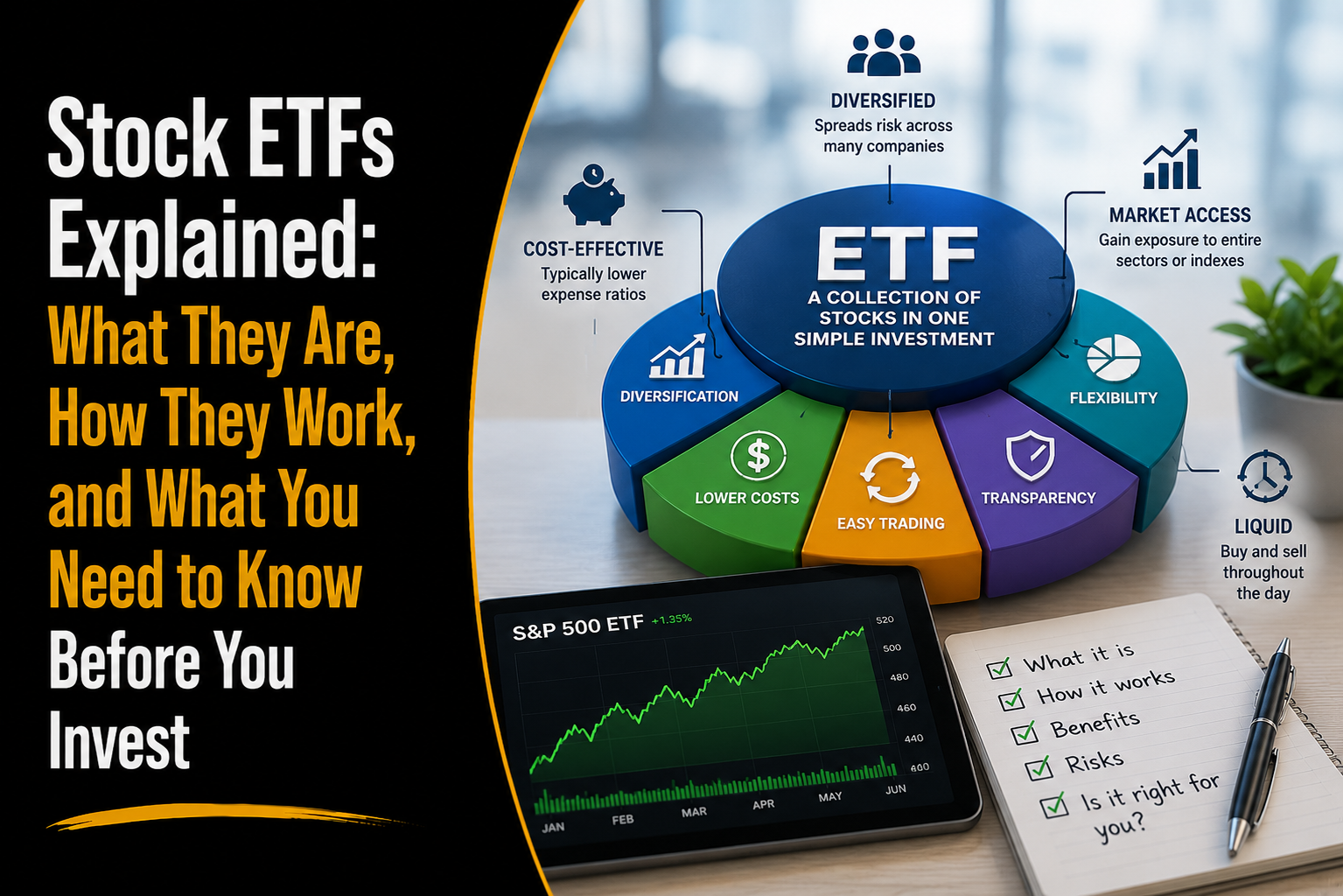
A stock ETF — also called an equity ETF — is a type of investment that bundles a collection of individual stocks together into one package that you can buy and sell on the stock market, just like a single stock.
Think of it like a sampler platter at a restaurant. Instead of ordering one dish and hoping it's good, you get a little bit of everything on one plate. That's essentially what a stock ETF does — it gives you small pieces of ownership in many different companies all at once.
Simple enough, right? Good. Now let's go a little deeper.
How Does a Stock ETF Actually Work?
Here's the thing about ETFs — they work a lot like mutual funds in some ways, but there are some key differences you need to understand.
Like a mutual fund, a stock ETF holds shares from many different companies. That built-in variety helps protect you. If one company in the fund has a bad year, the other companies can help balance things out. That's called diversification, and it's one of the most important principles in smart investing.
Most stock ETFs are built to mirror a stock market index — like the S&P 500 or the Dow Jones Industrial Average. That means instead of having a team of experts hand-picking stocks, the ETF just automatically holds whatever stocks are in that index.
This is called passive management, and it's one of the reasons ETFs tend to have lower fees than actively managed funds.
But here's where it gets different from a mutual fund: ETFs are bought and sold throughout the day on a stock exchange — just like individual stocks. The price goes up and down in real time, and you buy in at whatever the price is at that moment.
How Do You Buy a Stock ETF?
To buy a stock ETF, you'll need a brokerage account. Once you have one set up, you can search for any ETF by its ticker symbol and purchase shares at the current market price.
Here's what you need to know going in:
- You cannot set up automatic monthly contributions to buy ETF shares the way you can with mutual funds. You have to manually buy them each time.
- Every time you buy or sell shares, you may be charged a commission or transaction fee — and those fees can add up fast if you're trading frequently.
- Because the price changes throughout the day, there's always a temptation to try to "time the market" — buying low and selling high. Real talk: that strategy almost never works long-term.
The Different Types of Stock ETFs
Not all ETFs are the same. Here's a breakdown of the main types you'll come across:
Index Stock ETFs
These are the most common. They're designed to match the performance of a specific market index like the S&P 500. If the index goes up, your ETF goes up. If it drops, your ETF drops with it.
Market-Cap Stock ETFs
These ETFs focus on companies based on their size — specifically their market capitalization, which is the total value of a company's stock. Some ETFs focus on large companies, others on mid-size or smaller companies.
Sector Stock ETFs
These ETFs zero in on one specific industry — like technology, healthcare, or energy. They're less diversified because all the companies inside them are in the same space. If that sector struggles, the whole ETF struggles.
International Stock ETFs
These hold stocks from companies based outside the United States. They're a way to add some global diversity to your portfolio.
Dividend Stock ETFs
These focus on companies that regularly pay out dividends to their investors. If you're looking for a fund that generates some income along the way, this is the type to look at.
The Honest Pros and Cons of Stock ETFs
Let's keep it real, family. Every investment has upsides and downsides. Here's the full picture:
The Upsides
Easy Diversification
With one purchase, you get exposure to dozens or even hundreds of companies. That's a simple way to spread your risk without having to research every single stock.
Lower Fees
Because most ETFs are passively managed — just tracking an index — they don't need a big team of analysts. That keeps the costs down, which means more of your money stays invested.
Tax Advantages
ETFs held in a taxable brokerage account tend to generate fewer taxable events than other investments. That means you may owe less in capital gains taxes as your investment grows.
The Downsides
No Active Management
Most ETFs just follow the market — they don't try to beat it. If you want a team of professionals working to outperform the market on your behalf, ETFs aren't built for that.
Transaction Costs Add Up
Even though the fees inside the fund are low, you can still get hit with commissions every time you buy or sell. If you're investing regularly, those costs can chip away at your returns.
Not Ideal for Long-Term Automation
One of the most powerful wealth-building habits is investing consistently every single month — automatically. ETFs make that harder because you can't set up automatic purchases the way you can with mutual funds.
Stock ETFs vs. Mutual Funds: Which One Is Right for You?
This is the big question, and I want to give you a straight answer.
For long-term retirement investing — your 401(k), your Roth IRA, your future — I recommend good growth stock mutual funds over ETFs. Here's why:
Mutual funds are built for consistent, long-term investing.
You can set up automatic monthly contributions and let your money grow without having to think about it. That consistency is one of the biggest keys to building real wealth over time.
Mutual funds give you more options.
There are thousands of mutual funds available — many of them actively managed by professionals whose entire job is to research the market and try to beat it. That's something most ETFs simply don't offer.
The right mutual funds can outperform the market.
While ETFs are designed to match the market, actively managed growth stock mutual funds are designed to beat it. Over a long time horizon, that difference can mean hundreds of thousands of dollars in your retirement account.
Now — does that mean ETFs have no place in your financial plan? Not exactly.
When Does It Make Sense to Invest in Stock ETFs?
Here's the honest truth: ETFs can still be a smart tool under the right circumstances.
If you've already maxed out your 401(k) and your Roth IRA and you still want to keep investing, a taxable brokerage account is your next move. And in that account, ETFs — especially ones that track a broad index like the S&P 500 — can be a solid, tax-efficient option.
The key is this: treat ETFs the same way you'd treat any long-term investment. Buy and hold. Don't try to time the market. Don't panic when the market dips. Stay focused on the long game.
Your children's children's children are counting on the decisions you make today.
What This Means For You
Family, here's the bottom line.
Stock ETFs are a real investment tool — and now you understand exactly how they work. They offer diversification, lower fees, and tax advantages. But for most people building toward retirement, growth stock mutual funds are still the better long-term choice because of their active management, automation options, and potential to outperform the market.
ETFs aren't bad. They're just not the best first move for most everyday investors.
Start with the basics. Get out of debt. Build your emergency fund. Then invest 15% of your income into good growth stock mutual funds inside your 401(k) and Roth IRA. Once you've done all of that — then you can explore ETFs as a complement to your portfolio.
One step at a time. That's how real wealth gets built.
Conclusion
Let's bring it home. Here's what we covered today:
- A stock ETF is a bundle of stocks that trades on the market like a single share.
- Most ETFs passively track a market index, which keeps fees low but limits growth potential.
- There are several types — index, market-cap, sector, international, and dividend ETFs.
- ETFs have real advantages, but they also come with limitations — especially for long-term, automated investing.
- For retirement, growth stock mutual funds are the better choice. ETFs shine in taxable brokerage accounts after your retirement accounts are maxed out.
Here's your move: If you're not sure where your money should be going right now, start by getting clear on your financial foundation. Are you debt-free? Do you have a fully funded emergency fund? Are you investing 15%? If not — that's your starting point.
Now I want to hear from you: Have you ever invested in an ETF? What questions do you still have about investing? Drop them in the comments — let's build together.
Keep building,

Lorem ipsum dolor sit amet, consectetur adipiscing elit. Suspendisse varius enim in eros elementum tristique. Duis cursus, mi quis viverra ornare, eros dolor interdum nulla, ut commodo diam libero vitae erat. Aenean faucibus nibh et justo cursus id rutrum lorem imperdiet. Nunc ut sem vitae risus tristique posuere.
like what you’ve just read?
Make sure to share it with your tribe!
.webp)
like what you’ve just read?
Make sure to share it with your tribe!


