

Let me ask you something real quick.
At the end of the month, do you know exactly where your money went? Or does it just... disappear?
If you're like most families I talk to, it's the second one. And it's not because you're bad with money. It's because nobody ever sat you down and showed you how to build a plan. That ends today.
A family budget isn't about restriction. It's about direction. When you tell your money where to go before the month starts, you stop living in reaction mode — and you start building something real.
I've seen this work for families making $35,000 a year and families making $135,000 a year. The income is different. The principle is the same. Let's walk through it together.
What Is a Family Budget?
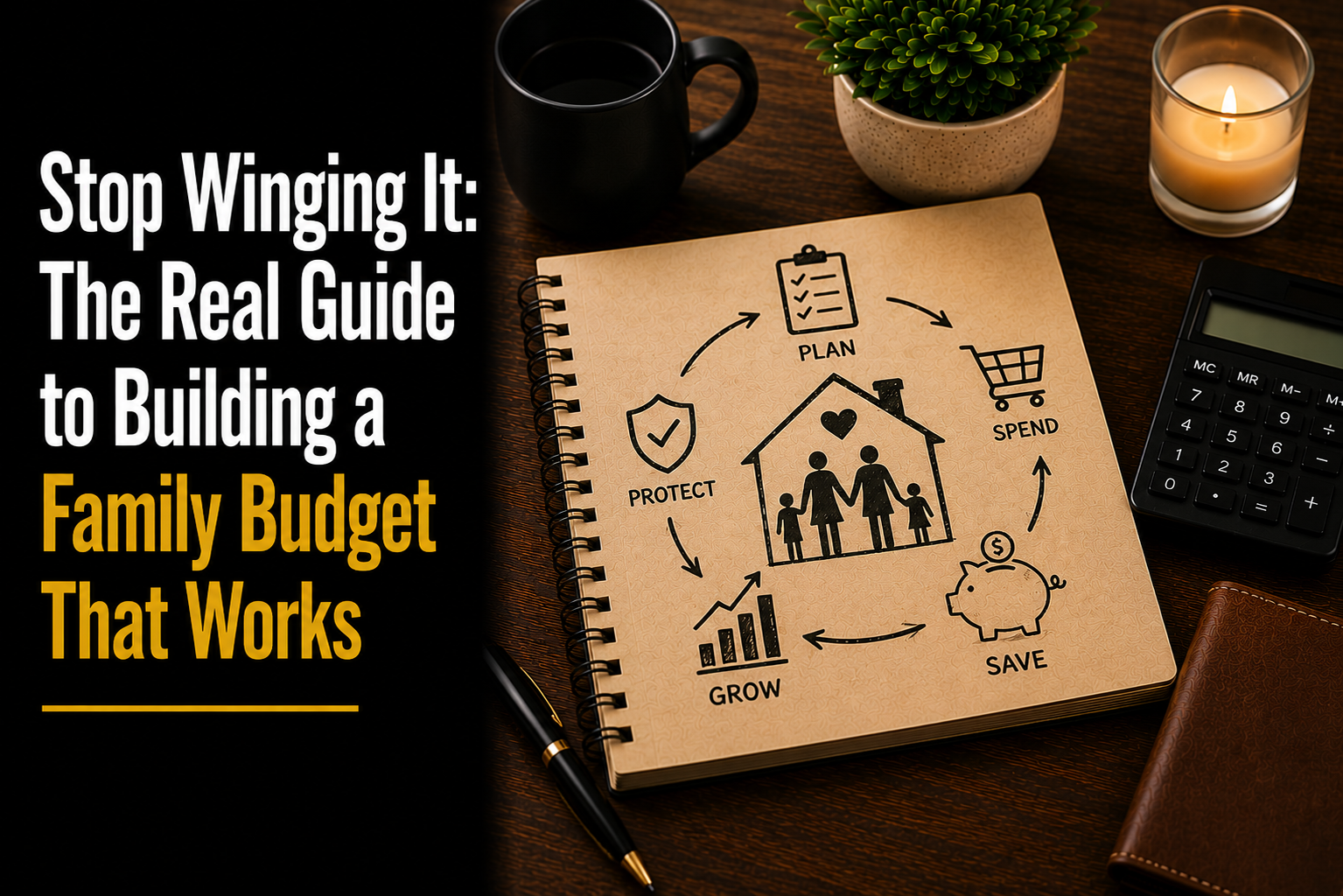
A family budget is a written plan for every dollar your household earns and spends in a given month.
That means everything — your rent, your groceries, your Netflix, your tithe, your savings. Every dollar gets a name before the month begins.
This isn't about being cheap. It's about being intentional. There's a big difference.
When you budget, you're not telling yourself "no." You're telling your money "go here" — and that changes everything.
How to Build a Family Budget in 5 Steps
Step 1: Write Down Everything Coming In
Start with your income. Every source. Every dollar.
List your take-home pay after taxes — not your gross salary, your actual take-home. Then add anything else coming into the household: your spouse's income, a side job, freelance work, child support, anything consistent.
If your income varies month to month, use your lowest realistic number. It's always better to plan conservatively and have extra than to plan high and come up short.
This number is your starting point. Everything else gets built around it.
Step 2: List Every Expense — In the Right Order
Now here's where most people go wrong. They start listing expenses randomly and wonder why the numbers never add up.
There's an order to this. Follow it.
Start with giving. Before a single bill gets paid, honor God first. Biblical wisdom teaches that generosity is the foundation of financial health — not the reward at the end of it. Tithing is not something you do when you have extra. It's something you do first, and then watch God move on the rest.
Then save. If you don't have a starter emergency fund of one month of take-home pay, that's your next line item. You cannot build financial stability without a cushion underneath you.
Then cover your Four Walls:
- Food for your family
- Utilities to keep the lights on
- Housing — your rent or mortgage
- Transportation to get to work
These are your non-negotiables. They get funded before anything else.
After that, list everything else:
- Insurance premiums
- Debt payments
- Childcare and school expenses
- Personal spending
- Entertainment and dining out
- Subscriptions
Don't guess. Pull up your bank statements from the last 60 days and look at what's actually happening. Honesty here is what makes the budget work.
Step 3: Subtract Your Expenses From Your Income
Here's the target: zero.
Not zero in your bank account — zero on paper. This is called a zero-based budget, and it means every single dollar of income has been assigned a purpose before the month begins.
Income minus expenses equals zero.
If you have money left over after covering everything, don't let it float. Give it a job. Put it toward your debt snowball. Add it to your emergency fund. Save it for a specific goal. Unassigned money has a way of disappearing into nothing.
If your expenses are more than your income, that's not a crisis — that's information. Start cutting from the bottom: entertainment, subscriptions, dining out. Needs always come before wants. Always.
Step 4: Track Your Spending All Month Long
Building the budget is step one. Living inside it is where the real work happens.
Every time money moves — in or out — you track it. Every grocery run. Every gas station stop. Every "quick" Amazon order that somehow turned into three items.
Tracking keeps you honest. It keeps you aware. And if you're married, it keeps you and your spouse on the same page — which is one of the most powerful things a couple can do for their relationship.
Money fights are almost always communication fights. When you're both looking at the same numbers in real time, there's nothing to argue about. You're a team working the same plan.
Step 5: Build a New Budget Before Every Month Starts
Your budget is not a one-time document. It's a living plan that gets rebuilt every single month.
Before the new month begins, sit down and create a fresh budget. Use last month as your starting point, then adjust for what's coming:
- Birthdays and holidays
- Back-to-school expenses
- Annual bills or renewals
- Seasonal changes in utilities
Planning ahead is how you stop being surprised. And when you stop being surprised by your money, you start being in control of it.
Tips to Make Your Family Budget Actually Stick
Talk About Money — Out Loud
More than half of Americans say they were never taught how to handle money growing up. That silence gets passed down. It becomes shame. It becomes avoidance. It becomes generational.
Break the cycle. Talk about money with your spouse. Talk about it with your kids at an age-appropriate level. Normalize the conversation so your children grow up with the financial literacy you had to figure out on your own.
Know the Difference Between Wants and Needs
This sounds simple. It's not always easy.
Needs are the things that keep your family safe, fed, and functional. Wants are everything else.
This isn't about never enjoying life. It's about sequence. You handle the needs first — then you enjoy the wants guilt-free because you planned for them. That's what "permission to prosper" actually looks like.
Set Goals You Can Both See
A budget without a goal is just math. A budget with a goal is a mission.
What are you working toward? Paying off debt? Saving for a down payment? Building a three-month emergency fund? Write it down. Put it somewhere visible. Let that goal be the reason you say no to things that don't serve it.
When the whole family knows what you're building toward, everyone pulls in the same direction.
Hold a Monthly Budget Meeting
Once a month, sit down together and review how the budget went. What worked? What didn't? What's different about next month?
Keep it focused. Keep it short. Celebrate the wins — even the small ones. And yes, have snacks. Everything is better with snacks.
Adjust Without Shame
Your first budget will not be perfect. Neither will your second. That's completely normal.
The goal is not perfection. The goal is progress. Every time you adjust and keep going, you're building a skill that most people never develop. Give yourself grace, make the correction, and move forward.
Pay Off Debt — It's Non-Negotiable
Household debt in America is at an all-time high. And debt doesn't just cost you money — it costs you options. It costs you peace. It costs you the ability to build anything lasting.
The debt snowball method is the most effective way to pay off debt for everyday families. You list your debts smallest to largest, attack the smallest one with everything you've got while making minimum payments on the rest, and when it's gone — you roll that payment into the next one.
It works because it creates momentum. And momentum creates belief. And belief is what keeps you going when it gets hard.
You cannot build generational wealth while you're drowning in debt. The two cannot coexist. So the budget isn't just about managing money — it's about creating the margin to get free.
Use a Budgeting App to Make It Easier
The best budget is the one you'll actually use. And the easier it is to track, the more likely you are to stick with it.
A good budgeting app lets you and your spouse share access, track spending in real time, and see your progress toward goals — all in one place. When the budget is always in your pocket, there's no excuse for losing track.
Find a tool that works for your family and use it consistently. Consistency is the whole game.
Conclusion
Family, let me leave you with this.
A budget is not a punishment. It's not a sign that you're struggling. It's a sign that you're serious.
Serious about your family. Serious about your future. Serious about breaking the cycle and building something your children's children's children will actually inherit.
We walked through the five steps:
- List every dollar coming in
- List every expense — in the right order
- Subtract to zero
- Track your spending all month
- Build a new budget before each month starts
You don't need more income to start. You don't need a finance degree. You just need a plan and the discipline to work it.
Here's your move: Tonight, sit down and write out your first family budget. Use a notebook, a spreadsheet, or a budgeting app. Just start. One decision changes the whole trajectory.
Now I want to hear from you — what's the hardest part of budgeting for your family right now? Drop it in the comments. Let's work through it together.
Keep building,

Anthony O'Neal is a bestselling author, speaker and personal finance educator. He teaches families how to get out of debt and build real wealth on any income through The Escape Plan, his show The Table with AO, and the In the Black app.

Find $516 you didn't know you had
Writing the budget is the easy part. In the Black tracks your spending against the plan and puts a money assignment in your pocket every morning. The average person finds $516 in their first 30 days.
Get startedIn the Black is my app.
Recommended for this topic
Find $516 you didn't know you had
Writing the budget is the easy part. In the Black tracks your spending against the plan and puts a money assignment in your pocket every morning. The average person finds $516 in their first 30 days.
Get startedIn the Black is my app.
more articles
Money Tips
October 16, 2026
The Monthly Paycheck Trap (And How to Beat It Every Single Time)
Money Tips
October 16, 2026
The Right Way to Use Multiple Bank Accounts Without Losing Track of Your Money
Money Tips
October 15, 2026
The Weekly Habit That Keeps Your Budget From Falling Apart
Money Tips
October 15, 2026
When Your Budget Falls Apart Mid-Month, Do This
Money Tips
October 14, 2026
Stop Buying Dad Stuff. Give Him This Instead.
Money Tips
October 14, 2026
Still Living Paycheck to Paycheck? Here's the Budget App Difference Nobody Explains
Where this fits
The Escape Plan
Five phases, one plan. Find where you are, then take the next step.
In The Black
A coach in your pocket
Daily money assignments and real accountability, built around the Escape Plan. Know your next step every single day.
$59.99 a quarter or $179.99 a year
Get In The Black →Get the plan in your inbox.
Weekly money tips, real stories, and my free Wealth Checklist.
Free. Unsubscribe anytime.