

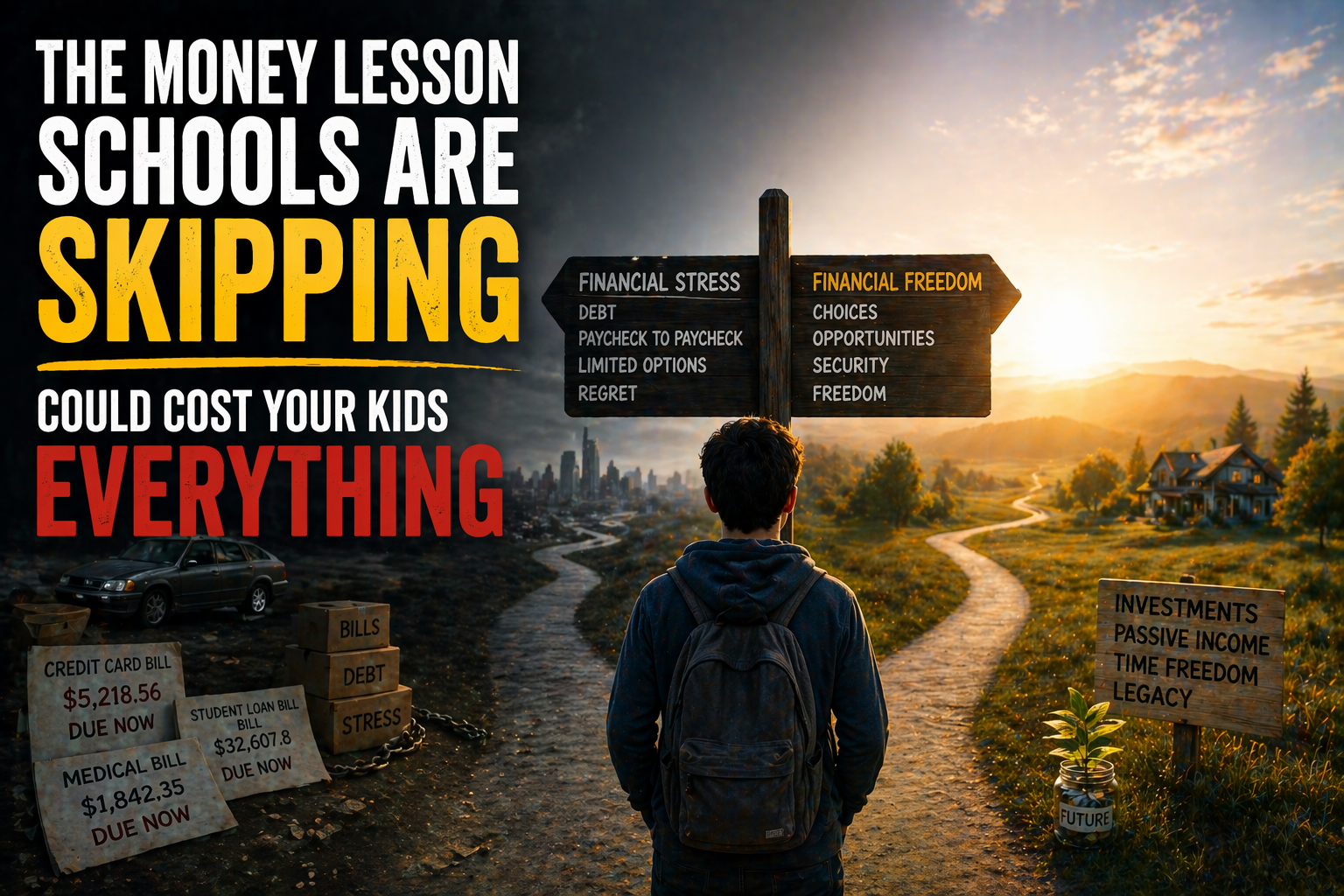
Let me ask you something. If your child graduated tomorrow — diploma in hand, cap and gown, the whole nine — could they tell you the difference between a debit card and a credit card? Could they build a budget? Could they explain what interest is doing to a loan?
If the answer is no, that's not their fault. It's the system's fault. Because right now, most schools are measuring student readiness by GPAs, test scores, and college acceptance letters. But nobody's asking the question that actually matters: Can this young person handle money?
According to the TIAA Institute's 2025 Personal Finance Index, Gen Z adults answered just 38% of basic financial literacy questions correctly. Not investing. Not tax strategy. The basics. Spending. Saving. Borrowing.
Family, our kids are graduating with honors and still walking into financial disaster. But it doesn't have to be this way.
The System Is Teaching Them to Spend, Not to Build
Here's the reality nobody wants to say out loud. Our kids are getting a financial education every single day — just not from a classroom.
They're learning from Instagram ads. From buy now, pay later apps. From watching us swipe without thinking. The Consumer Financial Protection Bureau reported that 53.6 million Americans used buy now, pay later loans in 2023, up 12% from the year before. These platforms live in the same apps our kids scroll through before breakfast.
And it gets worse. The Federal Trade Commission calls these tactics "dark patterns" — design tricks built to speed up spending decisions and reduce the friction between wanting something and buying it. Our children are being trained to be consumers before they ever learn to be stewards.
If the school isn't teaching them, and the culture is teaching them wrong, then who's responsible?
We are.
Seeing Money Isn't the Same as Understanding Money
This is where a lot of parents get tripped up. We think because our kids see transactions happening — tap to pay, Venmo, Apple Pay, online shopping — they understand how money works.
They don't.
The 2025 Personal Finance Index showed that U.S. adults overall answered only 49% of practical financial questions correctly. Adults. People with years of experience handling money. And Gen Z scored even lower at 38%.
Let me put that on the bottom shelf for you. If grown adults with decades of experience are struggling, why would we expect an 18-year-old to figure it out on their own? Constant exposure to money is not producing competence. Not for us. Definitely not for our kids.
Understanding money requires intentional teaching. Not osmosis. Not TikTok. Teaching.
Why High School Is the Make-or-Break Window
There's a reason I'm passionate about this. High school is the last window where we can teach young people about money before the consequences become real and hard to reverse.
First Paychecks Are Happening Now
Most teens get their first real income from a part-time job or summer work. That's their first taste of earning. But without guidance, that money disappears into fast food, sneakers, and subscriptions. With a simple spending plan — even on $400 a month — they start building the discipline that will carry them for life.
College and Career Decisions Are on the Table
This is when students start making choices that will follow them for decades. A Junior Achievement and Citizens survey found that more than half of teens feel unprepared to finance their future — including education and major life decisions. When a young person doesn't understand money, a four-year degree doesn't feel possible. Trade school feels risky. Everything feels out of reach. Not because it is, but because nobody showed them the math.
Mistakes Made Now Compound Fast
Here's the part that should concern every parent, every teacher, every mentor. If a young person doesn't learn money management in high school, they learn it through pain after graduation. Credit card debt at 22. A car loan they can't afford at 24. Student loans they didn't understand at 18 that are still haunting them at 35.
Waiting to teach these lessons is expensive. And our kids are the ones paying the price.
What Every Student Needs to Know Before They Leave Home
I'm going to make this as simple as possible. Cookie jar on the bottom shelf. Before your child, your mentee, your niece, your nephew walks across that stage, they need to know how to do five things:
- Build a budget for every paycheck. Even $200 deserves a plan. Every dollar gets a name.
- Separate needs from wants. This one skill alone will save them tens of thousands of dollars over their lifetime.
- Save an emergency fund. Start with $500. That small cushion is the difference between a bad week and a financial crisis.
- Pay with cash. If you can't pay for it in cash, you can't afford it. Teach them this now so debt doesn't teach them later.
- Think long-term. A dollar invested at 18 is worth dramatically more than a dollar invested at 38. Time is their greatest asset. Help them use it.
These aren't advanced wealth-building strategies. This is the foundation. And without it, everything else — the degree, the career, the dream — sits on shaky ground.
This Isn't an Add-On. This Is the Core.
Real talk. We've been treating financial education like an elective when it should be a requirement. Not just in schools — in our homes, in our churches, in our communities.
Student readiness isn't just about passing a test or getting into a good college. It's about whether that young person can make sound decisions with money when nobody's watching. When the credit card offer shows up in the mail. When the car dealership says they're "approved." When the buy now, pay later button is one tap away.
Personal finance education gives students something that consumer culture never will — a plan, a sense of control, and the confidence to make decisions based on where they're going, not what's trending.
Conclusion
Family, the stakes are higher than they've ever been. Our kids are growing up in a world designed to separate them from their money before they even understand what money is.
But we can change that. One conversation. One budget lesson. One honest talk about debt, saving, and building for the future.
We covered a lot today:
- The system is teaching our kids to spend, not to build
- Exposure to money doesn't equal understanding
- High school is the critical window before consequences compound
- Five foundational money skills every student needs before graduation
- Financial education isn't optional — it's essential
You don't need a finance degree to teach your kids about money. You just need to start the conversation.
Here's your move: This week, sit down with a young person in your life and walk them through one simple exercise — help them build a budget for their next paycheck or allowance. Show them where the money goes. Give them what most of us never got: a real financial education before the real world hits.
What's the one money mistake you made as a young adult that you wish someone had warned you about? Drop it in the comments. Let's build together so the next generation doesn't have to learn the hard way.
Keep building,

Anthony O'Neal is a bestselling author, speaker and personal finance educator. He teaches families how to get out of debt and build real wealth on any income through The Escape Plan, his show The Table with AO, and the In the Black app.