

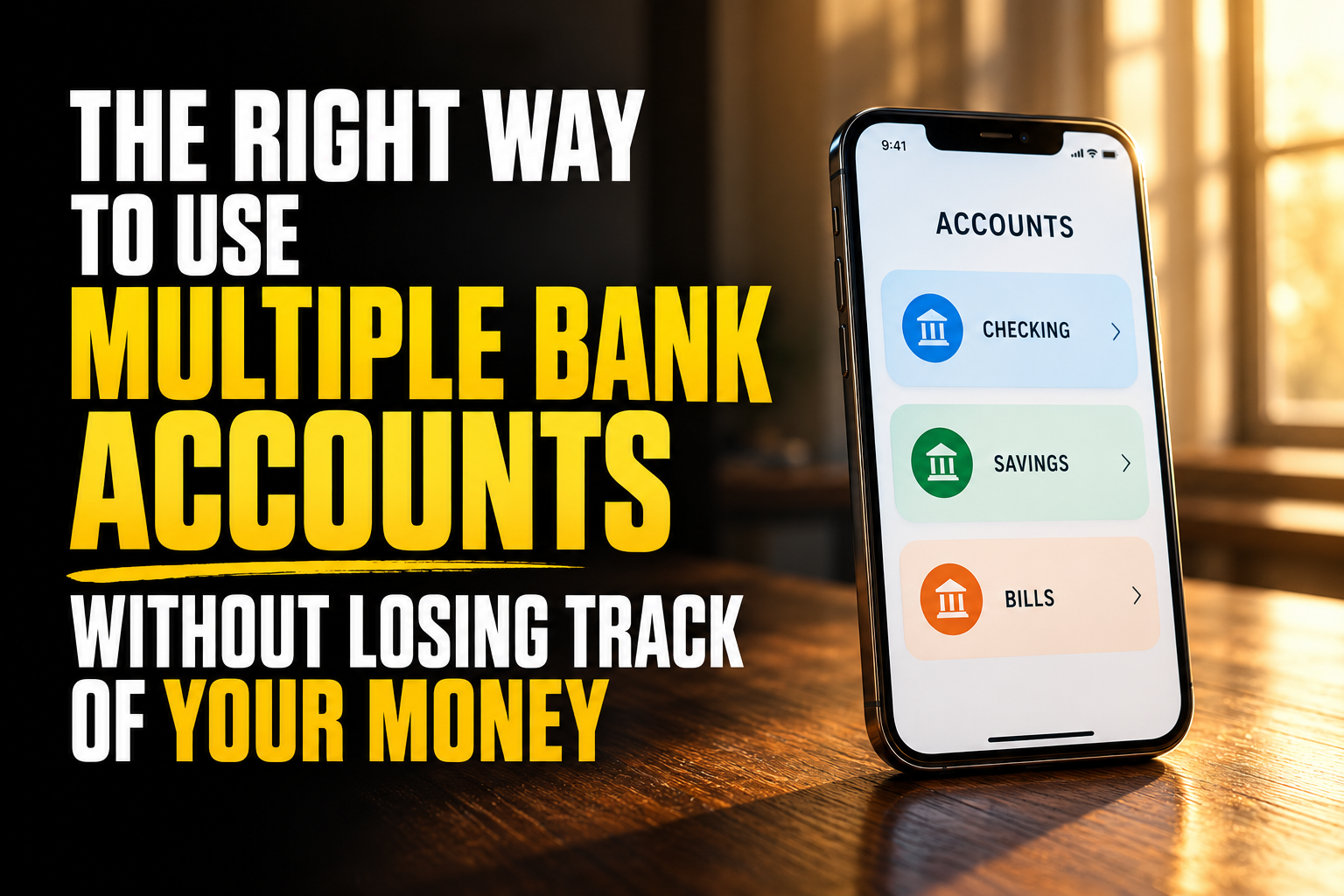
One account for bills. One for groceries. One for savings. Maybe a fourth for vacation, and a fifth "just because."
It sounds organized. In practice, it usually creates the opposite — more passwords, more transfers, and less clarity about where your money actually is.
Here's the truth: multiple accounts can work, but only if each one has a job. Without a plan behind them, they just become more places for money to get lost.
Let's walk through how to actually do this right.
What Multi-Account Budgeting Is — and Why People Use It
Multi-account budgeting means giving each bank account a specific purpose instead of keeping everything in one place. Think of it as the digital version of the envelope method. Instead of separating cash into envelopes, you separate money into accounts.
Some people use this approach because it creates mental separation between goals. One account holds bills. Another holds emergency savings. Another holds money for a car repair or a vacation. That separation can genuinely help some people avoid overspending.
But here's what matters: you don't need a separate account for every spending category. Groceries, gas, dining out — a zero-based budget, where every dollar is assigned a job before the month begins, already organizes that for you.
The place where separation really helps is savings. If your emergency fund sits in the same account as your spending money, it starts to feel spendable. Keeping it apart creates a boundary between money you're using now and money you're protecting for later.
Which Accounts You Actually Need
For most people, the system is simple:
- A checking account — income comes in, bills and everyday spending go out.
- A savings account — holds your emergency fund and your sinking funds (car repairs, holidays, medical costs, home maintenance).
That's the foundation. From there, some people split savings into two accounts — one high-yield account strictly for the emergency fund, and a separate account for sinking funds. That way the emergency fund stays protected for true emergencies, and the sinking funds stay available for planned expenses.
Others keep it all in one savings account using labeled buckets instead of separate accounts. Both approaches work. The principle that matters is this: keep savings separate from everyday spending.
Where you are in your financial journey affects how much separation you need. If you're still building your starter emergency fund, a simple checking and savings setup is enough. Once that's in place and you're focused on paying off debt and building sinking funds for the future, more structure in your savings may serve you well.
And if you're married, this isn't a "yours and mine" conversation. Combine your accounts completely. Shared money belongs in shared accounts, because you're building one life, not two parallel ones.
How to Assign Your Budget to the Right Accounts
Your budget comes first. Your accounts follow it. Most people get this backward — they open accounts first and then try to force their spending into them.
Instead, build your zero-based budget. Assign every dollar of your take-home pay to a category before the month starts. Then decide which categories actually need a separate account.
Here's how that typically breaks down:
Recurring monthly bills — rent, car payment, insurance, utilities — live in your checking account. Variable spending like groceries, gas, and entertainment lives there too. Giving and debt snowball payments also run through checking.
Sinking funds — vacation, car repairs, holiday gifts — belong in your savings account. Your emergency fund belongs there as well, kept separate and untouched except for genuine emergencies.
Most categories don't need their own account. They need a line in your budget. Restaurants don't need a separate debit card — your budget categories already do that work. The categories worth separating are the ones tied to savings, because distance creates discipline.
Name your savings buckets after the actual goal, not a generic label. "Emergency Fund" and "Vacation — Paid in Full" will mean more to you than "Miscellaneous Savings," and they're a lot harder to spend by accident.
Keeping Track of Money Across Accounts
This is where most multi-account systems quietly fall apart. The accounts get opened, a transfer or two happens, and then nobody checks anything again. A transfer gets missed. A bill drafts early. By the middle of the month, nobody can say where the money actually went.
The fix is simple: track every account inside one budget, not five separate banking apps.
Set a short weekly check — ten minutes is enough. Review your account balances. Categorize your transactions. Confirm transfers posted the way they were supposed to. Fix overspending the moment you see it, not three weeks later.
Then close out the month properly. Compare what you actually spent to what you budgeted. Move any extra money toward savings or debt. Check that your sinking funds are on track for what's coming. Build next month's budget before the new month starts.
Ten minutes a week and thirty minutes at month's end is what keeps this system honest.
Setting Up Transfers the Right Way
If you're using more than one account, automate as much of this as you can. The less this system depends on your memory, the more likely it is to actually work.
Most employers allow a split direct deposit, where a set amount goes straight to savings and the rest goes to checking. That matters because your savings move first, before you have a chance to spend what's left over.
To set that up, you'll need your routing number, your account number, and access to your payroll system. Both numbers are usually available in your banking app under account details. Transfers between accounts at the same bank are typically instant. Transfers between different banks usually take a few business days, so plan ahead if you're counting on that money to cover something specific.
The Mistakes That Undo a Multi-Account System
Let's not beat around the bush. These are the five ways this breaks down:
- Opening an account to solve a behavior problem. If you're overspending on takeout, a new "food account" won't fix that. Overspending is a planning and discipline issue, not an account issue.
- Keeping accounts with no clear purpose. If you can't explain what an account is for in one sentence, it's not helping you — it's hiding money from you.
- Not checking the budget regularly. A missed transfer or an unexpected draft will expose a gap you didn't know existed.
- Paying fees on accounts that should be free. Minimum balance requirements and maintenance fees quietly drain money every month. Review your accounts once a year and eliminate anything with avoidable fees.
- Failing to automate transfers. If moving money into savings depends on remembering to do it manually, it eventually won't happen.
None of these mistakes mean you're bad with money. They mean the system needs more structure than it currently has.
A Simple Six-Step Setup
Whether you use one account or several, the process stays the same:
- Build a zero-based budget and give every dollar a job before the month begins.
- Decide honestly whether you need more than one checking and one savings account.
- Name every account based on its purpose, not a generic label.
- Automate your transfers for payday, so savings moves before spending happens.
- Track everything in one place so you can see the full picture, not fragments of it.
- Review weekly, and close out the month before building the next one.
What This Means For You
If you've got money scattered across four or five accounts right now, this isn't about shame. It's about structure.
You don't need more accounts to get control of your money. You need a plan that every account serves. That's the difference between organization and chaos that just looks organized.
Conclusion
Here's what we covered: multiple bank accounts can work, but only when each one has a clear purpose tied to a real plan. Most people need one checking account and one savings account. The one place separation truly helps is your emergency fund, because distance creates discipline. And none of it works without a weekly check-in.
You're not behind because you have the wrong number of accounts. You're behind because nobody gave you a system to follow. That changes today.
Here's your move: pick one account you can't fully explain the purpose of, and either give it a job or close it this week.
What's the one account in your name right now that you couldn't explain if someone asked?
Keep building,

Anthony O'Neal is a bestselling author, speaker and personal finance educator. He teaches families how to get out of debt and build real wealth on any income through The Escape Plan, his show The Table with AO, and the In the Black app.
more articles
Money Tips
October 16, 2026
The Monthly Paycheck Trap (And How to Beat It Every Single Time)
Money Tips
October 15, 2026
The Weekly Habit That Keeps Your Budget From Falling Apart
Money Tips
October 15, 2026
When Your Budget Falls Apart Mid-Month, Do This
Money Tips
October 14, 2026
Stop Buying Dad Stuff. Give Him This Instead.
Money Tips
October 14, 2026
Still Living Paycheck to Paycheck? Here's the Budget App Difference Nobody Explains
Money Tips
October 13, 2026
The Real Timeline: What It Actually Takes to Become Debt-Free
Where this fits
The Escape Plan
Five phases, one plan. Find where you are, then take the next step.
In the Black
A coach in your pocket
Daily money assignments and real accountability, built around the Escape Plan. Know your next step every single day.
$19.00 a month
Get In the Black →Get the plan in your inbox.
Weekly money tips, real stories, and my free Wealth Checklist.
Free. Unsubscribe anytime.