
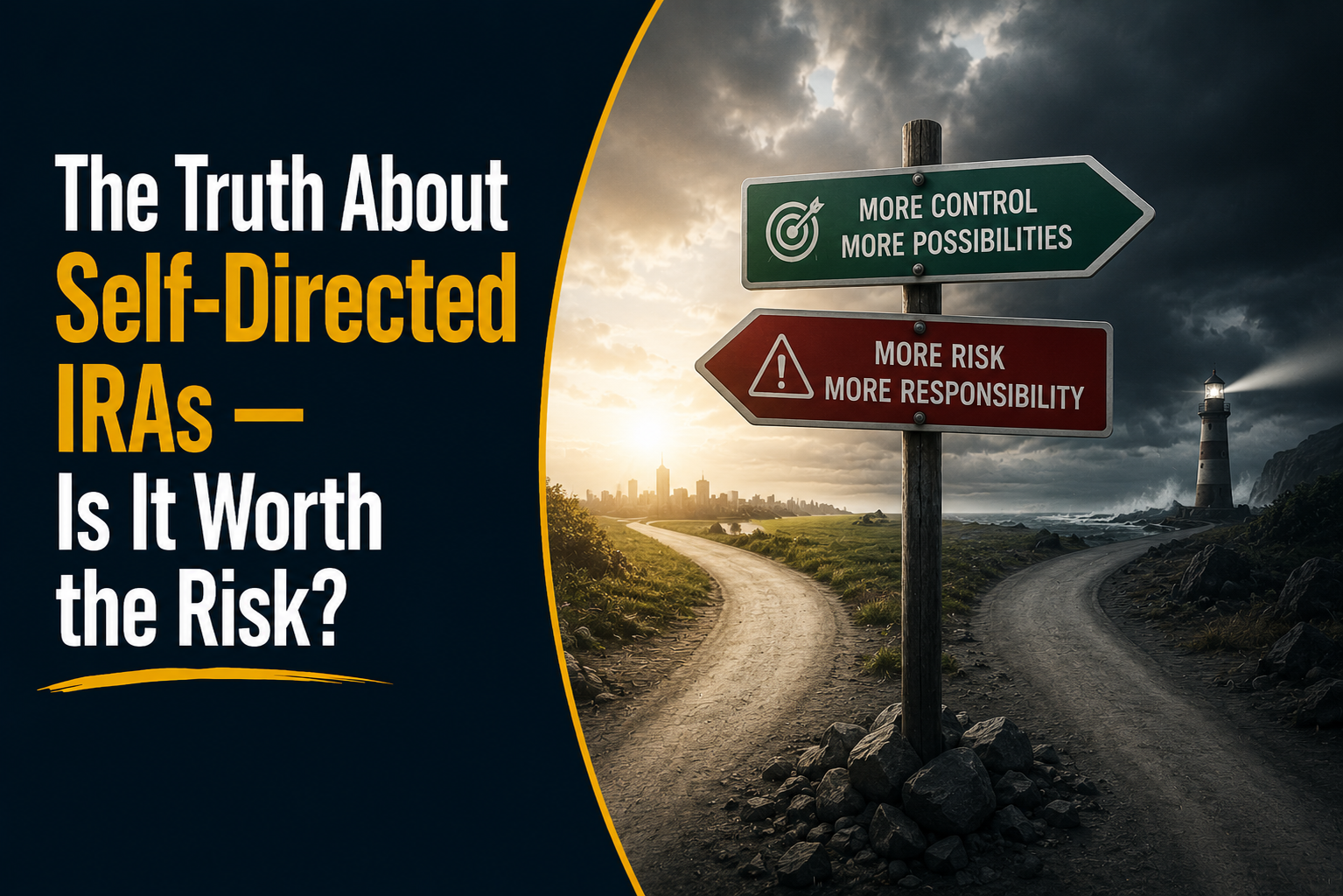
The Truth About Self-Directed IRAs — Is It Worth the Risk?

3 min read
Key Takeaways
- A self-directed IRA gives you access to alternative investments like real estate, precious metals, and cryptocurrency — but it comes with serious rules and risks.
- The IRS has strict guidelines. Break them, and your entire account could become taxable overnight.
- In most cases, a regular Roth IRA is still the smarter, simpler move for everyday wealth builders.
- If you're considering a self-directed IRA, talk to a financial professional first — this is not a DIY situation.
Let me ask you something, family.
Have you ever walked into an ice cream shop with 50 flavors and spent 20 minutes trying to decide — only to end up more stressed than when you walked in?
That's exactly what a self-directed IRA can feel like.
On the surface, it sounds amazing. More choices. More control. More ways to grow your retirement money. But underneath all that freedom is a long list of IRS rules, high-risk investments, and complicated fees that can quietly eat away at everything you've worked for.
Real talk — I'm not here to scare you away from building wealth. I'm here to make sure you build it the right way. So let's break down exactly what a self-directed IRA is, how it works, and whether it actually belongs in your retirement plan.
So What Exactly Is a Self-Directed IRA?
A self-directed IRA — sometimes called an SDIRA — is a retirement account that works a lot like a traditional or Roth IRA, but with one major difference.
It lets you invest in things that regular IRAs typically don't allow.
We're talking about investments like:
- Real estate — rental properties, undeveloped land
- Precious metals — gold, silver, and other metals
- Cryptocurrency — Bitcoin, Ethereum, and others
- Private businesses — investing in companies not listed on public markets
- Promissory notes — essentially lending money and earning interest
- Tax lien certificates — purchasing the right to collect unpaid property taxes
- Energy and natural resources — oil, gas, water rights, mineral rights
- Livestock — yes, you read that right
Now, you still get the same tax benefits as a regular IRA — either tax-deferred growth with a traditional self-directed IRA, or tax-free growth with a Roth self-directed IRA.
But here's the catch: because the investments are more complex, you are responsible for managing them. The custodian — the company that holds your account — is not allowed to give you financial advice. That means every decision falls on you.
How Does a Self-Directed IRA Actually Work?
Here's where it gets important, family. Pay close attention.
With a regular IRA at a brokerage like Fidelity or Vanguard, you can buy and sell stocks, bonds, and mutual funds with a few clicks. Simple. Straightforward.
A self-directed IRA is different. Because the investments are less traditional — and often harder to buy and sell quickly — you'll need to work with a specialized custodian. These are companies that specifically handle self-directed IRAs, and they don't operate like your typical bank or brokerage.
A few things to know before you go down this road:
- Different custodians handle different investments. Not every company will manage every type of asset. Do your homework before you open an account.
- Fees can be steep. Custodians often charge higher-than-average fees for account setup and maintenance. Those fees can quietly chip away at your returns over time.
- You can have both. Nothing stops you from having a regular IRA and a self-directed IRA at the same time. But no matter how many accounts you have, your total annual contributions across all IRAs cannot exceed the IRS limit.
The Rules You Cannot Afford to Ignore
This is the part most people skip — and it's the part that gets them in serious trouble.
The IRS has strict rules around self-directed IRAs. If you break them — even accidentally — your entire account could be treated as a taxable distribution. That means a massive tax bill, penalties, and potentially losing years of growth in one move.
Here are the three big rules you need to understand:
1. Prohibited Transactions
Not everything is fair game inside a self-directed IRA. The IRS specifically bans certain investments, including:
- Collectibles (art, antiques, coins, stamps, rare items)
- Life insurance policies
- Real estate that you personally live in
So no — you cannot use your retirement funds to buy your dream home or that rare sneaker collection you've been eyeing. The IRS will not allow it.
2. Disqualified Persons
You also cannot do business with certain people through your self-directed IRA. The IRS calls these "disqualified persons," and the list includes:
- Your spouse, children, and parents
- The company that manages your IRA
- Any business where a disqualified person owns more than 50%
- Any business where you are a significant employee or major shareholder
This rule exists to prevent conflicts of interest. The moment you cross this line, you're in dangerous territory.
3. No Self-Dealing
This one trips people up the most. You cannot use your self-directed IRA to do business with yourself. That means:
- You cannot buy or sell property to yourself through the account
- You cannot lend yourself money from the IRA
- You cannot pay personal expenses from the account or take money home
The IRA is a separate entity. Treat it that way — always.
Traditional vs. Roth Self-Directed IRA — Which One Is Better?
Just like regular IRAs, self-directed IRAs come in two versions: traditional and Roth.
Both have the same contribution limits as regular IRAs, and both require you to wait until age 59½ to make withdrawals without penalty.
Here's the key difference:
With a traditional self-directed IRA, you may get a tax deduction now — but you'll pay income taxes on every dollar you withdraw in retirement.
With a Roth self-directed IRA, you pay taxes upfront — and your investments grow completely tax-free. Withdrawals in retirement? Not taxed at all.
If you're going to open a self-directed IRA, the Roth version is the way to go. Tax-free growth is always the goal, family. Always.
The Honest Pros and Cons
Let me give it to you straight — no sugarcoating.
The Pros
More investment options and flexibility.
If you have deep knowledge in a specific area — like real estate — a self-directed IRA lets you put that expertise to work inside a tax-advantaged account. That's a real benefit for the right person.
Potential for portfolio diversification.
A self-directed IRA can complement your existing retirement accounts by adding assets that don't move with the stock market. For some investors, that's a meaningful hedge.
Same tax benefits as a regular IRA.
You still get either tax-deferred or tax-free growth, depending on which version you choose. The tax advantages don't disappear just because the investments are different.
The Cons
Higher fees and complicated recordkeeping.
Specialized custodians charge more. The investments are harder to track. The paperwork is more involved. All of that costs you time and money.
A long list of IRS rules to follow.
One wrong move — one prohibited transaction — and your entire account could be treated as a taxable distribution. The risk is real, and it's not small.
High-risk investments.
Most of the assets that require a self-directed IRA structure are inherently more volatile and unpredictable. Cryptocurrency. Tax lien certificates. Private businesses. These are not the kind of investments you want to bet your retirement on without serious knowledge and guidance.
Should You Actually Open a Self-Directed IRA?
Here's my honest answer: probably not — at least not yet.
For most people — especially those who are still paying off debt, building their emergency fund, or just getting started with investing — a self-directed IRA is not the move. It's complex, it's risky, and it's easy to make a costly mistake.
The better path for most families looks like this:
Step 1: Pay off all non-mortgage debt using the debt snowball method.
Step 2: Build a fully funded emergency fund of 3–6 months of expenses.
Step 3: Invest 15% of your gross income for retirement — starting with your employer's 401(k) up to the match, then maxing out a Roth IRA.
Step 4: Pay off your home early.
Step 5: Build wealth and give generously.
A self-directed IRA only makes sense after you've completed those steps — and even then, only if you have specific expertise in an alternative investment like real estate, and only if you're buying that investment with cash (no debt, ever).
And even if you do open one, it should complement your regular retirement accounts — not replace them.
Talk to a Pro Before You Make a Move
Self-directed IRAs are not a DIY project. One wrong decision can trigger a tax bill that wipes out years of growth. Before you open one, sit down with a financial advisor who can look at your full picture and tell you whether it actually makes sense for your situation.
Don't have a financial advisor yet? That's okay. Start by getting connected with a trusted professional who understands your goals, your values, and where you're trying to go.
Conclusion
Family, here's the bottom line.
A self-directed IRA is a powerful tool — but it's not for everyone. It comes with more freedom, yes. But it also comes with more responsibility, more risk, and more ways to get it wrong.
Here's what we covered today:
- A self-directed IRA lets you invest in alternative assets like real estate, precious metals, and cryptocurrency inside a tax-advantaged account.
- The IRS has strict rules — prohibited transactions, disqualified persons, and no self-dealing. Break them and you could face a massive tax bill.
- The Roth version is always the better choice if you go this route.
- For most people, a regular Roth IRA is still the smarter, simpler, and safer path to retirement wealth.
Your move: If you're not yet investing 15% of your income for retirement, start there. Open a Roth IRA this week. Build the foundation first — then explore advanced strategies when the time is right.
Your future self will thank you.
Now I want to hear from you — have you ever considered a self-directed IRA, or does this feel too complicated to touch? Drop it in the comments below. Let's talk it through together.
Keep building,

Lorem ipsum dolor sit amet, consectetur adipiscing elit. Suspendisse varius enim in eros elementum tristique. Duis cursus, mi quis viverra ornare, eros dolor interdum nulla, ut commodo diam libero vitae erat. Aenean faucibus nibh et justo cursus id rutrum lorem imperdiet. Nunc ut sem vitae risus tristique posuere.
like what you’ve just read?
Make sure to share it with your tribe!
.webp)
like what you’ve just read?
Make sure to share it with your tribe!


