
Where Did My Money Go? How to Track Your Expenses and Finally Take Control

3 min read
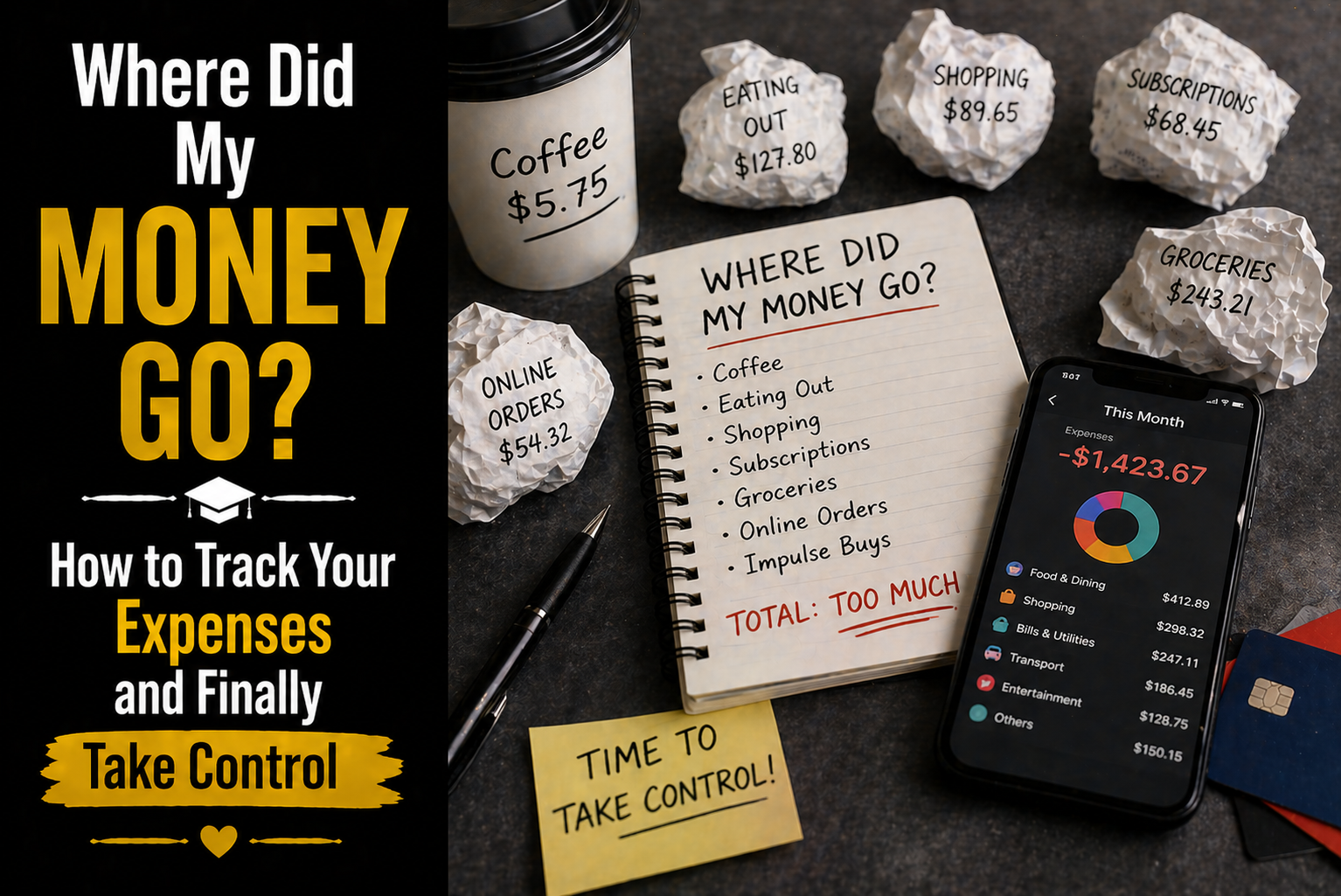
You made it to the end of the month — and somehow, the money is gone.
You didn't go on a shopping spree. You didn't take a vacation. You just... lived. And now you're sitting there wondering where it all went.
Family, I've been there. And I want to tell you something important: you don't have a money problem. You have a tracking problem.
When you don't know where your money is going, it disappears. Every time. But when you track your expenses — every dollar, every transaction — you take back control. You stop reacting to your money and start directing it.
Today, I'm walking you through exactly how to track your monthly expenses, step by step. No complicated spreadsheets. No finance degree required. Cookie jar on the bottom shelf — simple, clear, and actionable.
Let's get to work.
Why Tracking Your Expenses Changes Everything
Here's a stat that should stop you in your tracks: 77% of Americans report feeling financially anxious — and most of them have no idea what they spent last month.
That's not a coincidence.
When you don't track, you guess. And guessing with money is how you end up overdrafted, in debt, and stressed out every single month.
Tracking your expenses does three things:
- It shows you where your money is actually going (not where you think it's going)
- It helps you catch leaks — subscriptions, impulse buys, forgotten bills
- It gives you power and peace — because you're in control, not your bank account
Biblical wisdom teaches us to be good stewards of what we've been given. You can't steward what you can't see. Tracking is stewardship in action.
How to Track Your Monthly Expenses in 4 Steps
Step 1: Build Your Budget First
Before you can track anything, you need a plan. That plan is called a budget.
A budget is simply telling your money where to go before the month starts — not after. The best method? A zero-based budget, where every dollar you earn gets assigned a job.
Here's how to set it up:
List your monthly income
Write down every dollar coming in — your paycheck, side hustle, child support, everything. Add it up. That's your number.
List your monthly expenses
Go through your last two months of bank statements and write down everything you paid for. Then organize your expenses in this order:
- Giving (10% of your income — this comes first, family)
- Savings (based on where you are in your financial journey)
- The Four Walls — food, utilities, housing, transportation
- Other essentials — insurance, childcare, minimum debt payments
- Extras — dining out, entertainment, subscriptions
Subtract your expenses from your income
The goal is zero. Not negative. Zero. Every dollar has a job.
If you've got money left over, put it toward your savings goal or debt payoff. If you're in the negative, cut the extras until you hit zero.
Real talk: Most people skip the budget because it feels like a cage. But a budget isn't a cage — it's a key. It unlocks the freedom you've been looking for.
Step 2: Track Every Dollar You Earn
When money comes in, log it.
Your regular paycheck, your side hustle payment, that $200 you made selling stuff on Facebook Marketplace — all of it goes in.
This step matters especially if your income changes month to month. If you planned low (which you should when income is irregular), and you end up making more, now you know exactly how much extra you have to work with. Put it toward your current money goal — don't let it disappear.
Even if your paycheck is the same every two weeks, still track it. You're building the habit. And habits are what create lasting change.
Step 3: Track Every Dollar You Spend
This is where most people fall off. And it's the most important step.
Every. Single. Transaction. All month long.
Gas? Track it. Groceries? Track it. That random $7 charge you forgot about? Track it.
When you spend money, subtract it from the right budget category. That way, you always know how much you have left — before you swipe again.
Here's why this matters: most overspending doesn't happen in big purchases. It happens in small ones. The $12 lunch. The $9 subscription. The $4 coffee three times a week. Those small leaks add up to hundreds of dollars every month.
Tracking stops the leaks.
Pro tip: Don't wait until the end of the week to log your spending. Track it in the moment — right there in the parking lot, right after you check out. The longer you wait, the more you forget.
Step 4: Set a Consistent Tracking Rhythm
Tracking once a month won't cut it. You need a rhythm.
Some people track daily. Some do it every other day. Some sit down every Sunday evening and log the week. Find what works for you — and then protect that habit like it's a bill you have to pay.
If you're married, this step is non-negotiable: you and your spouse need to be working from the same budget and tracking together. Money fights in marriage almost always come from a lack of communication. When you're both looking at the same numbers, there are no surprises — and no blame.
The 4 Ways to Track Your Expenses
Now that you know the steps, let's talk about the tools. There are four main ways people track their spending. Here's an honest breakdown:
Method 1: Pen and Paper
Old school. Simple. No technology required.
The good:
- Forces you to slow down and think
- No app to learn, no account to set up
- Writing things down creates mental awareness
The not-so-good:
- Easy to lose receipts or forget transactions
- You have to do all the math yourself
- Hard to share with a spouse in real time
Bottom line: Better than nothing — way better. If pen and paper is what gets you started, start there. A budget on paper beats no budget every time.
Method 2: The Cash Envelope System
You pull out cash at the beginning of the month, divide it into labeled envelopes by category, and spend only what's in each envelope.
The good:
- When the envelope is empty, you stop spending — period
- You physically feel the money leaving, which changes your behavior
- No math required — the envelope does the tracking for you
The not-so-good:
- Inconvenient for online purchases
- Carrying cash isn't always practical
- Easy to "borrow" from one envelope for another
Bottom line: This method is powerful, especially if you struggle with overspending on food, entertainment, or personal spending. Even if you don't go all-cash, try it for your two or three biggest problem categories.
Method 3: Spreadsheets
For the detail-oriented folks who love a good Excel or Google Sheet.
The good:
- Fully customizable to your life
- Can set up formulas to do the math automatically
- Great visual overview of your full financial picture
The not-so-good:
- You have to be at your computer to update it
- If you forget to log something, the whole thing is off
- Not always easy to share with a spouse on the go
Bottom line: If spreadsheets are your thing, use them. Just make sure you're updating consistently — a spreadsheet you check once a week isn't protecting you from daily overspending.
Method 4: A Budgeting App
This is the most effective method for most people — and here's why: your phone is always with you.
The good:
- Track expenses in real time, right from your phone
- The math is done for you automatically
- Many apps connect directly to your bank account
- Easy for couples to share and stay on the same page
- Sends alerts when you're getting close to a budget limit
The not-so-good:
- Requires consistent internet access
- Takes a little setup time upfront
- Some apps charge a monthly fee
Bottom line: A budgeting app is the most convenient, most consistent, and most effective way to track your expenses. If you want to make this habit stick, this is the tool that makes it easiest.
What This Means For You
Family, here's the truth: you don't need more money to start winning with money. You need more awareness.
Tracking your expenses is not about restriction. It's about direction. It's about looking at your money and saying, "I decide where you go — you don't decide for me."
That shift in mindset? That's where freedom starts.
You are not too far behind. You are not too disorganized. You are one decision away from a completely different financial story.
Conclusion
Let's bring it home. Here's what we covered:
- Build your budget first — give every dollar a job before the month starts
- Track every dollar you earn — know exactly what's coming in
- Track every dollar you spend — catch the leaks before they drain you
- Set a consistent tracking rhythm — make it a non-negotiable habit
And when it comes to tools, you've got options: pen and paper, cash envelopes, spreadsheets, or a budgeting app. The best one is the one you'll actually use — consistently.
Your move right now: Open your bank app and look at your last 30 days of transactions. No judgment — just truth. Then build your budget for next month before the month starts.
One month of tracking can change everything. I've seen it happen. I've lived it.
Now I want to hear from you — what's been your biggest challenge when it comes to tracking your spending? Drop it in the comments below. Let's figure it out together.
Keep building,

Lorem ipsum dolor sit amet, consectetur adipiscing elit. Suspendisse varius enim in eros elementum tristique. Duis cursus, mi quis viverra ornare, eros dolor interdum nulla, ut commodo diam libero vitae erat. Aenean faucibus nibh et justo cursus id rutrum lorem imperdiet. Nunc ut sem vitae risus tristique posuere.
like what you’ve just read?
Make sure to share it with your tribe!
.webp)
like what you’ve just read?
Make sure to share it with your tribe!


