
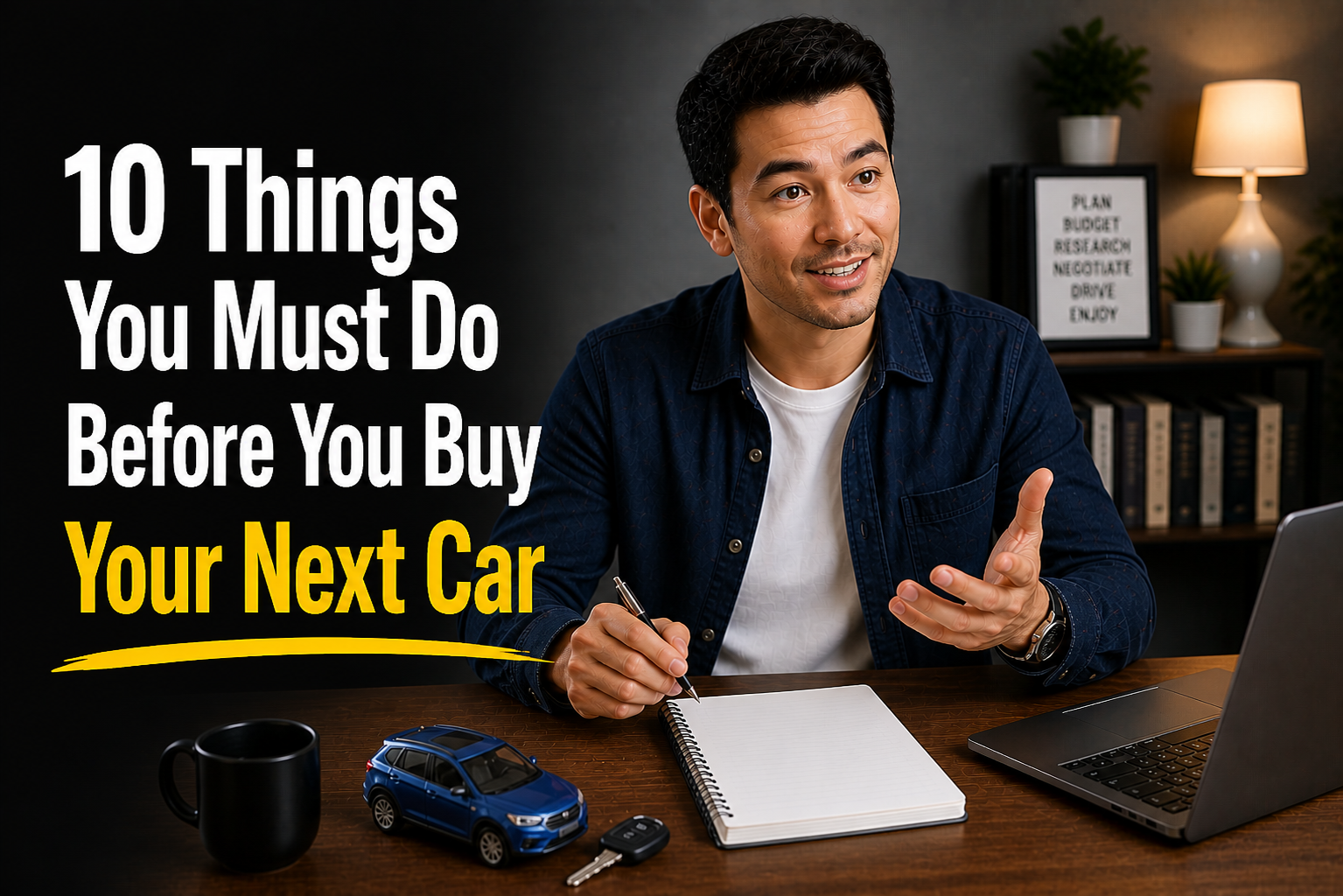
10 Things You Must Do Before You Buy Your Next Car

3 min read
Key Takeaways
- Never finance a car — save up and pay cash. A car is transportation, not a status symbol.
- Research the car's value, history, and insurance cost before you ever step foot on a lot.
- Negotiate from a position of power, skip the dealer extras, and always bring someone with you.
Buying a car is one of the biggest financial decisions you'll make — and most people get it completely wrong.
Here's the truth, family: the average car payment in America is over $700 a month for a new vehicle. That's $700 that could be going toward your emergency fund, your investments, or your children's future. Instead, it's lining the pockets of a dealership.
I've been there. I know what it feels like to want something you can't afford and convince yourself the monthly payment "isn't that bad." But that mindset is exactly what keeps people stuck — living paycheck to paycheck, stressed, and one emergency away from financial disaster.
Today, I'm giving you 10 things you must do before you buy your next car. Follow these steps and you'll drive off that lot with confidence — not regret.
Let's get to work.
1. Know Your Budget Before You Know the Car
Before you fall in love with a vehicle, you need to fall in love with your numbers.
Real talk: the car you can afford is the car you can pay for in cash. That's it. No exceptions.
Here's a simple rule of thumb — your car should never be worth more than half of your annual income. So if you're bringing home $50,000 a year, you have no business driving a $40,000 vehicle. Period.
If you don't have the cash right now, that's okay. That just means it's not time to buy yet. Start a car fund, cut expenses, and save with purpose. The goal is to buy a car without a payment — because a car payment is not a way of life. It's a wealth killer.
Your move: Write down exactly how much cash you have available for a car today. That number is your ceiling.
2. Choose Used Over New — Every Time
Brand-new cars lose up to 20% of their value the moment you drive off the lot. Within five years, that car has lost nearly 60% of what you paid for it.
That's not a car. That's a liability dressed up in new leather seats.
Unless your net worth is well over $1 million, a used car is always the smarter move. You get reliable transportation at a fraction of the cost — and you keep more of your money where it belongs: in your pocket and building toward your future.
Look for a used vehicle that is 2–4 years old with low mileage. You get the reliability without the new-car price tag. That's "cookie jar on the bottom shelf" simple.
3. Research the Car's Value Before You Negotiate
Never walk into a dealership blind. That's how they win and you lose.
Before you even think about negotiating, look up the fair market value of the car you want. Use tools like:
- Kelley Blue Book (KBB.com) — industry standard for car values
- Edmunds.com — great for comparing prices in your area
- CarGurus.com — shows you if a deal is fair, good, or overpriced
When you know what a car is actually worth, you negotiate from a position of power — not desperation. Knowledge is leverage, family.
4. Pull the Vehicle History Report
A car can look clean on the outside and be a complete disaster underneath. Don't let a fresh coat of paint fool you.
Always request the Vehicle Identification Number (VIN) from the seller and run a full history report. You're looking for:
- Accident history — has it been in a major collision?
- Title issues — is it salvaged or rebuilt?
- Odometer rollbacks — has the mileage been tampered with?
- Service records — has it been maintained properly?
Use Carfax.com or VehicleHistory.com to pull the report. Some are free, some cost a small fee — but it's worth every penny compared to buying a lemon.
If a seller refuses to give you the VIN or gets defensive when you ask for a report, walk away. That's a red flag you can't ignore.
5. Get a Car Insurance Quote First
Here's one most people skip — and it costs them later.
The type of car you drive directly affects your insurance premium. A sports car or luxury vehicle can cost you hundreds more per month in insurance alone. That changes your real cost of ownership significantly.
Before you commit to any vehicle, call your insurance agent and get a quote. If the insurance cost pushes the car out of your budget, it's not the right car — no matter how much you love it.
Pro tip: Shop around. An independent insurance agent can compare multiple carriers to find you the best rate.
6. Take It for a Real Test Drive
Not a quick spin around the parking lot. A real test drive.
Find a route that includes:
- Highway driving — how does it handle at speed?
- City streets — how does it feel in stop-and-go traffic?
- Bumps and turns — does anything rattle, shake, or feel off?
Pay attention to everything. Weird noises, pulling to one side, rough shifting — write it all down. These aren't just comfort issues. They're negotiating tools.
And stay focused. Don't let a smooth-talking salesperson distract you from what you're actually there to evaluate.
7. Get an Independent Mechanic Inspection
This step is non-negotiable.
Before you hand over a single dollar, take the car to a mechanic you trust — not one the dealership recommends — for a full inspection. A good inspection costs between $100–$200 and can save you thousands.
A mechanic will check:
- Engine and transmission condition
- Brake wear
- Suspension and steering
- Fluid levels and leaks
- Signs of hidden damage or rust
If the seller won't allow an inspection, that tells you everything you need to know. Walk away.
8. Time Your Purchase Strategically
Timing matters more than most people realize.
The best times to buy a car are:
- End of the month — salespeople are chasing quotas
- End of a quarter — March, June, September, December
- Late summer/early fall — dealerships clearing inventory for new models
- Holiday weekends — sales events with real discounts
Going later in the day also helps. A salesperson who hasn't hit their numbers by 5pm is more motivated to make a deal.
You may not always be able to time it perfectly — but when you can, use it to your advantage.
9. Negotiate Hard and Be Willing to Walk Away
Negotiation is not rude. It's responsible.
Start lower than what you're actually willing to pay. Give yourself room to meet in the middle. And always — always — be willing to walk away. The moment a dealer knows you have to have that car, you've lost your leverage.
A few negotiation rules:
- Negotiate the total price, not the monthly payment. Dealers love to distract you with payments. Stay focused on the full number.
- Mention competing offers. If another lot has the same car for less, say so.
- Pay in cash. Cash buyers have power. Use it.
- Don't be rushed. Take your time. Sleep on it if you need to.
The right deal will still be there tomorrow. A bad deal will cost you for years.
10. Skip the Dealer Add-Ons and Extended Warranties
Once you've agreed on a price, the finance office will try to sell you a list of extras:
- Paint protection packages
- Fabric protection
- Extended warranties
- Gap insurance (through them)
- Tire and wheel protection
Most of these are pure profit for the dealership and little to no value for you. Say no to all of it.
Extended warranties sound like protection, but they're designed to make the dealer money — not save you money. If you have a fully funded emergency fund, you already have your own warranty. That's the real protection plan.
Stay firm. They will push. You push back.
Conclusion
Look, family — buying a car doesn't have to be stressful or complicated. It just requires preparation, discipline, and the willingness to walk away from a bad deal.
Here's a quick recap of your 10 steps:
- Know your budget — cash only
- Buy used, not new
- Research the car's value
- Pull the vehicle history report
- Get an insurance quote first
- Take a real test drive
- Get an independent inspection
- Time your purchase strategically
- Negotiate hard and walk away if needed
- Skip the dealer add-ons
You don't need a car payment to get a great car. You need a plan. And now you have one.
Here's your move: Before you step foot on a lot, write down your cash budget, pull up KBB for the car you want, and call your insurance agent for a quote. Do those three things first — and you'll already be ahead of 90% of buyers out there.
Now I want to hear from you: Have you ever made a car-buying mistake that cost you? Or do you have a tip that saved you money? Drop it in the comments below — let's help each other build smarter.
Keep building,

Lorem ipsum dolor sit amet, consectetur adipiscing elit. Suspendisse varius enim in eros elementum tristique. Duis cursus, mi quis viverra ornare, eros dolor interdum nulla, ut commodo diam libero vitae erat. Aenean faucibus nibh et justo cursus id rutrum lorem imperdiet. Nunc ut sem vitae risus tristique posuere.
like what you’ve just read?
Make sure to share it with your tribe!
.webp)
like what you’ve just read?
Make sure to share it with your tribe!


