

Key Takeaways
- The debt avalanche method tells you to pay off debt by interest rate first. It sounds smart on paper, but it rarely survives real life.
- The debt snowball method pays off your smallest balance first, regardless of interest rate — and it's the only method I teach, because it's the only one most people actually finish.
- Debt isn't a math problem. It's a behavior problem. Your plan has to account for that.
Let's Not Beat Around the Bush
If debt was just about math, none of us would be in it.
We know interest rates matter. We know the "smart" move is supposed to be attacking the highest interest rate first. But here's the truth nobody says out loud: knowing the math has never been what keeps people stuck.
Behavior keeps people stuck.
So when someone hands you a debt-payoff strategy built purely on numbers, it misses the one thing that actually gets you free — momentum.
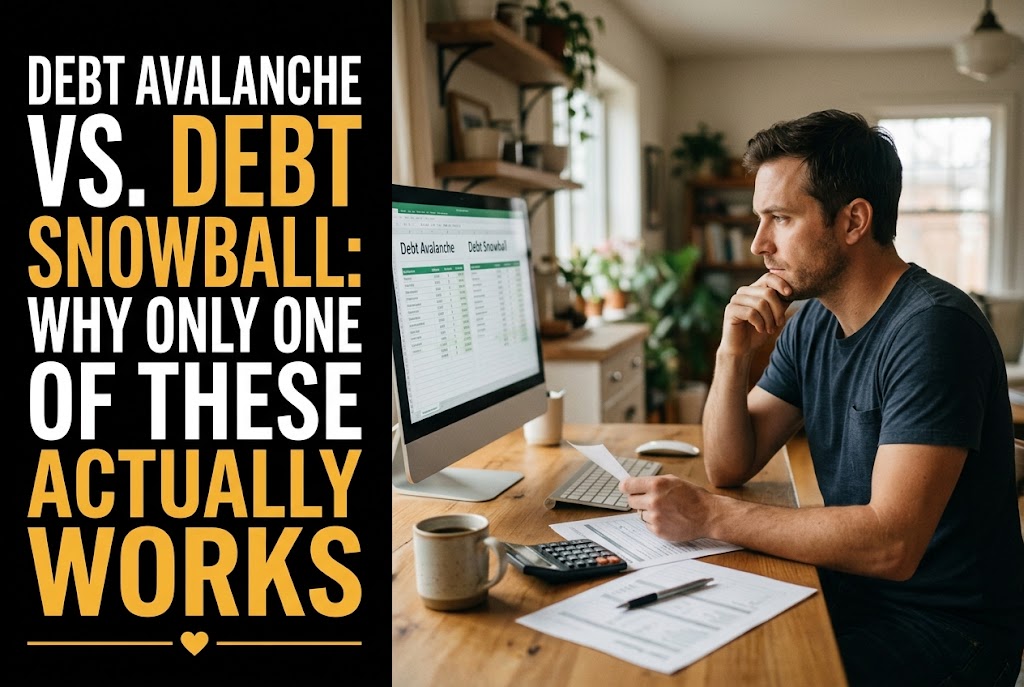
That's the real difference between the debt avalanche and the debt snowball. One is built for a calculator. The other is built for a human being.
What the Debt Avalanche Method Gets Wrong
The debt avalanche method says: list your debts from highest interest rate to lowest, and attack the highest rate first — no matter how big that balance is.
In theory, this saves you the most money in interest over time. I'm not going to pretend that's not true.
But here's what that plan asks of you in real life: it often asks you to stare down your biggest, most intimidating balance first — with no quick win in sight. Months can pass before you see a debt fully disappear.
That's not a math flaw. That's a human flaw. And it's destructive, because it sets people up to lose motivation before they ever build any.
You're not weak if that's happened to you. The plan was never designed with your discipline in mind — it was designed around a spreadsheet.
The Debt Snowball Method: Small Wins, Real Freedom
The debt snowball method takes a different approach entirely. You list your debts from smallest balance to largest — ignoring interest rate completely. You attack the smallest one with everything you've got, while making minimum payments on the rest.
When that smallest debt is gone, you take everything you were paying on it and roll it into the next smallest. Then the next. Then the next.
Here's why this works when the avalanche doesn't: it gives you proof early. Proof that you can actually do this. That proof is what keeps you in the fight long enough to finish.
This isn't about ignoring the math. It's about being honest that discipline, not interest rates, is the real battle.
A Real Example
Let's say you're carrying five debts — a mix of credit cards, a personal loan, a student loan, and a couple of car notes, ranging from a couple thousand dollars up to twenty thousand.
Under the avalanche method, you'd be told to go after whichever balance has the highest interest rate — even if that happens to be your largest debt. That could mean a year or more before you cross a single debt off the list.
Under the snowball method, you start with your smallest balance — maybe that smaller car loan — and knock it out in a matter of months. That's a finished debt. Gone. Off the list.
Now you take that payment and apply it to the next smallest balance. Then the next. Each one falls faster than the last, because you're rolling more money forward every time. By the time you reach your largest balance, you're attacking it with serious force — and serious momentum behind you.
That's not a coincidence. That's the system working the way it's designed to.
Why Momentum Beats Math Every Time
Scripture reminds us that faithfulness in small things leads to faithfulness in large things. That principle applies here directly.
The debt snowball isn't the "emotional" choice and the avalanche the "logical" one. That framing is backwards. The snowball is the method that accounts for how people actually change — through small, visible wins that build belief.
Freedom isn't just a math outcome. It's a behavior outcome. And the method that aligns with your behavior is the one that actually gets you to the finish line.
What This Means for You
If you're sitting with a list of debts right now, feeling the weight of all of them at once, here's your next step:
Write every debt down — smallest balance to largest. Not by interest rate. By size.
Make minimum payments on everything except the smallest one. Attack that smallest balance with every extra dollar you can find. When it's gone, roll that payment into the next one.
That's it. That's the whole system. Simple, not easy — but it works because it's built for you, not for a formula.
Conclusion
Here's what we covered: the debt avalanche method focuses on interest rates and leaves you waiting for a win. The debt snowball method focuses on small balances first and gives you one early — and that win is what carries you to the next one, and the next, until you're free.
This isn't about which method is smarter. It's about which method you'll actually finish.
Your move this week: List your debts smallest to largest. Pick the smallest one. Start there.
Which debt are you tackling first? Drop it below — let's build this together.
Keep building,

Anthony O'Neal is a bestselling author, speaker and personal finance educator. He teaches families how to get out of debt and build real wealth on any income through The Escape Plan, his show The Table with AO, and the In the Black app.
more articles
Money Tips
November 5, 2026
14 Low-Cost Valentine's Day Dates That Won't Wreck Your Budget
Money Tips
November 5, 2026
What Trump's Economic Plan Actually Means for Your Household Budget
Money Tips
November 4, 2026
The Debt-Free Degree: A Real Plan to Get Your Kid Through College Without Loans
Money Tips
November 4, 2026
The Real Reason Your Grocery Bill Keeps Going Up
Money Tips
November 3, 2026
The Spending Freeze: 17 Ways to Take Back Control of Your Money
Money Tips
November 3, 2026
The $1.86 Trillion Problem: What Student Loan Debt Really Looks Like in 2026
Where this fits
The Escape Plan
Five phases, one plan. Find where you are, then take the next step.
In The Black
A coach in your pocket
Daily money assignments and real accountability, built around the Escape Plan. Know your next step every single day.
$59 a quarter or $179 a year
Get In The Black →Get the plan in your inbox.
Weekly money tips, real stories, and my free Wealth Checklist.
Free. Unsubscribe anytime.