

Key Takeaways
- Taxes aren't just an April 15th problem — they're built into almost everything you do, from your paycheck to your grocery run to your investments.
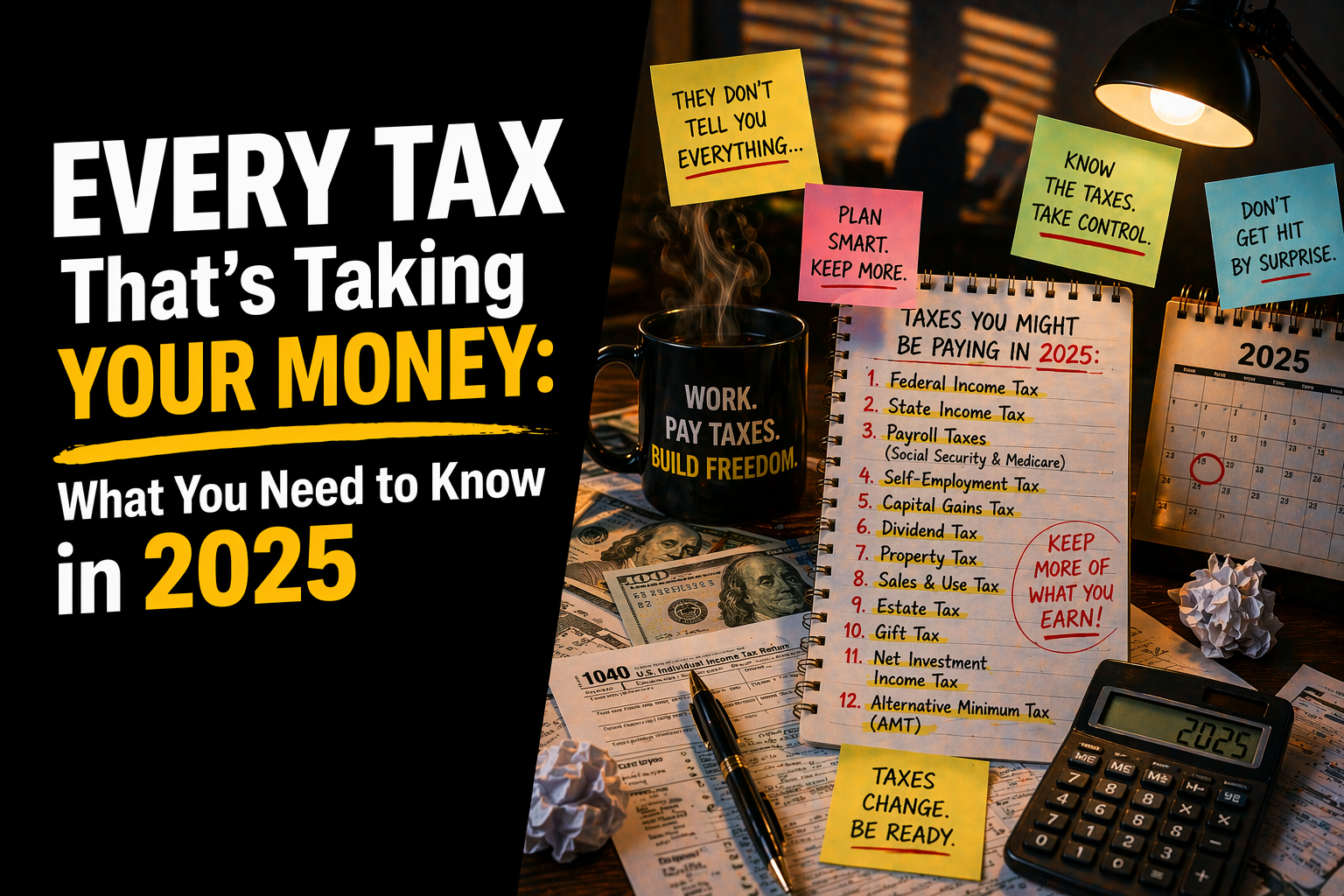
- There are six main types of taxes you need to understand: income, consumption, property, payroll, capital gains, and wealth transfer taxes.
- The U.S. uses a progressive tax system for federal income tax — meaning not all your money is taxed at the same rate. Your income moves through brackets, and each bracket is taxed differently.
- Long-term investors get rewarded. If you hold an investment for more than a year, your capital gains are taxed at lower rates (0%, 15%, or 20%) compared to short-term gains, which are taxed at your regular income rate.
- Understanding how taxes work isn't optional — it's one of the most important wealth-building skills nobody taught us in school.
What if I told you that you're probably paying 6 to 10 different types of taxes right now and don't even realize it?
Real talk. Most of us think taxes are a once-a-year headache — something we deal with in April, file some paperwork, and move on. But family, taxes are touching your money every single day. When you get your paycheck. When you buy groceries. When you fill up your gas tank. When you sell an investment. Even when you pass wealth down to your children.
And here's what frustrates me: nobody teaches us this. Not in high school. Not in most colleges. We're just expected to figure it out — and when we don't, we end up overpaying, missing deductions, and leaving money on the table that could be going toward building real wealth.
That stops today. I'm going to break down every major type of tax in plain language — cookie jar on the bottom shelf — so you know exactly where your money is going and how to keep more of it.
Let's get to work.
What Exactly Is a Tax?
A tax is a mandatory payment collected by the government — federal, state, or local — from individuals and businesses. That money funds public services like roads, schools, the military, Social Security, and Medicare.
Now, do I love paying taxes? Nobody does. But here's the truth: taxes are part of the system. And the people who build wealth aren't the ones who complain about taxes — they're the ones who understand taxes and use the rules to their advantage.
The tax code is over 70,000 pages long. I'm not asking you to read all of it. But I need you to understand the basics so you stop giving away more money than you have to.
So let's break down the six main types of taxes that are affecting your wallet right now.
The 6 Main Types of Taxes
Here's your cheat sheet:
- Income taxes
- Consumption taxes
- Property taxes
- Payroll taxes
- Capital gains taxes
- Wealth transfer taxes
Every tax you'll ever encounter falls into one of these categories. Let me walk you through each one.
1. Income Taxes
This is the big one. Income tax is the primary way the federal government — and most state governments — collect revenue. It's a tax on the money you earn, whether that's from your job, a side business, interest from your savings account, or even some Social Security benefits.
The more you earn, the more you pay. Simple as that.
Federal Income Tax
When most people say "taxes," this is what they're talking about.
The federal government uses what's called a progressive tax system. This is important, so stay with me. A lot of people think if they're in the 24% tax bracket, all their income is taxed at 24%. That's not how it works.
Here's the truth: your income moves through brackets. The first chunk of your income is taxed at 10%. The next chunk at 12%. Then 22%. And so on, all the way up to 37% for the highest earners.
So if you're in the 24% bracket, only the last portion of your income is taxed at 24%. Everything below that is taxed at lower rates. This is why it's called progressive — it steps up gradually.
Why this matters for you: Don't ever turn down a raise or extra income because you're afraid of "moving into a higher tax bracket." You'll still take home more money. The higher rate only applies to the income above the bracket threshold, not everything you earn.
State and Local Income Tax
Uncle Sam isn't the only one who wants a piece. Most states collect their own income tax on top of what you owe the federal government.
Some states like California have progressive systems with rates ranging from 1% to 13.3%. Others like Louisiana keep it simple with a flat rate of 3% — everybody pays the same percentage regardless of income.
And then there are the states with no state income tax at all — like Texas, Florida, Tennessee, and Nevada. These states make up the difference through other taxes like sales tax and property tax.
Why this matters for you: Where you live directly impacts how much of your paycheck you keep. This is one reason I did that video on the best and worst states for building wealth. Your zip code is either helping you or hurting you.
2. Consumption Taxes
Consumption taxes are based on what you spend, not what you earn. Every time you buy something, there's a good chance a tax is baked into that purchase.
Sales Tax
This is the one you see on every receipt. Sales tax is a percentage added to the price of goods and services at the register. The rate depends on your state — and sometimes your city or county stacks on extra.
For example, if your state has a 10% sales tax and you buy a $200 pair of headphones, you're paying $220 at checkout. That extra $20 goes straight to the government.
Some states have no sales tax at all — like Oregon, Montana, and Delaware. But most states charge anywhere from 4% to over 10% when you combine state and local rates.
Why this matters for you: Sales tax is one of the most sneaky taxes because it hits you on every single purchase. When you're budgeting, factor in sales tax — especially on big purchases. That $1,000 laptop might actually cost you $1,080 or more depending on where you live.
Excise Tax
An excise tax is a targeted tax on specific products — usually things the government considers harmful or costly to society. Think cigarettes, alcohol, soda, and gambling (including sports betting).
These are sometimes called "sin taxes." The idea is to discourage certain behaviors while generating revenue.
Why this matters for you: If you're spending money on these categories regularly, you're paying more in taxes than you realize. Something to think about.
Tariffs
A tariff is a tax on goods imported from other countries. The company importing the product pays the tariff, but let's be honest — they pass that cost right along to you through higher prices.
When tariffs go up on electronics, cars, clothing, or food from overseas, you feel it at the checkout counter. This is why tariff news matters to your wallet even if it sounds like political noise.
Why this matters for you: Pay attention when you hear about new tariffs in the news. It directly affects the prices you pay on everyday items. This is real money coming out of your pocket.
3. Property Taxes
If you own stuff — especially a house — the government wants a piece of that too.
Real Property Tax
Real property tax is a tax on real estate you own — your home, land, rental properties, or commercial buildings. This tax is collected by your local government and funds things like public schools, road repairs, police, and fire departments.
Property tax rates vary widely depending on where you live. Some areas charge less than 0.5% of your home's assessed value. Others charge over 2%. On a $300,000 home, that's the difference between $1,500 and $6,000 a year.
The good news is that if you have a mortgage, your property tax is usually rolled into your monthly payment through an escrow account. So you're paying it — you just might not notice it.
Why this matters for you: Property taxes are a real cost of homeownership that a lot of first-time buyers overlook. When you're budgeting for a home, don't just look at the mortgage payment. Factor in property taxes, insurance, and maintenance. The full picture matters.
Personal Property Tax
This is a tax on movable assets — things like business equipment, inventory, vehicles, and furniture. In most cases, this applies to businesses more than individuals.
But some states do charge personal property tax on vehicles. So depending on where you live, you might be paying an annual tax just to own your car.
Why this matters for you: If you're starting a business — and I hope you are — understand that your equipment and inventory may be taxed. Factor this into your business budget from day one.
4. Payroll Taxes
Every time you get a paycheck, money is withheld before it ever hits your bank account. That's payroll taxes at work. These fund Social Security, Medicare, and unemployment insurance.
Social Security Tax
Social Security tax is a 12.4% tax split evenly between you and your employer — so you each pay 6.2%. If you're self-employed, you pay the full 12.4% yourself. That stings, but it's the reality of being your own boss.
This money funds retirement benefits, disability payments, and survivor benefits for families.
Medicare Tax
Medicare tax is a 2.9% tax, also split between you and your employer at 1.45% each. Self-employed? You're paying the full 2.9%.
And if you're a high earner making over $200,000, there's an additional 0.9% Medicare surtax on top of that.
Why this matters for you: Payroll taxes are the reason your take-home pay is less than your salary. If you make $60,000 a year, you're not taking home $60,000. After federal income tax, state tax, Social Security, and Medicare, you might be taking home closer to $45,000-$48,000 depending on your situation. This is why budgeting off your net pay — not your gross — is so critical.
5. Capital Gains Taxes
This one is for everyone who's investing — and if you're following what I teach, that should be all of you.
Capital gains tax is a tax on the profit you make when you sell an investment — stocks, mutual funds, real estate, or bonds. You don't pay this tax inside tax-advantaged retirement accounts like your 401(k) or Roth IRA. Those get special treatment.
But here's where it gets important: how long you hold the investment changes how much tax you pay.
Short-Term Capital Gains
If you buy a stock and sell it within one year or less, any profit is taxed as ordinary income — meaning it's added to your regular income and taxed at your federal bracket rate, anywhere from 10% to 37%.
This is one of the biggest reasons I tell people to stop trying to day-trade or flip investments for quick money. The tax bill eats into your gains significantly.
Long-Term Capital Gains
If you hold your investment for more than one year before selling, you qualify for long-term capital gains rates: 0%, 15%, or 20% depending on your taxable income.
That's a massive difference. Instead of paying 22% or 24% on your gains, you might only pay 15%. The tax code literally rewards patience.
Why this matters for you: This is why I preach buy-and-hold investing. When you invest in index funds or the S&P 500 and leave your money alone for years, you're not just building wealth through compound growth — you're also paying less in taxes when you eventually sell. Patience pays off in more ways than one.
6. Wealth Transfer Taxes
You might think taxes stop when you pass away. They don't. The government has found a way to tax your money even after you're gone.
Estate Tax
The estate tax — sometimes called the "death tax" — is a federal tax on everything you plan to leave behind for your loved ones. Cash, investments, real estate, businesses, personal property — all of it.
Now, here's the good news. For 2025, the estate tax exemption is $13.99 million per individual (or $27.98 million for married couples). That means most families won't owe federal estate tax. But estates above that threshold can be taxed at rates up to 40%.
Why this matters for you: Even if your estate isn't near that threshold today, this is why I talk about legacy planning. The exemption amount can change with new tax laws. And if you're building generational wealth the way I teach — your children's children's children — you need to be thinking about this now, not later.
Inheritance Tax
Unlike the estate tax (which is paid by the estate), an inheritance tax is paid by the person receiving the inheritance.
There's no federal inheritance tax, but six states currently have one: Nebraska, Kentucky, Pennsylvania, New Jersey, Iowa, and Maryland. Maryland is the only state with both an estate tax and an inheritance tax.
Why this matters for you: If you live in one of these states or have family there, factor this into your estate planning. A good CPA and estate attorney can help you structure things so your family keeps more of what you've built.
Gift Tax
Thinking about giving your wealth away while you're still alive to avoid estate taxes? The government thought of that too.
The gift tax applies to money or property you give someone without receiving equal value in return. But there's an annual exclusion: for 2025, you can give up to $19,000 per person per year without reporting it or paying any tax.
That means you could give $19,000 to your son, $19,000 to your daughter, $19,000 to your best friend — all tax-free. No limit on how many people you give to, just a limit per recipient.
Why this matters for you: This is a powerful tool for transferring wealth to your family while you're alive. If you're in a position to start blessing your loved ones financially, do it strategically within these limits.
What This Means for You
Family, I know that was a lot. But here's why it matters: the people who build wealth understand how money moves — and that includes how taxes work.
Every dollar you save on taxes is a dollar you can invest, give, or use to build something that lasts. You don't need to become a tax expert. But you do need to understand the basics so you stop leaving money on the table.
And listen — this is exactly why I tell people to get a real CPA once you start making real money. Not TurboTax. Not your cousin who "does taxes on the side." A certified professional who can save you thousands every single year. My CPA costs me about $10,000 a year but saves me multiples of that. That's not an expense — that's an investment with a serious return.
Conclusion
Look, taxes aren't going anywhere. But your understanding of them can change everything.
We covered the six types of taxes affecting your money right now:
- Income taxes — federal and state taxes on what you earn
- Consumption taxes — sales tax, excise tax, and tariffs on what you spend
- Property taxes — taxes on your home, land, and assets
- Payroll taxes — Social Security and Medicare taken from every paycheck
- Capital gains taxes — taxes on your investment profits
- Wealth transfer taxes — estate, inheritance, and gift taxes on passing wealth down
The truth is, you're not too far behind to learn this. You're just one decision away from being smarter with your money.
Here's your move: Take 30 minutes this week and review your last pay stub. Look at every deduction. Understand where your money is going. Then go to anthonyoneal.com/getmyplan and book a free 15-minute financial plan session so you can start making your money work harder for you.
Now I want to hear from you: Which tax surprised you the most? Drop it in the comments — let's learn together.
Keep building,

Anthony O'Neal is a bestselling author, speaker and personal finance educator. He teaches families how to get out of debt and build real wealth on any income through The Escape Plan, his show The Table with AO, and the In the Black app.
more articles
Money Tips
October 23, 2026
The Weight Behind the Pulpit: What It Really Means to Steward a Church Well
Money Tips
October 23, 2026
Why Generosity Isn't About How Much You Have Left Over
Money Tips
October 22, 2026
Building a Stewardship Ministry That Actually Changes Lives: A 5-Step Guide for Pastors
Money Tips
October 22, 2026
A Smarter Way to Make Extra Money This Christmas Season
Money Tips
October 21, 2026
Extra Work Won't Save You If It Burns You Out First
Money Tips
October 21, 2026
15 Passive Income Streams You Can Actually Build in 2026 (Ranked by Effort)
Where this fits
The Escape Plan
Five phases, one plan. Find where you are, then take the next step.
In The Black
A coach in your pocket
Daily money assignments and real accountability, built around the Escape Plan. Know your next step every single day.
$59.99 a quarter or $179.99 a year
Get In The Black →Get the plan in your inbox.
Weekly money tips, real stories, and my free Wealth Checklist.
Free. Unsubscribe anytime.