
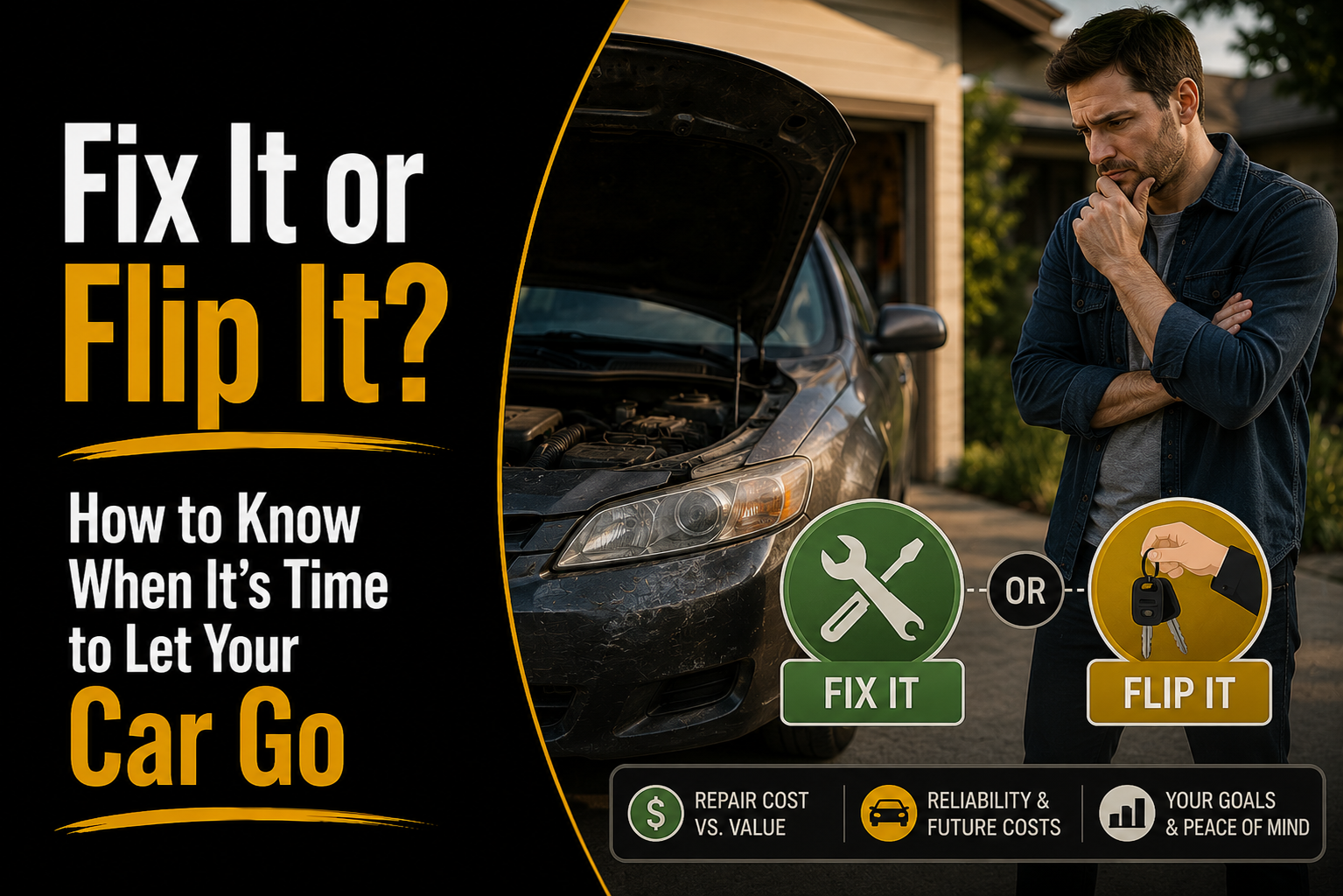
Fix It or Flip It? How to Know When It's Time to Let Your Car Go

3 min read
Key Takeaways
- If your repair bill is higher than what your car is worth, that's usually a sign to move on — but not always.
- The real decision comes down to your car's value, repair costs, how often it breaks down, safety concerns, and your current budget.
- If you repair, shop around, handle what you can yourself, and focus on what's urgent.
- If you replace, buy used, pay cash, and never let frustration push you into a car payment you can't afford.
Let me be straight with you, family.
There are few things more draining than pouring money into a car that keeps letting you down. You fix the brakes, then the transmission goes. You fix the transmission, then the AC dies. And somewhere in the middle of all that, you start asking yourself — is this even worth it anymore?
Real talk: that question deserves a real answer. Not an emotional one. Not a rushed one. A smart one.
Because here's what I've seen happen too many times — someone gets fed up with repair bills, walks into a dealership, and drives off with a $700-a-month car payment they can't afford. Now they've traded a $900 repair for a $42,000 mistake.
That's not freedom. That's a new kind of stuck.
So before you make any moves, let's slow down and think this through together.
The General Rule — And Why It's Not the Whole Story
Most financial experts will tell you: if the repair costs more than the car is worth, replace it.
And honestly? That's a solid starting point.
But it's not the whole story. Your budget, the type of car you drive, how often it needs work, and what's happening in the car market right now — all of that matters too.
So let's break it down, step by step.
What You Need to Think About Before You Decide
Know What Your Car Is Actually Worth
This is step one — and most people skip it.
Before you agree to any repair or start shopping for a replacement, find out what your car is actually worth. Sites like Kelley Blue Book or Edmunds let you enter your car's year, make, model, mileage, and condition to get a real market estimate.
Get two numbers: what it's worth as-is and what it would be worth after the repair. That gap tells you a lot.
If you owe more on your car than it's worth right now, that's a whole separate problem. You're upside down — and in that case, you need to deal with that before anything else.
"The plans of the diligent lead to profit as surely as haste leads to poverty." — Proverbs 21:5
Don't make a $10,000 decision based on frustration. Get the facts first.
Understand the Real Cost of the Repair
Once you know what your car is worth, find out exactly what the repair will cost — parts and labor included. Call at least two or three shops. Don't just take the first number you're handed.
Then ask yourself three questions:
- Does the repair cost more than the car is worth?
- Will this fix actually last, or is it just buying me a few more months?
- Am I going to be right back in this same spot by next spring?
A $2,000 repair on a car worth $9,000 that buys you two more solid years? That's a smart move. A $5,500 repair on a car worth $4,000? That math doesn't work, family.
Also keep in mind — if you drive a luxury brand or a foreign car with expensive parts, your repair costs are going to run higher than average. Factor that in.
Look at How Often It's Breaking Down
There's a big difference between normal maintenance and a car that's bleeding you dry.
Oil changes, tire rotations, new brake pads — that's just part of owning a car. But if you're at the mechanic every couple of months dropping $400 to $700 each visit, you need to add that up.
Five hundred dollars every two months is $3,000 a year. On a car worth $5,000. That's not a car — that's a money pit with four wheels.
Do your research on your specific make and model. Check car forums. Talk to other owners. Brands like Toyota, Honda, and Lexus are known for lasting well past 200,000 miles with regular upkeep. If you've got one of those, it might be worth holding on. But if your car has a reputation for expensive, recurring problems — that's important information.
Be Honest About Safety
Safety is never something to compromise on. Faulty brakes, steering problems, a failing transmission — those need to be addressed. Period.
But here's the honest question: is your car actually unsafe, or are you using safety as a reason to justify an upgrade you already want?
There's nothing wrong with wanting a newer car. Just be honest with yourself about the real reason. A good mechanic will tell you straight up what's a genuine safety concern and what can wait.
Pay Attention to the Car Market
This one gets overlooked all the time.
The average new car payment right now is over $700 a month. That's not a car payment — that's a second rent check. And used car loans aren't much better once you factor in interest rates.
A $1,200 repair bill feels painful in the moment. But compare it to $700 a month for 60 months — that's over $42,000 out of your pocket before interest. Suddenly that repair doesn't look so bad.
Don't let frustration push you into a financial decision you'll be paying for the next five years.
If You Decide to Repair Your Car
Shop around before you commit. Don't accept the first quote. Call multiple shops, ask about current specials, and get recommendations from people you trust. Labor costs vary significantly from shop to shop — and that's usually where the biggest savings are hiding.
Handle what you can yourself. YouTube is a powerful tool. Door handles, air filters, windshield wipers, even some brake jobs — if you're comfortable and capable, you can save hundreds of dollars doing it yourself. Know your limits, but don't pay someone else for what you can handle.
Prioritize what's urgent. Ask your mechanic directly: what needs to be fixed right now, and what can wait? Safety items come first — brakes, tires, steering. The cracked dashboard or the broken cup holder? That can wait while you save up.
If You Decide to Replace Your Car
Buy used, not new. I know the new car is tempting. But new cars lose up to 60% of their value in the first five years. You're paying a premium for something that starts losing value the second you drive off the lot. A reliable used car — especially a Toyota or Honda — can serve you just as well for a fraction of the cost.
Pay cash. I know some of you just tensed up reading that. But hear me out. A car loan is not a wealth-building tool. It's a wealth destroyer. When you finance a car, you're paying interest on something that's losing value every single day. That's the opposite of building generational wealth.
Start with what you have. Sell your current car. Save aggressively. Get into something reliable with cash — even if it's not your dream car yet. You can upgrade later. Debt-free.
Save up strategically for the car you actually want. Here's a simple plan: once you buy a car with cash, take what would have been your car payment — let's say $500 a month — and save it. In 12 months, that's $6,000 toward your next upgrade. Add in what you get from selling your current car, and you're moving up fast — with no debt, no interest, and no stress.
That's how you build. One smart decision at a time.
Repair or Replace — You Still Need a Budget
Here's the thing, family — no matter what you decide, you need a budget that accounts for your car.
Gas, routine maintenance, a sinking fund for future repairs, and eventually saving to replace it — all of that needs a line in your budget. When you plan for it, a surprise repair doesn't have to become a financial crisis.
That's the power of budgeting. It gives you options. It gives you peace. And it keeps you from making emotional decisions when something breaks down.
Conclusion
Look, this isn't just about a car. It's about protecting your money, your peace, and your future.
You work too hard to let one bad financial decision set you back years. Whether you fix it or replace it — do it with a plan, do it with wisdom, and if you're replacing it, do it with cash.
Here's what we covered:
- Know your car's real value before you do anything
- Get multiple repair estimates and ask the right questions
- Track how often and how much you're spending on repairs
- Never compromise on safety — but be honest with yourself
- Don't let the car market or frustration pressure you into a bad decision
Your move right now: Pull up Kelley Blue Book today and find out exactly what your car is worth. Then get a repair estimate if you need one. Knowledge is power — and it'll help you make the right call with confidence.
Biblical wisdom teaches us to be good stewards of what we have. That includes your car, your money, and your future. You don't have to figure this out alone — and you don't have to make a rushed decision.
Take your time. Run the numbers. And make the move that sets you up for freedom, not more stress.
Now I want to hear from you — are you currently facing a repair or replace decision? What's making it hard to choose? Drop it in the comments below. Let's work through it together.
Keep building,

Lorem ipsum dolor sit amet, consectetur adipiscing elit. Suspendisse varius enim in eros elementum tristique. Duis cursus, mi quis viverra ornare, eros dolor interdum nulla, ut commodo diam libero vitae erat. Aenean faucibus nibh et justo cursus id rutrum lorem imperdiet. Nunc ut sem vitae risus tristique posuere.
like what you’ve just read?
Make sure to share it with your tribe!
.webp)
like what you’ve just read?
Make sure to share it with your tribe!


