
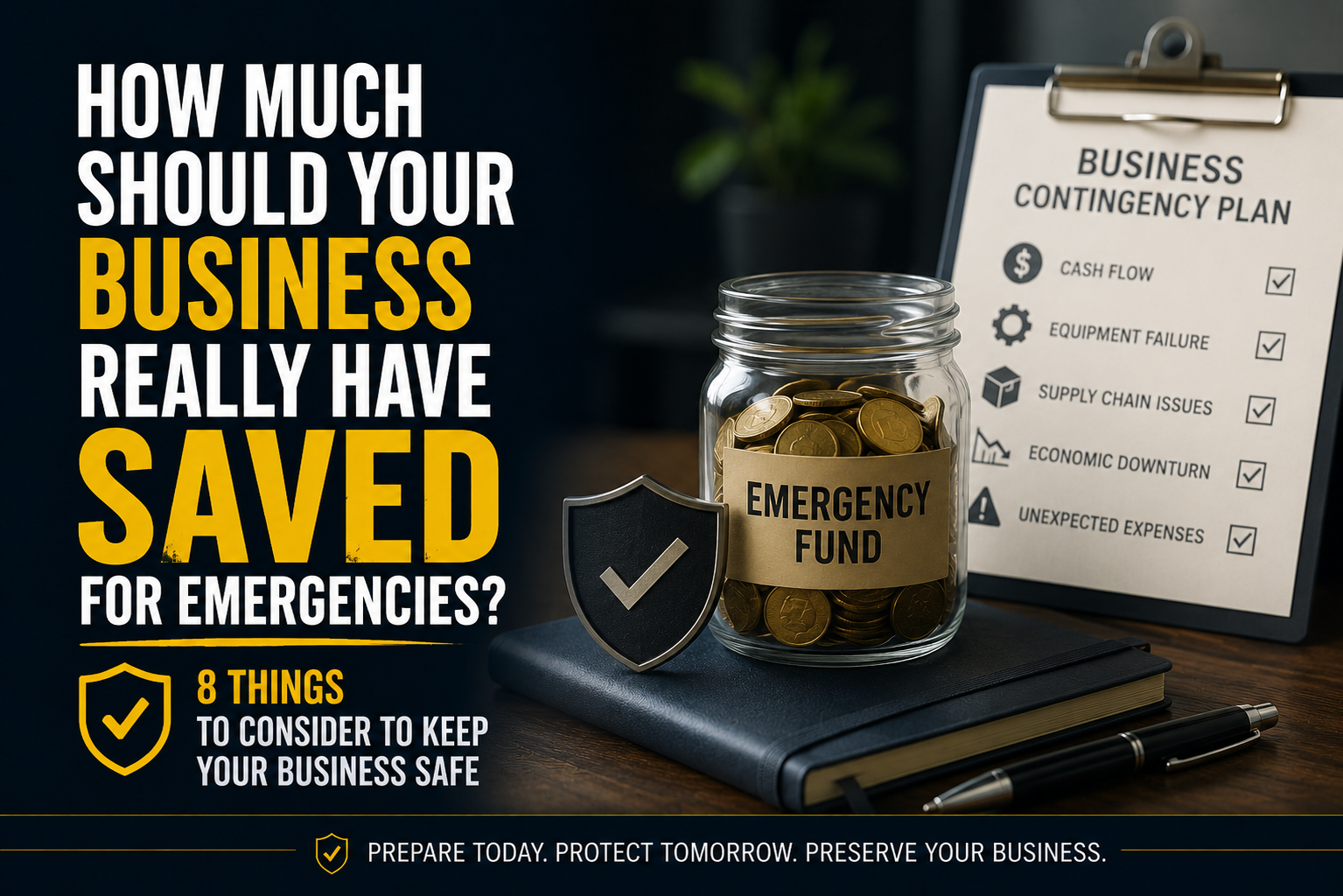
How Much Should Your Business Really Have Saved for Emergencies?

3 min read
Key Takeaways
- A business emergency fund is money set aside specifically for unexpected financial challenges — not opportunities, not upgrades, not impulse decisions.
- Every business needs one, whether you're just starting out or well established.
- You don't have to be debt-free before you start saving.
- The goal is six months of operating expenses in a separate, interest-bearing account.
- Small, consistent deposits add up faster than you think — start where you are.
Family, let me ask you something real quick.
If your biggest client called you tomorrow and canceled their contract — what would you do?
Would you have enough cash to keep the lights on, pay your team, and keep moving forward? Or would you be scrambling, stressed, and reaching for a credit card or a loan just to survive?
That moment right there — that's why a business emergency fund isn't optional. It's essential.
I've talked to a lot of entrepreneurs and small business owners in this community. And one of the most common things I hear is this: "I'll start saving once things pick up." But here's the truth — if you wait until things are perfect to start saving, you'll never start. And when the storm hits, and it will hit, you won't be ready.
Let's fix that today. Here's everything you need to know about building a business emergency fund — and exactly how much you should have set aside.
What Is a Business Emergency Fund, Really?
A business emergency fund is a dedicated stash of cash set aside specifically for unexpected financial challenges your business faces.
Not for new equipment you've been eyeing. Not for a marketing campaign. Not for a team retreat. For emergencies.
This money lives in a separate, interest-bearing account — like a high-yield savings or money market account — completely apart from your day-to-day operating account. Keeping it separate is not just a strategy. It's a boundary. It protects the money from being spent on things that feel urgent but aren't true emergencies.
In the accounting world, this falls under what's called retained earnings — money your business keeps after expenses. Smart business owners use retained earnings for three things: emergencies, reinvesting in the business, and seizing real opportunities when they come.
But before any of that can happen, the emergency fund has to come first.
Why Your Business Cannot Afford to Skip This
Here's what I want you to understand. Running a business without an emergency fund is like driving without a seatbelt. Most days, nothing happens. But the one day something does — and it will — you'll wish you had it.
A business emergency fund protects you in situations like:
- A major client cancels a contract without warning
- Equipment breaks down and you need it to generate revenue
- A slow season hits harder than expected
- A global disruption shuts down your supply chain
- You need to cover payroll while waiting on outstanding invoices
Now, some people will tell you to just open a line of credit or take out a small business loan when things get tight. And I want to be direct with you — that advice will keep you in bondage. Debt is a trap. When you borrow to survive a crisis, you come out of the crisis still in a hole. And now you owe somebody.
When you have your own cash saved, you are your own bank. You handle the emergency, you keep moving, and you don't owe anyone a dime.
That is freedom.
Do You Have to Be Debt-Free First?
This is one of the most common questions I get, and the answer is no.
If you're familiar with the Baby Steps, those are designed for your personal finances. The approach for your business is a little different.
For your business, the goal is to work two buckets at the same time — paying down debt and building savings simultaneously. You don't have to choose one or the other.
Here's how to think about it practically:
If your business carries debt, start by adjusting your salary to a reasonable living wage. Comfortable, but not excessive. Then take your remaining profits and split them — a larger portion goes toward eliminating debt, and a smaller portion goes into your retained earnings and emergency fund.
For example, you might direct 80% of profits toward debt and 20% toward savings. That ratio can shift as your debt decreases. The point is you're making progress on both fronts at the same time.
Is it hard? Yes. Is it worth it? Absolutely.
The business owners I've seen follow this path consistently end up debt-free, with cash reserves, and with far less stress than the ones who borrowed their way through every rough patch.
How Much Should You Actually Have Saved?
Here's the number you need to know — six months of operating expenses.
That means if it costs you $20,000 a month to run your business — payroll, rent, utilities, software, supplies — you need $120,000 sitting in your business emergency fund.
I know that number might feel overwhelming right now. That's okay. You don't build it overnight. You build it consistently, one deposit at a time. Here's how:
Set up an automatic transfer.
Open a dedicated savings account for your business emergency fund and set up an automatic monthly deposit. Even if it starts small, automation removes the temptation to skip it. You'll be surprised how fast it grows when you stop thinking about it and just let it work.
Save more when business is good.
When revenue is up, resist the urge to upgrade everything or reward yourself too early. Pour that extra cash into your reserves. The goal is to hit six months of operating expenses — and strong months are your fastest path to get there.
Never dismiss small amounts.
Not every month will allow for a large deposit. That's okay. A small deposit is still a deposit. Consistency over time is what builds real security. Slow and steady still wins the race.
When Is It Actually Okay to Use It?
This is where discipline matters most. Your business emergency fund is for business emergencies — full stop.
Ask yourself this before you touch it:
Is this an unexpected expense that threatens the operation of my business? If yes, that's what the fund is for.
Is this something I could have planned for, or something I simply want? If yes, leave the fund alone.
Broken equipment that generates your revenue — that's an emergency. Payroll you can't cover because a client hasn't paid — that's an emergency. A shiny new piece of tech you've been wanting — that is not an emergency.
Seasonal businesses, pay close attention here. If your business slows down every winter, that is not an emergency. That is a pattern. Plan for it. Save during your peak months so you can cover your team and your expenses during the slow ones. Your emergency fund should not be your seasonal cash flow plan.
What This Means For You
Family, whether you're running a side hustle, a small business, or a growing company — this applies to you.
You work too hard to let one unexpected event take everything down. A business emergency fund is not a luxury for big companies. It is a basic act of stewardship for anyone serious about building something that lasts.
Proverbs 21:20 says the wise store up for the future. That's not just personal finance wisdom — that's business wisdom too.
Start where you are. Save what you can. Build the habit. And protect what God is helping you build.
Conclusion
Here's what we covered today:
- A business emergency fund is dedicated cash for unexpected challenges — kept separate from your operating account
- You do not need to be debt-free before you start saving — work both buckets at the same time
- The target is six months of operating expenses
- Automate your savings, save more during strong months, and never dismiss small deposits
- Use the fund only for true emergencies — not upgrades, not wants, not things you could have planned for
You don't have to have it all figured out to get started. You just have to start.
Here's your move: Calculate what six months of your business operating expenses looks like. Write that number down. Then open a separate savings account this week and make your first deposit — even if it's $100. That first deposit is the most important one you'll ever make.
Now I want to hear from you — do you currently have a business emergency fund? Where are you in the process? Drop it in the comments below. Let's build together.
Keep building,

Lorem ipsum dolor sit amet, consectetur adipiscing elit. Suspendisse varius enim in eros elementum tristique. Duis cursus, mi quis viverra ornare, eros dolor interdum nulla, ut commodo diam libero vitae erat. Aenean faucibus nibh et justo cursus id rutrum lorem imperdiet. Nunc ut sem vitae risus tristique posuere.
like what you’ve just read?
Make sure to share it with your tribe!
.webp)
like what you’ve just read?
Make sure to share it with your tribe!


