

Key Takeaways
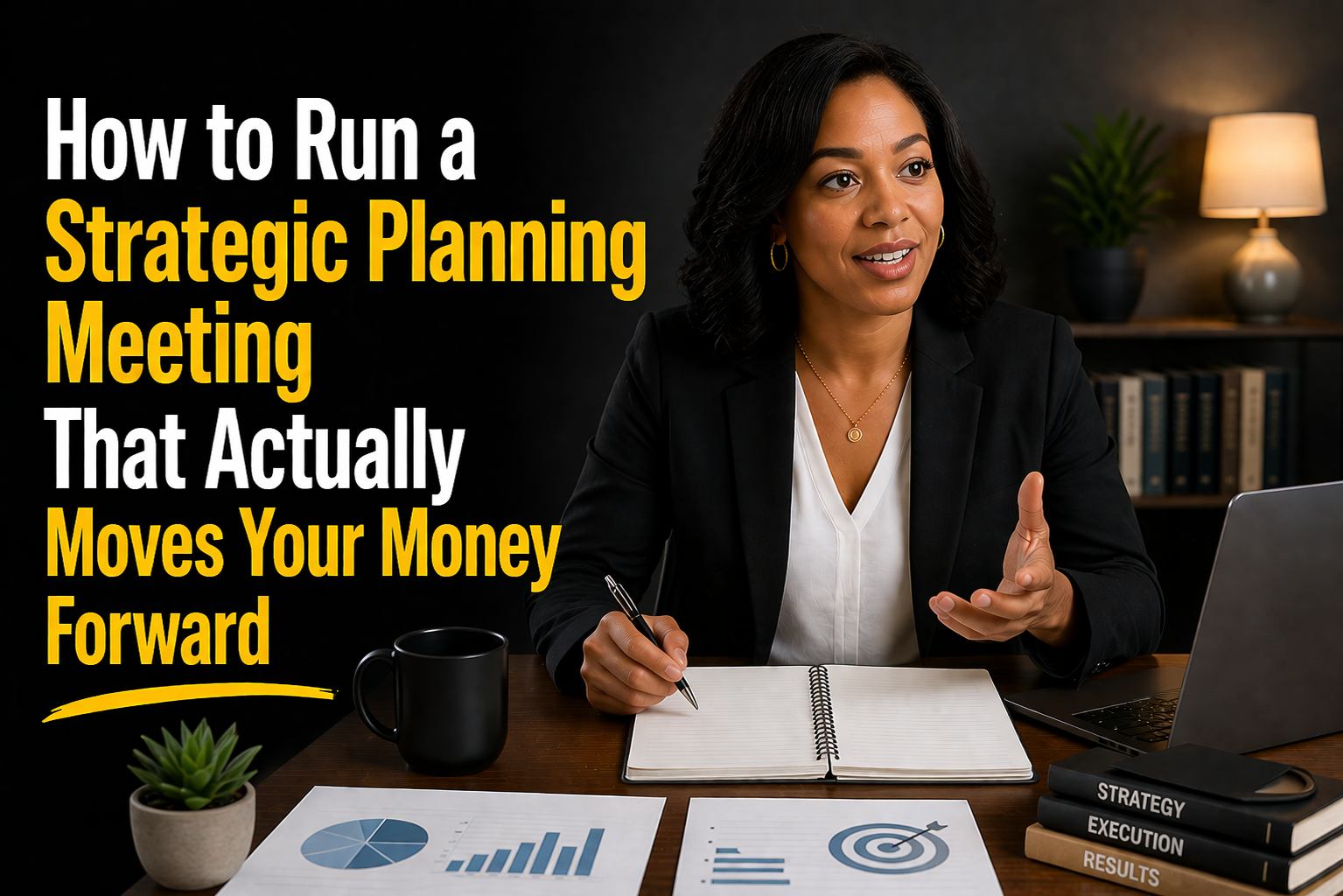
- Definition: A strategic planning meeting is where you and your household or business team sit down to set real goals and map out the next steps to build the future you actually want.
- Prepare before the meeting. Pick the right time, invite the right people, set the ground rules, and come ready to be honest.
- Lead with focus and clarity. Start with reflection, review where you are, create or update your plan, and assign clear action steps.
- Schedule a follow-up. Share the plan, hold regular check-ins, and review your progress every quarter.
Real talk — most people spend more time planning a vacation than they do planning their financial future.
They'll research flights, hotels, and restaurants for weeks. But sit down and map out where their money is going for the next 12 months? That conversation never happens.
And then they wonder why they're still stuck.
Here's what I've learned from years of working with families, couples, and entrepreneurs: the people who win with money aren't always the smartest or the highest earners. They're the ones with a plan. A real one. Written down. Reviewed regularly. Built with intention.
That's what a strategic planning meeting is — and today, I'm going to show you exactly how to run one that changes the trajectory of your life.
Let's get to work.
What Is a Strategic Planning Meeting (And Why You Need One)?
A strategic planning meeting is a dedicated time — away from the noise of everyday life — where you sit down and get serious about your future.
For a business, it's where leadership aligns on goals and direction. For a household, it's where you and your partner (or even just you) get honest about where you are, where you want to go, and what it's going to take to get there.
This isn't your average budget check-in. This is bigger.
This is where you ask the hard questions:
- Are we actually building wealth, or just managing debt?
- What does our financial life look like in 5 years? 10 years?
- Are we on the same page — or are we just coexisting?
Biblical wisdom teaches us that without vision, people perish. A strategic planning meeting is how you build that vision and put legs on it.
The 3 Stages of a Powerful Strategic Planning Meeting
Stage 1: Before — How to Prepare
Preparation is everything. If you walk into this meeting without doing the work beforehand, you'll spend the whole time reacting instead of building.
Here's how to prepare:
Choose the right setting. Get out of your normal environment. Go to a coffee shop, a park, a hotel lobby — anywhere that signals to your brain that this is different. This is important. This is intentional.
Invite the right people. If you're married or in a serious relationship, your partner needs to be in the room. If you're running a business, bring your core team — not everyone, just the people who own the outcomes. Strategic planning is not a group chat. It's a focused conversation with the people who are actually building with you.
Do your homework first. Before you sit down together, each person should spend time individually reflecting. Where did we win this past year? Where did we fall short? What do we need to stop doing? What do we need to start? Come to the table with answers, not just questions.
Set the ground rules. No phones. No distractions. No defensiveness. This is a safe space to be honest — not a place to assign blame. The goal is clarity, not conflict.
Questions to ask yourself before the meeting:
- What are our top 3 financial wins from the last 12 months?
- What's the one thing that kept us from moving forward?
- What does our desired future actually look like — specifically?
Stage 2: During — How to Run the Meeting
You set the tone. Walk in with energy, intention, and a clear agenda. Open with prayer or a moment of silence to center everyone and remove distractions.
Step 1: Start with an honest reflection.
Before you can build the future, you have to face the present. Pull out your numbers. Look at your budget, your debt, your savings, your investments. No sugarcoating. No excuses. Just truth.
Ask: Where are we, really?
This is where a lot of people get uncomfortable — and that's okay. Discomfort is the beginning of change.
Step 2: Define your desired future.
This is the most important part of the meeting. You need a clear, specific picture of where you want to be in the next 12 months.
Not "we want to save more money." That's not a plan. That's a wish.
Try this instead: "By December 31st, we will have paid off $15,000 in debt, saved a 3-month emergency fund, and started investing 15% of our income."
That's a desired future. Specific. Measurable. Achievable with discipline.
Step 3: Build your defining objectives.
Once you have your desired future, work backwards. What has to be true for you to get there? These are your defining objectives — the 3 to 5 benchmarks that tell you you're on track.
For example:
- Cut monthly expenses by $400
- Pick up one additional income stream by March
- Automate savings contributions by February 1st
- Complete Dave Ramsey's Baby Steps 1 and 2 by Q3
Step 4: Have a reality check.
Look at your plan and ask honestly — do we have at least a 70% chance of pulling this off? If the goal is too easy, push harder. If it's unrealistic, scale it back. The goal is to stretch without breaking.
Step 5: Assign action items.
Every objective needs an owner and a deadline. Don't leave the meeting with a beautiful plan and zero accountability. Decide who is responsible for what — and by when.
Tips for keeping the meeting productive:
- Present one question at a time
- Give everyone space to speak — don't let one voice dominate
- Take a break every 90 minutes
- Write everything down — if it's not written, it didn't happen
Stage 3: After — How to Follow Through
This is where most people drop the ball. They have a great meeting, feel fired up, and then life happens and the plan collects dust.
Don't let that be you.
The first two weeks matter most. While the energy is still fresh, take action on your first defining objective. Don't wait. Momentum is built in the beginning.
Hold weekly check-ins. These don't have to be long — 15 to 20 minutes is enough. Review your progress, flag any blockers, and adjust if needed. Consistency beats intensity every time.
Schedule quarterly reviews. Every 90 days, sit back down and ask: Are we on track? What's working? What needs to change? This keeps you from drifting and helps you catch problems before they become crises.
Questions to ask in your follow-up:
- Is our progress green (on track), yellow (slightly off), or red (need to pivot)?
- What's blocking us right now?
- What do we need to do differently next quarter?
What This Means For You
Family, here's the bottom line.
You don't need a Fortune 500 company to benefit from strategic planning. You need a kitchen table, an honest conversation, and the courage to build something on purpose.
The couples and families I've seen win with money aren't the ones who got lucky. They're the ones who sat down, got real, made a plan, and worked it — together.
God didn't design you to drift. He designed you to build. And a strategic planning meeting is one of the most practical tools you have to do exactly that.
Conclusion
Look, family — this isn't complicated. But it does require intention.
Here's what we covered:
- Before: Prepare individually, choose the right setting, invite the right people, and set ground rules
- During: Reflect honestly, define your desired future, build your objectives, and assign action items
- After: Follow through in the first two weeks, hold weekly check-ins, and review quarterly
You're not too busy for this. You're too busy not to do this.
Here's your move: Block two to three hours on your calendar in the next 30 days. Call it your Strategic Planning Meeting. Come prepared. Come honest. Come ready to build.
Now I want to hear from you — what's the one area of your financial life that needs the most attention right now? Drop it in the comments. Let's build together.
Keep building,

Lorem ipsum dolor sit amet, consectetur adipiscing elit. Suspendisse varius enim in eros elementum tristique. Duis cursus, mi quis viverra ornare, eros dolor interdum nulla, ut commodo diam libero vitae erat. Aenean faucibus nibh et justo cursus id rutrum lorem imperdiet. Nunc ut sem vitae risus tristique posuere.