


Key Takeaways
- An irregular income is not an excuse to skip budgeting — it's the reason you need one even more.
- Always budget based on your lowest monthly income so you're never caught off guard.
- Prioritize your Four Walls first: food, utilities, shelter, and transportation.
- A zero-based budget means every dollar has a job — even if your paycheck fluctuates.
- Consistency and adjustments are what separate people who win with money from people who stay stuck.
Listen, family. If your income looks different every single month, I already know the frustration. One month you're feeling good. The next month you're wondering how you're going to cover everything. And somewhere in between, you just stop trying to plan because it feels pointless.
I get it. I've been there.
But here's the truth nobody tells you. People with irregular income don't need less of a budget. They need more of one. A budget isn't a restriction. It's a plan. It's you telling your money where to go instead of wondering where it went.
Whether you're freelancing, driving rideshare, working on commission, doing contract work, or picking up gig jobs on the side — this is for you. Today I'm breaking down exactly how to budget when your paycheck changes every month. Six steps. No fluff. Let's get to work.
Step 1: Figure Out Your Lowest Monthly Income (And Start There)
Here's where most people mess up. They budget based on what they hope to make. Or they average out the last few months and use that number. That sounds smart, but it sets you up to overspend.
Instead, I need you to look back at the last three to six months of income. What was your lowest month? That's your starting number.
Why? Because if you plan for the worst month and a better month shows up, you've got margin. But if you plan for a great month and a bad one hits? Now you're scrambling. Now you're stressed. Now you're pulling out the credit card.
We don't do that here.
Here's what to do right now:
- Pull up your bank statements or pay stubs from the last 3–6 months
- Find the lowest total income month
- Write that number down — that's your baseline budget income
If this is your first month with irregular income and you don't have history yet, estimate conservatively. You can always adjust upward. You cannot easily recover from overestimating.
Step 2: List Your Expenses in Priority Order
This is where discipline meets wisdom. When your income fluctuates, the order you budget matters just as much as the amounts.
You're not budgeting like someone with a guaranteed salary. You're budgeting like a general allocating resources in a battle. The most critical things get funded first.
Here's the order I teach:
Tithes and Giving (10%)
Family, I know some of you are going to push back on this. But I firmly believe the first 10% goes back to God. This isn't about math. It's about faith. And I've never seen a generous person go broke at their core. Try God for 30 days. Watch what happens.
Savings
Before you spend a dime on anything else, pay yourself. Even if it's $25 this month. If you're still in debt, this money goes toward your debt snowball. If you're past that stage, it goes into your emergency fund inside a high-yield savings account.
The Four Walls
These are non-negotiable. Before any subscription, any eating out, any shopping — cover these:
- Food
- Utilities
- Shelter (rent or mortgage)
- Transportation
Essential Expenses
Insurance, childcare, minimum debt payments, medication — the things that keep your life running.
Everything Else
Streaming services, dining out, entertainment, personal spending. These get funded last. And in a low month? Some of these might not get funded at all. That's okay. That's not failure. That's wisdom.
Step 3: Make Every Dollar Work (Zero-Based Budget)
Here's the principle that changed everything for me. Your income minus your expenses needs to equal zero.
Now hold on. That does not mean your bank account hits zero. Keep a small cushion of $100–$300 in your checking account so nothing bounces. What zero-based means is that every single dollar you earn gets assigned a specific purpose.
- Giving? Assigned.
- Savings? Assigned.
- Rent? Assigned.
- Groceries? Assigned.
- That $47 left over? Assigned — maybe it goes toward your debt snowball or your emergency fund.
When every dollar has a job, you stop making impulse decisions. You stop "accidentally" spending $200 at Target. You stop wondering where your money went because you already told it where to go.
What if you have money left over?
Put it toward your current financial goal. If you're paying off debt, throw it at the debt snowball. If you're building your emergency fund, add it there. If you're investing, let it grow. Do not let extra money just sit in your checking account with no assignment. Unassigned money always finds somewhere to go — and it's usually somewhere that doesn't serve your future.
What if your expenses exceed your income?
Cut from the bottom of your list. That means the nonessentials go first. Maybe this month you're cooking at home instead of eating out. Maybe you pause a subscription. Maybe date night is a walk in the park and a home-cooked meal instead of a restaurant. There's no shame in that. That's called being strategic for a season.
Step 4: Track Every Dollar All Month Long
A budget without tracking is like a GPS you never look at. You set the destination but you're driving blind.
Every time you spend money, subtract it from that budget line. Every time you earn money, add it to your income. This is especially critical with irregular income because you need to know in real time where you stand.
You can do this daily. You can do it every time you swipe your card. The method doesn't matter as much as the habit.
Why this matters:
- You'll catch overspending before it becomes a crisis
- You'll see exactly how much you're earning each month (many irregular earners underestimate this)
- You'll build financial awareness that compounds over time
Real talk — the first month is going to feel tedious. The second month gets easier. By month three, it becomes second nature. And once you see the clarity it brings? You won't want to stop.
Step 5: Adjust Your Budget Every Time You Get Paid
This is the step that separates people who win with irregular income from people who stay frustrated.
Your budget is not a stone tablet. It's a living document. Every time a paycheck, a gig payment, or a commission check hits your account, you revisit the budget.
If you earned more than expected:
Add that extra income to your budget. Then decide where it goes. Maybe you fund one of those nonessential categories you had to skip. Maybe you throw it all at debt. Maybe you boost your emergency fund. The point is — give it a job before it disappears.
If you earned less than expected:
Trim from the bottom. Nonessentials get cut first. Protect your Four Walls. Protect your giving and saving. Everything else is negotiable.
This is why budgeting with irregular income requires you to be more engaged, not less. You're not checking in once a month. You're checking in every paycheck. And that level of attention is what builds real financial discipline.
Step 6: Build a New Budget Before Every Month Begins
A budget is not something you set once and forget. Every month is different. Your income will be different. Your expenses will shift. Life happens.
So before the first of every month, sit down and build a fresh budget. Copy over what worked from last month. Adjust for what's coming — maybe there's a birthday, a car registration renewal, an annual subscription, or a holiday.
The key word is before. Not on the 5th when you're already behind. Not on the 15th when half the month is gone. Before the month starts, you already have a plan.
This takes 15–20 minutes. That's it. And those 15–20 minutes will save you hours of stress, arguments, and financial regret throughout the month.
The Real Secret: Margin Changes Everything
Family, I want to leave you with this.
When I was broke, living in my car at 25, I didn't have a budget. I didn't have a plan. I was just surviving. And every opportunity that came my way — I couldn't take it because I was trapped.
But when I got intentional with my money, when I started telling every dollar where to go, when I built margin into my life — doors started opening. I could say yes to investments. I could say yes to opportunities. I could breathe on the first of the month.
An irregular income does not mean an unstable life. It means you need a system. And now you have one.
"Biblical wisdom teaches us to be faithful stewards of what we've been given — whether it's a lot or a little. The discipline you build in the lean months is the same discipline that will manage the abundant ones."
Conclusion
Look, family — budgeting with an irregular income isn't harder. It's just different. And different requires a different level of intentionality.
Here's what we covered:
- Start with your lowest monthly income — plan low so you can always adjust up
- Prioritize your expenses — tithes, savings, Four Walls, then everything else
- Make every dollar work — zero-based budgeting keeps you in control
- Track every dollar — awareness is the foundation of financial freedom
- Adjust every paycheck — stay flexible and stay engaged
- Build a new budget every month — because no two months are the same
You're not too far behind. You're not too broke. You're one decision away from a new story.
Here's your move: Before you go to bed tonight, pull up your last three months of income and find your lowest month. That's your starting number. Then head to anthonyoneal.com/savings and make sure your emergency fund is sitting in a high-yield savings account that's actually working for you — not collecting dust at 0.01%.
Now I want to hear from you: What's the hardest part about budgeting with an irregular income for you? Drop it in the comments — let's figure this out together.
Keep building,

Anthony O'Neal is a bestselling author, speaker and personal finance educator. He teaches families how to get out of debt and build real wealth on any income through The Escape Plan, his show The Table with AO, and the In the Black app.
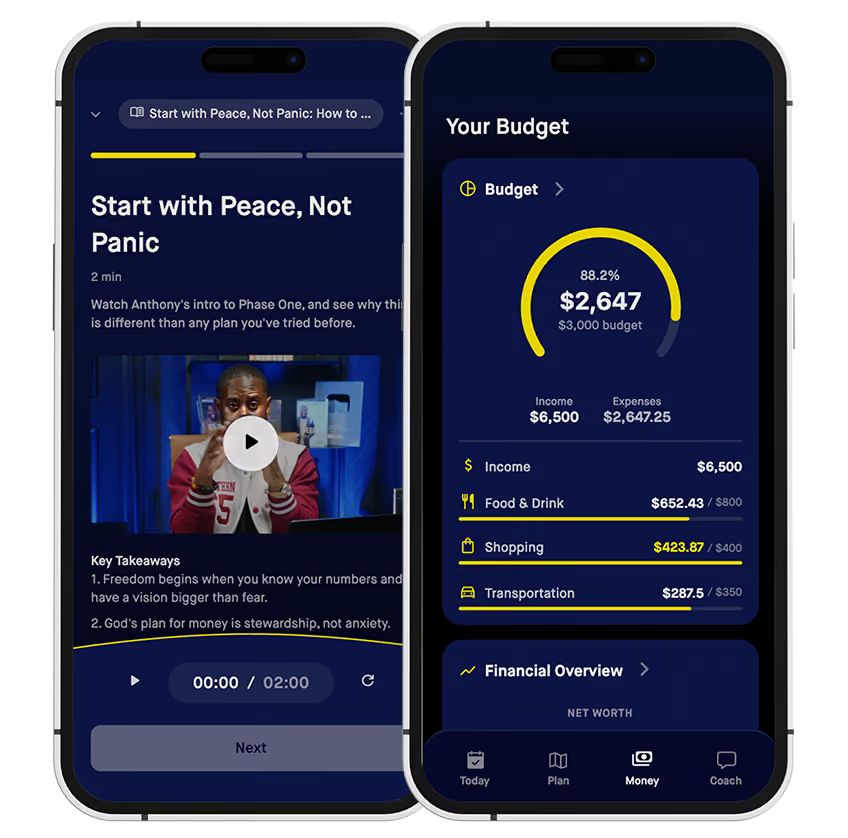
Find $516 you didn't know you had
Writing the budget is the easy part. In the Black tracks your spending against the plan and puts a money assignment in your pocket every morning. The average person finds $516 in their first 30 days.
Get startedIn the Black is my app.
Recommended for this topic
Find $516 you didn't know you had
Writing the budget is the easy part. In the Black tracks your spending against the plan and puts a money assignment in your pocket every morning. The average person finds $516 in their first 30 days.
Get startedIn the Black is my app.
more articles
Money Tips
October 16, 2026
The Monthly Paycheck Trap (And How to Beat It Every Single Time)
Money Tips
October 16, 2026
The Right Way to Use Multiple Bank Accounts Without Losing Track of Your Money
Money Tips
October 15, 2026
The Weekly Habit That Keeps Your Budget From Falling Apart
Money Tips
October 15, 2026
When Your Budget Falls Apart Mid-Month, Do This
Money Tips
October 14, 2026
Stop Buying Dad Stuff. Give Him This Instead.
Money Tips
October 14, 2026
Still Living Paycheck to Paycheck? Here's the Budget App Difference Nobody Explains
Where this fits
The Escape Plan
Five phases, one plan. Find where you are, then take the next step.
In The Black
A coach in your pocket
Daily money assignments and real accountability, built around the Escape Plan. Know your next step every single day.
$59.99 a quarter or $179.99 a year
Get In The Black →Get the plan in your inbox.
Weekly money tips, real stories, and my free Wealth Checklist.
Free. Unsubscribe anytime.