
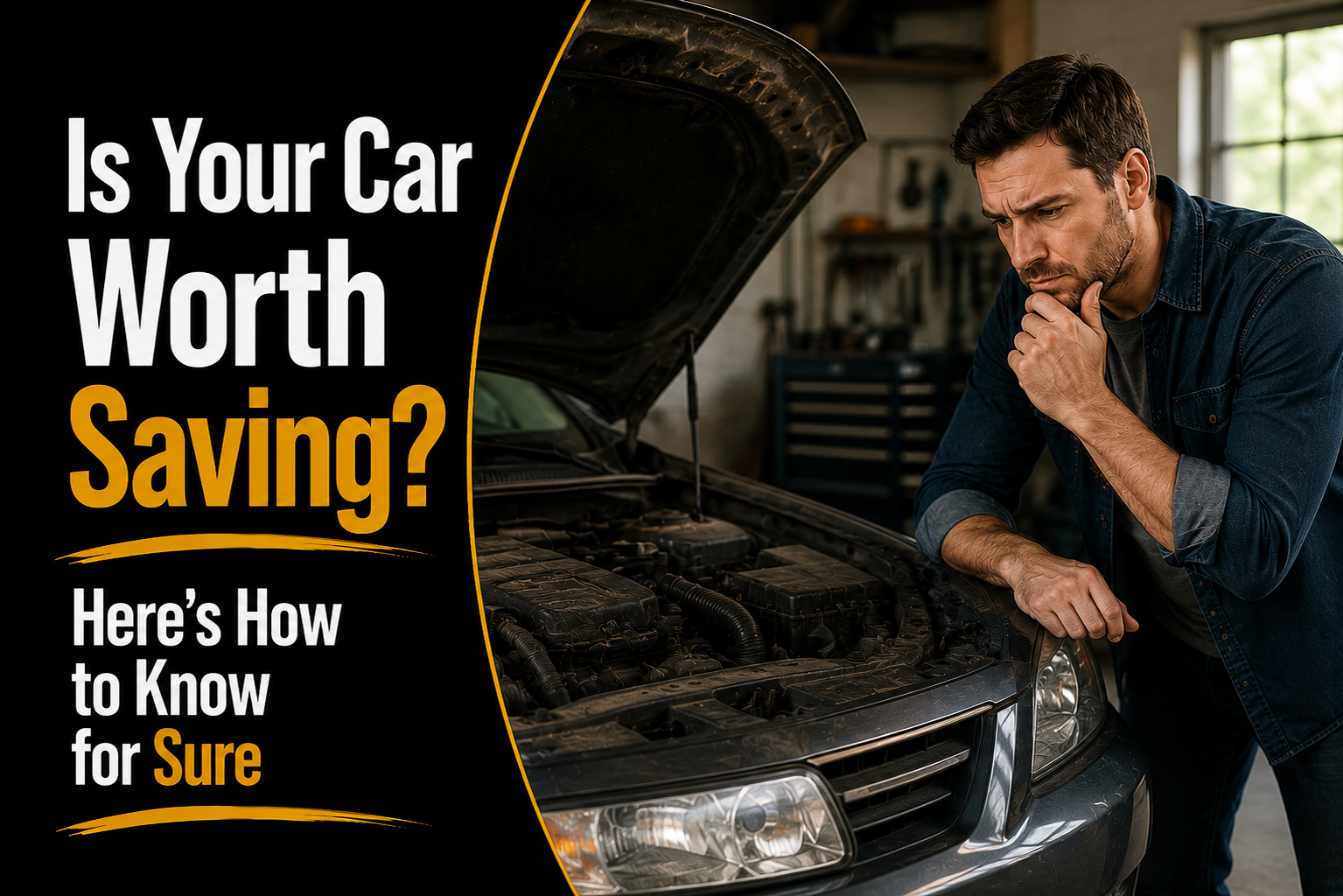
Is Your Car Worth Saving? Here's How to Know for Sure

3 min read
Let me be straight with you, family.
That repair bill sitting on your kitchen table right now? It's stressing you out. And the thought of walking into a dealership and driving off in something new feels like relief.
But here's what I need you to understand before you make that move: one emotional decision at a car dealership can cost you $40,000 or more. And most people don't realize it until they're already locked into a payment they can't afford.
I've talked to thousands of families across this country. And one of the most common financial mistakes I see is people trading in a fixable car for a brand new car payment — because they were frustrated, not because it was the right financial move.
So before you do anything, let's think this through together. Here's exactly how to decide whether your car is worth saving — or whether it's time to let it go.
The Two Numbers You Need First
Everything starts here. Before you make any decision, you need two numbers in front of you.
What is your car worth right now?
Go to Kelley Blue Book or Edmunds. Enter your car's year, make, model, mileage, and honest condition. Get a real number — not what you paid for it, not what you wish it was worth. What it is worth today.
What will the repair actually cost?
Call at least two or three shops and get quotes. Don't accept the first number you hear. Labor costs vary significantly between shops, and an independent mechanic will almost always beat a dealership on price.
Once you have both numbers, here is the rule most financial experts agree on:
If the repair costs more than the car is worth, it is usually time to move on.
But that is not always the final answer. There are five key factors that should shape your decision — and I am going to walk you through every one of them.
Factor One: The Real Value of Your Car
Knowing your car's value is not just about the number today. You also need to know what the car will be worth after the repair is made.
Here is why that matters. If your car is worth $8,000 and a $3,500 repair keeps it running strong and holds that value — that is a smart financial move. But if your car is worth $3,000 and needs a $4,000 repair that barely moves the needle on its value — the math is working against you.
Also consider this: if you currently owe more on your car than it is worth, you are in what is called an upside-down situation. In that case, the priority is getting out from under that loan — not sinking more money into repairs on top of it.
Know your numbers. The numbers will tell you the truth even when your emotions won't.
Factor Two: What the Repair Will Actually Get You
Not every repair is the same. A $2,000 fix that extends the life of your car by three or four years is a completely different situation than a $2,000 fix that buys you three more months.
When you get your estimate, ask the mechanic one direct question: "How long will this repair realistically last me?"
That answer changes everything.
Also think about the type of car you drive. Luxury vehicles and specialty foreign brands come with premium parts and premium labor costs. A repair that runs $700 on a Toyota might cost $2,500 on a Land Rover. Factor that into your decision before you commit.
The goal is not just to fix the problem in front of you. The goal is to understand what you are actually buying with that repair money — and whether it is worth it.
Factor Three: How Often Is It Breaking Down?
This is the question people avoid because the honest answer is uncomfortable.
There is a real difference between normal maintenance and a car that is quietly draining your finances every few months. Oil changes, tire rotations, brake pads — that is just part of owning a vehicle. That is not a crisis.
But if you are dropping $400 to $700 every couple of months on a car that is only worth $5,000 — that car is eating your budget alive. And it will keep eating it.
Here is what I want you to do right now. Add up every dollar you have spent on repairs over the last 12 months. Not routine maintenance — actual repairs. If that number is getting close to what a reliable used car would cost you, your car is sending you a message. Do not ignore it.
Some vehicles are built to go the distance. Brands like Toyota, Honda, and Lexus are known to run well past 200,000 miles with consistent care. If you have one of those, it may absolutely be worth holding on to. But if your car has become a money pit with no end in sight — it is time to have an honest conversation about moving on.
Factor Four: Is It Actually a Safety Issue?
Let me be clear: safety is never negotiable.
Failing brakes, worn-out tires, steering problems, a cracked windshield — these are not things you delay. These are issues that put your life and the lives of others at risk. You fix them. Full stop.
But I also want you to be honest with yourself here. Is your car genuinely unsafe — or are you using safety as a reason to justify an upgrade you have been wanting for a while?
A trustworthy mechanic will give you a straight answer. Ask them directly: "Is this car safe to drive as it sits right now?" If the answer is no, you fix it or you replace it. If the answer is yes, then safety is not the deciding factor — your budget is.
Factor Five: What Is the Car Market Doing Right Now?
This is the factor most people completely overlook — and it is one of the most important.
Replacing your car is not free. And right now, the car market is expensive.
The average new car payment in America is over $700 a month. That is before insurance, before gas, before maintenance. So when you are staring at a $900 repair bill and thinking about trading in, I need you to do this math with me:
$700 a month multiplied by 60 months equals $42,000.
That repair bill is looking a lot more reasonable now, isn't it?
I am not saying never replace your car. I am saying do not let frustration make a $42,000 decision for you. Slow down. Run the numbers. Make a plan — not an emotional move.
If You Decide to Repair Your Car
Get multiple quotes before you commit.
Never accept the first price you are given. Call two or three shops, ask about any current discounts, and find a mechanic your community actually trusts. Word of mouth matters here — ask people you know where they take their car.
Handle what you can yourself.
You do not need a mechanic for everything. Replacing a battery, swapping an air filter, installing new wiper blades — these are things you can learn from a YouTube video in under 15 minutes. Every repair you handle yourself is money that stays in your pocket.
Know what can wait.
Ask your mechanic to prioritize the list. Safety items come first — always. But the broken door handle or the air conditioning that has been out since last summer? That can wait while you save up. Do not let a shop pressure you into fixing everything at once when your budget cannot support it.
If You Decide to Replace Your Car
Buy Used — Not New
I will say this plainly: do not buy a brand new car.
New cars lose roughly 20% of their value the moment you drive off the lot. In the first five years, that number can climb to 60%. You are paying a significant premium just to be the first person to sit in that seat — and that premium does not build your wealth. It destroys it.
A well-maintained used car from a reliable brand can serve you well for years without the new car price tag. Do your research. Check the vehicle history report. Get a pre-purchase inspection from a mechanic you trust before you sign anything.
Pay Cash
I know this sounds out of reach if you have never done it. But stay with me.
When you finance a car, you are not just paying for the car. You are paying for the car plus thousands of dollars in interest. On a $25,000 vehicle at today's average interest rate, you could end up paying $33,000 or more by the time it is all said and done.
That extra money belongs to your future — not to a lender.
Here is the move: buy the most reliable car you can afford with the cash you have right now. Then take what would have been your monthly car payment and save it every single month. In less than a year, you will have enough to upgrade — and you will own it outright.
No payments. No interest. No lender with a claim on your income.
That is what financial freedom actually looks like.
Save With a Real Plan
Let's make this practical. Say you have $5,000 in cash today. You buy a solid used car. Then you commit to saving $600 a month. In 10 months, you have saved $6,000. Add in what you get from selling your current car — let's say $3,500 — and now you are shopping with close to $10,000 cash.
That is a completely different conversation at the dealership. You walk in with leverage. You walk in with options. And you walk out without owing anyone a single dollar.
That is how real wealth is built — not with payments, but with patience and a plan.
Whatever You Decide, You Need a Budget
Here is the truth that ties all of this together.
Whether you repair or replace, you need a budget. Car expenses do not stop after the purchase. Gas, insurance, registration, maintenance — it all adds up. And without a budget, every one of those expenses will feel like a surprise attack on your bank account.
A budget is not a restriction. It is a plan. It is how you stop reacting to your money and start directing it toward the life you actually want.
If you do not have a budget right now, that is your first step. Not the car decision — the budget. Because without one, you will keep making the same stressful financial decisions over and over again and wonder why nothing ever changes.
Conclusion
Family, here is what it all comes down to.
Know your car's value and the true cost of the repair. Pay attention to how often it is breaking down. Never compromise on safety. Do not let frustration push you into a car payment you cannot afford. And if you do replace it — buy used, pay cash, and build a plan to get the car you actually want.
You are not stuck. You are one smart decision away from getting ahead.
Here is your move right now: Go to Kelley Blue Book today, look up your car's current value, and get a repair estimate this week. Once you have both numbers in front of you, the decision becomes a lot clearer.
Now I want to hear from you — are you leaning toward fixing it or replacing it? Drop it in the comments below. Let's work through it together.
Keep building,

Lorem ipsum dolor sit amet, consectetur adipiscing elit. Suspendisse varius enim in eros elementum tristique. Duis cursus, mi quis viverra ornare, eros dolor interdum nulla, ut commodo diam libero vitae erat. Aenean faucibus nibh et justo cursus id rutrum lorem imperdiet. Nunc ut sem vitae risus tristique posuere.
like what you’ve just read?
Make sure to share it with your tribe!
.webp)
like what you’ve just read?
Make sure to share it with your tribe!


