
What Is a Roth Conversion? The Move That Could Save Your Family Thousands in Taxes

3 min read
Key Takeaways
- A Roth conversion means moving money from a traditional retirement account into a Roth IRA — and it could be one of the smartest financial moves you ever make.
- You'll pay taxes now, but your money grows tax-free after that. No more surprises in retirement.
- This isn't a one-size-fits-all move. Timing matters. Let's break it all down.
Listen, family — most people don't find out about the Roth conversion until it's almost too late to take full advantage of it. And that's not an accident. Nobody sat us down and explained that there's a way to legally protect your retirement money from taxes forever.
But today, that changes.
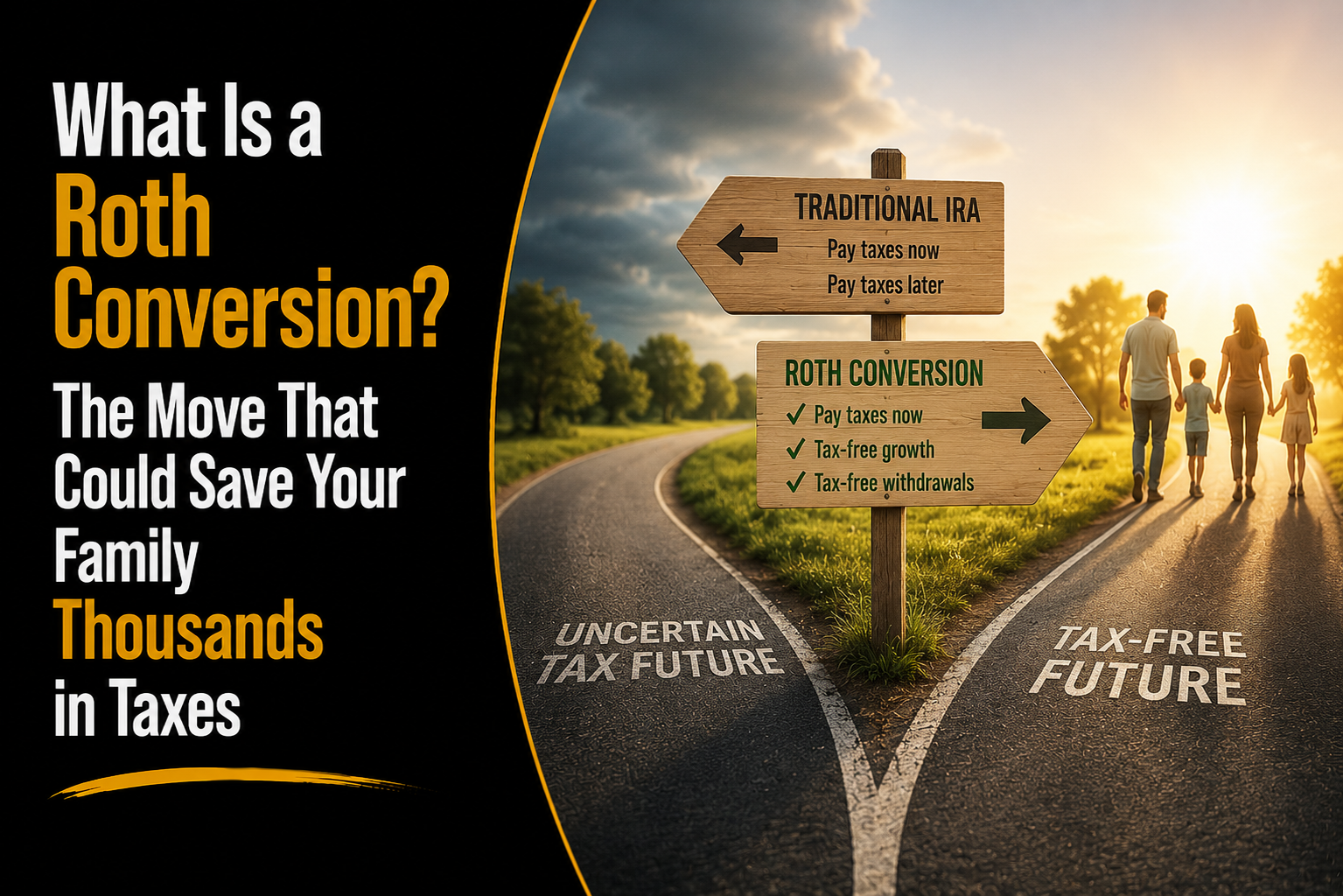
A Roth conversion is simply the process of moving money from a traditional retirement account — like a traditional 401(k) or IRA — into a Roth IRA. And if you do it right, it could save your family tens of thousands of dollars in taxes over your lifetime.
That's generational wealth we're talking about. Money that stays in your family — not Uncle Sam's pocket.
Let's break this down, cookie jar on the bottom shelf, so you can decide if a Roth conversion is the right move for you.
How Does a Roth Conversion Actually Work?
Here's the simple version:
- You move money from a traditional retirement account into a Roth IRA.
- That money gets added to your taxable income for the year — so yes, you'll owe taxes on it.
- But from that point forward? Your money grows completely tax-free. And when you pull it out in retirement, you owe nothing.
The whole idea is this: pay a little now so you don't pay a lot later.
There's no penalty for converting. The only thing you're on the hook for is the tax bill — and we're going to talk about how to handle that the right way.
Roth vs. Traditional — What's the Real Difference?
Real talk — most people don't understand the difference between these two accounts, and that confusion is costing them.
Here's what you need to know:
Traditional IRA or 401(k):
- You put money in before taxes (feels good now)
- Your money grows, but the IRS is waiting for you at the finish line
- When you withdraw in retirement, you pay taxes on every dollar
- The government forces you to start pulling money out at age 73 — whether you're ready or not
Roth IRA:
- You put money in after taxes (you pay now)
- Your money grows completely tax-free
- Withdrawals in retirement? Tax-free
- No forced withdrawals — ever. You're in control
The Roth conversion is how you move from the first column to the second. You're choosing freedom over convenience.
What Are the Real Benefits of a Roth Conversion?
Your Money Grows Without the IRS Watching
Once your money is inside a Roth IRA, every dollar of growth is shielded from taxes. We're talking decades of compound interest that Uncle Sam cannot touch. That's not just smart — that's legacy-building.
No Tax Bill Waiting for You in Retirement
With a traditional account, you've been deferring taxes your whole career. That means when you finally retire and start pulling money out, the IRS shows up with their hand out.
A Roth conversion flips that script. You settle up now, on your terms, and enjoy tax-free income when you actually need it most.
You Stay in Control of Your Money
Required Minimum Distributions — RMDs — are the government's way of forcing you to withdraw from traditional accounts starting at age 73. You don't get a choice.
Roth IRAs don't have RMDs. That means you decide when to take your money, how much to take, and what to do with it. That's the kind of freedom we're building toward, family.
When Does a Roth Conversion Make Sense?
A Roth conversion is a powerful move — but it's not for everybody in every season. Here's when it makes the most sense:
You're More Than Five Years From Retirement
The IRS requires the converted money to stay in the Roth account for at least five years. Pull it out before that and you could face penalties on top of taxes. The longer your money has to grow tax-free after the conversion, the more powerful this move becomes.
You Can Pay the Taxes With Cash — Not Retirement Funds
This is non-negotiable. Never use money from your retirement account to pay the tax bill on a Roth conversion. That defeats the entire purpose and costs you more in the long run.
Pay the taxes with cash you have set aside. If you can't do that right now, wait until you can. You can also convert smaller amounts over several years to keep the tax bill manageable.
You're Debt-Free or Close to It
If you're still buried in debt, a Roth conversion probably isn't your next move. Get the debt handled first. But if you're debt-free — including your mortgage — and you've got a fully funded emergency fund, you're in a strong position to start thinking about this.
The Rules You Need to Know
Direct Transfer vs. Indirect Transfer
There are two ways to move money into a Roth IRA:
Direct Transfer (the right way): Your financial institution moves the money directly from your traditional account to your Roth. Simple. Clean. No risk.
Indirect Transfer (the risky way): You receive a check and have 60 days to deposit it into your Roth account. Miss that window and you'll face penalties on top of the taxes you already owe. Don't do it this way.
Keep it simple. Always go direct.
No Income Limits. No Conversion Limits.
Here's some good news — anyone can do a Roth conversion regardless of income. There's no cap on how much you can convert in a year either. You can convert everything at once or spread it out over several years. The choice is yours.
How to Actually Do a Roth Conversion — 3 Steps
Step 1: Run the Numbers First
Before you do anything, understand what this conversion is going to cost you in taxes. The amount you convert gets added to your taxable income for the year — which could push you into a higher tax bracket if you're not careful.
This is where talking to a tax professional or financial advisor pays off. Know your numbers before you move.
Step 2: Contact Your Financial Institution
Reach out to whoever holds your traditional retirement account and tell them you want to do a Roth conversion. They'll walk you through the paperwork. Make sure you confirm the transfer was completed and get documentation.
Step 3: Pay Your Taxes With Cash
When tax season comes, you'll owe taxes on the amount you converted. Pay it with cash — not retirement funds, not a loan, not a credit card. Set that money aside the moment you decide to convert so there are no surprises come April.
Is a Roth Conversion Right for You?
Let me give you a real example, family.
Say you're 35 years old and you've got money sitting in a traditional retirement account. You decide to convert it to a Roth IRA. Yes, you'll owe taxes on that amount this year — that's the trade-off.
But here's what happens next: that money grows completely tax-free for the next 25 to 30 years. When you retire and start pulling it out, you owe nothing. Not a dime to the IRS.
Now compare that to leaving it in a traditional account. Every dollar you withdraw in retirement gets taxed. Over 20 to 25 years of retirement withdrawals, that tax bill can add up to hundreds of thousands of dollars.
The question isn't whether you can afford to do a Roth conversion. The question is whether you can afford not to.
Frequently Asked Questions
When is a Roth conversion NOT worth it?
- If you're already in a high tax bracket and converting would push you even higher
- If you don't have cash to cover the tax bill
- If you're within five years of retirement and won't have time to benefit from the tax-free growth
How much should I convert at one time?
You don't have to convert everything at once. In fact, spreading it out over several years can help you stay in a lower tax bracket and reduce your overall tax bill. Work with a financial advisor to find the right amount for your situation.
What's a backdoor Roth IRA?
If your income is too high to contribute directly to a Roth IRA, a backdoor Roth IRA is a legal strategy that lets you get around those limits by converting a traditional IRA into a Roth in stages. It's completely legal — and worth knowing about if you're a higher earner.
Can I convert a 401(k) at work to a Roth 401(k)?
Yes — this is called an in-plan Roth rollover. The money stays inside your employer's plan but shifts from traditional to Roth. Only do this if you can afford to pay the taxes this year.
Conclusion
Look, family — a Roth conversion isn't just a tax strategy. It's a wealth-building decision that could protect your family's financial future for generations.
Here's what we covered:
- A Roth conversion moves money from a traditional account to a Roth IRA
- You pay taxes now so your money grows tax-free forever
- It makes the most sense when you're debt-free, have cash to cover taxes, and are more than five years from retirement
- Always use a direct transfer and never pay the tax bill with retirement funds
Here's your move: Talk to a financial advisor or tax professional about whether a Roth conversion fits your situation. Don't guess your way through this one. Get the right guidance and make a decision based on your actual numbers.
You've worked too hard for your money to hand it over to the IRS in retirement. Let's keep it in the family.
Keep building,

Lorem ipsum dolor sit amet, consectetur adipiscing elit. Suspendisse varius enim in eros elementum tristique. Duis cursus, mi quis viverra ornare, eros dolor interdum nulla, ut commodo diam libero vitae erat. Aenean faucibus nibh et justo cursus id rutrum lorem imperdiet. Nunc ut sem vitae risus tristique posuere.
like what you’ve just read?
Make sure to share it with your tribe!
.webp)
like what you’ve just read?
Make sure to share it with your tribe!


