
What Is PSLF — And Is It Actually Worth It?

3 min read
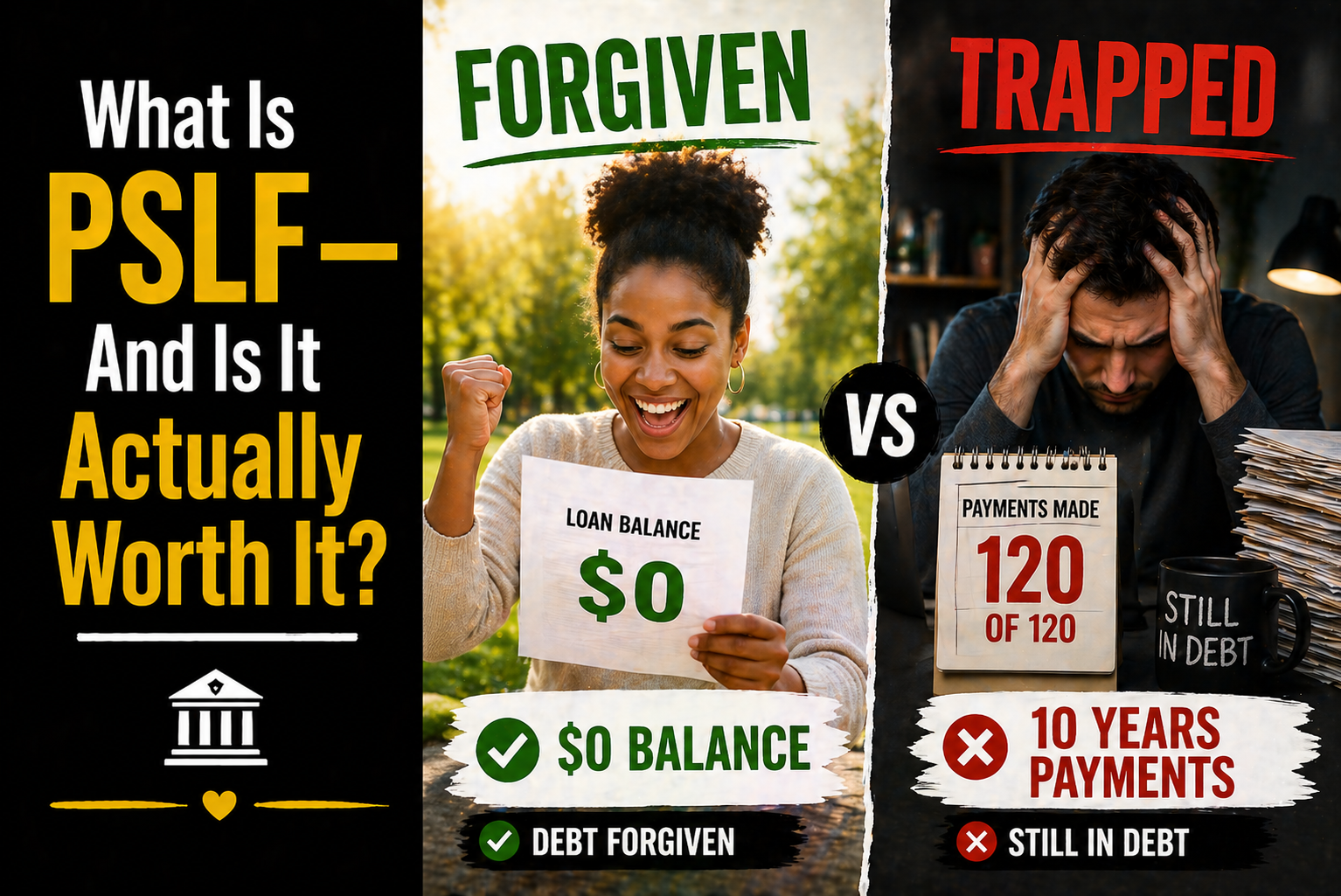
A Real Talk Guide for Public Servants Who Want Out of Student Loan Debt
If you became a teacher, a nurse, a firefighter, or a social worker because you felt called to serve — first, let me say this: thank you. That work matters. Your community needs you.
But here's the hard truth nobody told you when you signed up: the government created a program called Public Service Loan Forgiveness that was supposed to reward your sacrifice. And for most people? It has been one of the biggest financial disappointments in modern history.
Today, I'm breaking down exactly what PSLF is, whether you qualify, and — real talk — whether it's even worth your time to pursue it.
Let's get to work.
What Is Public Service Loan Forgiveness (PSLF)?
The Public Service Loan Forgiveness program launched in 2007 with a simple promise: work in public service for 10 years, make your payments, and the government will forgive whatever federal student loan balance you have left.
Sounds like a win, right?
Here's how it actually works. To qualify, you need to check four boxes — and every single one of them has fine print.
The 4 Requirements You Must Meet
1. You Must Work for a Qualifying Employer
Not every public service job counts. Your employer must be one of the following:
- A federal, state, local, or tribal government organization
- A 501(c)(3) nonprofit organization
- A qualifying not-for-profit that provides specific public services
- AmeriCorps or Peace Corps (full-time only)
Private companies — even ones that feel like public service — do not qualify. You must certify your employment at least once a year using the official PSLF Employment Certification Form.
2. You Must Make 120 Qualifying Payments
That's 10 years of payments. And not just any payments — they must meet all of these conditions:
- Made after October 1, 2007
- Paid in full, on time (within 15 days of your due date)
- Made while working full time for a qualifying employer
- Made under a qualifying repayment plan
Miss one condition? That payment doesn't count. You start over on that one.
3. You Must Be on a Qualifying Repayment Plan
This is where most people get tripped up, family.
The most common qualifying plans are income-driven repayment (IDR) plans — programs that lower your monthly payment based on what you earn. The reason the government pushes IDR plans for PSLF is simple: lower payments mean you'll still have a balance left to forgive after 10 years.
If you just paid the standard amount on your loans, you'd likely have them paid off before you ever hit 120 payments. No balance left = nothing to forgive.
4. You Must Have Federal Direct Loans
Only these loan types qualify:
- Federal Direct Subsidized Loans (Stafford Loans)
- Federal Direct Unsubsidized Loans (Stafford Loans)
- Federal Direct PLUS Loans
- Federal Direct Consolidation Loans
Private loans, Perkins Loans, and Federal Family Education Loans (FFEL) do not qualify. You can consolidate some of these into a Direct Loan — but be warned: consolidation resets your payment clock to zero. All 120 payments you've been counting? Gone.
What About Temporary Expanded PSLF (TEPSLF)?
If you applied for PSLF and got denied, there's a second-chance program called Temporary Expanded Public Service Loan Forgiveness (TEPSLF).
To qualify, you must:
- Have been denied PSLF because of a non-qualifying repayment plan
- Have worked full time for a qualifying employer for 10 years
- Have met TEPSLF requirements 12 months before applying
- Have made 120 qualifying payments
- Have made a final payment at least as large as what your IDR payment would have been
TEPSLF also expands the list of qualifying repayment plans to include Graduated, Extended, Consolidation Standard, and Consolidation Graduated plans.
The Success Rate Will Shock You
Family, I need you to sit with these numbers for a second.
When the first wave of borrowers became eligible for PSLF in 2017 — 10 years after the program launched — over 1 million people had requested employment certification. Nearly 900,000 were certified as eligible.
Seven months later? Only 55 people had actually received forgiveness.
Fast forward to today: of the 2 million people who have applied for PSLF and met employment requirements since 2020, fewer than 1% have received forgiveness under the original program structure.
Let that sink in. Less than 1%.
This isn't a wealth-building strategy. This is a waiting game with terrible odds.
So Is PSLF Worth It?
Real talk? For most people, no.
Here's why:
- The rules are complicated and constantly changing
- One wrong repayment plan or one missed certification can disqualify years of payments
- It keeps you in debt for a minimum of 10 years
- It can trap you in a job or career path you may have outgrown
- And after all of that — you might still get denied
The one exception: If you are already 7, 8, or 9 years into the program, have been doing everything right, and you're close to the finish line — go ahead and see it through. At that point, it makes sense to finish what you started.
But if you're just starting out and thinking PSLF is your exit strategy? I want you to consider a different path.
What I Recommend Instead
I know 10 years feels like a long time to wait for relief. But here's what I've seen work — over and over again — for real people in real situations:
Get on a written budget. Every dollar needs a name. If you don't know where your money is going, you can't direct it toward freedom.
Build a $1,000 starter emergency fund first. This keeps you from going deeper into debt when life happens.
Attack your student loans with the debt snowball method. List your loans smallest to largest. Pay minimums on everything except the smallest — then throw every extra dollar at that one until it's gone. Then roll that payment to the next. Repeat until you're free.
Increase your income. Pick up extra hours, a side hustle, or a skill that pays more. Every extra dollar accelerates your timeline.
Stay the course. Debt freedom doesn't happen overnight. But it does happen — and it happens faster than 10 years when you're intentional.
Conclusion
Look, family — I'm not here to crush your hope. I'm here to protect your future.
PSLF was designed with good intentions, but the execution has failed millions of hardworking Americans. Teachers, nurses, social workers — people who gave their lives to serve others — have been left holding the bag after a decade of sacrifice.
You deserve better than that.
Here's your move: Stop waiting on the government to fix your financial situation. Get on a budget, start the debt snowball, and take control of your own story. You don't need a forgiveness program to get free — you need a plan.
And if you're not sure where to start, that's what I'm here for.
Which part of this hit home for you? Are you currently in the PSLF program, or have you been thinking about it? Drop your situation in the comments — let's figure this out together.
Keep building,

Lorem ipsum dolor sit amet, consectetur adipiscing elit. Suspendisse varius enim in eros elementum tristique. Duis cursus, mi quis viverra ornare, eros dolor interdum nulla, ut commodo diam libero vitae erat. Aenean faucibus nibh et justo cursus id rutrum lorem imperdiet. Nunc ut sem vitae risus tristique posuere.
like what you’ve just read?
Make sure to share it with your tribe!
.webp)
like what you’ve just read?
Make sure to share it with your tribe!


