
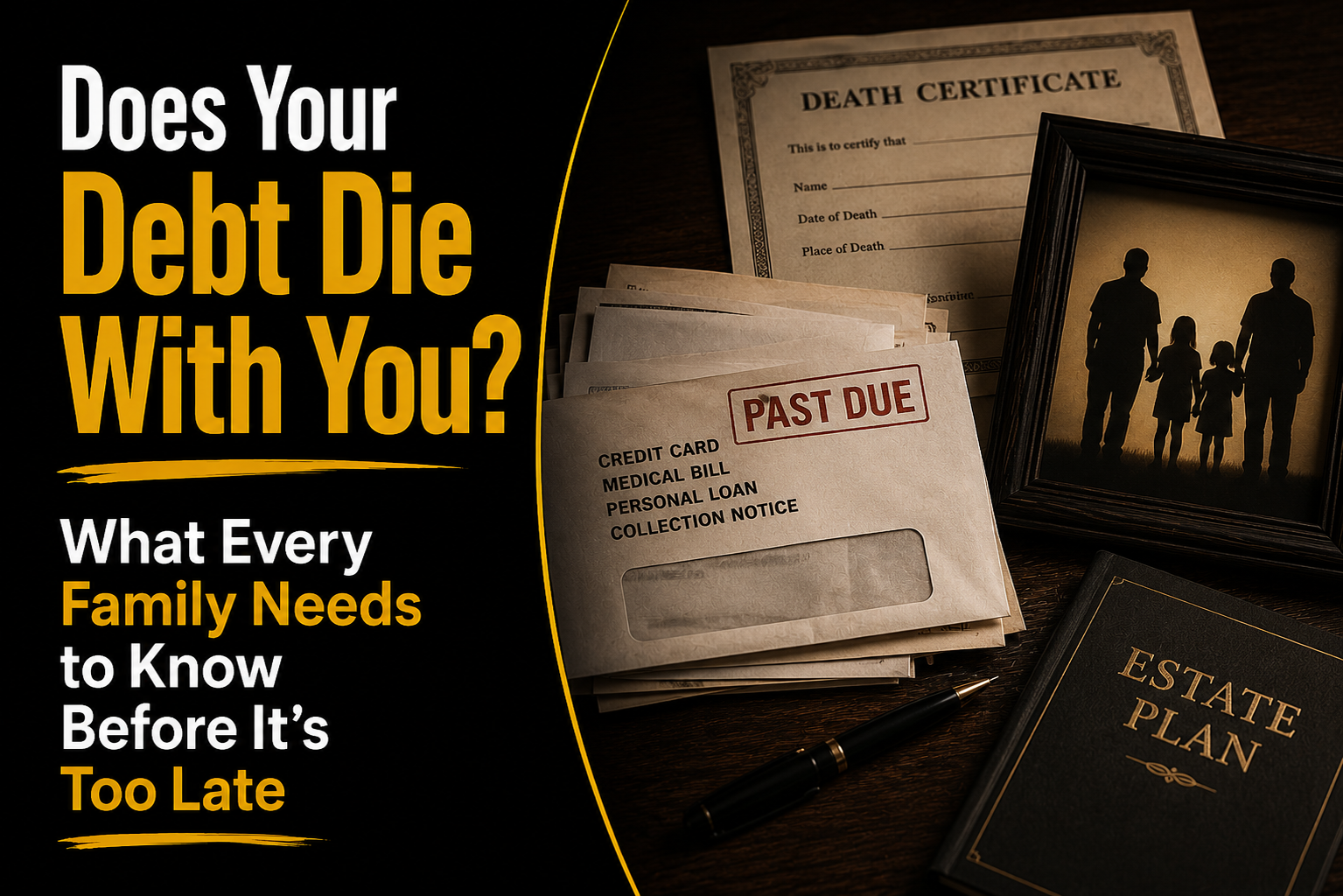
Does Your Debt Die With You? What Every Family Needs to Know Before It's Too Late

3 min read
Let me ask you something nobody talks about at the dinner table.
When you die — and I say when, not if, because none of us are getting out of here alive — what happens to all that debt you've been carrying?
Does it disappear? Does your family have to pay it? Can creditors come after your kids?
Real talk: most people have no idea. And that lack of knowledge is costing Black families generational wealth they worked their whole lives to build.
Today, I'm breaking it all down. No fluff. No confusion. Just the truth you need to protect the people you love.
Let's get to work.
Your Debt Doesn't Go to the Grave With You
Here's the first thing you need to understand, family.
When you pass away, your debt doesn't just vanish. It becomes the responsibility of your estate — which is everything you owned at the time of your death. Your bank accounts, your car, your home, your savings, your personal belongings. All of it.
Before your family receives a single dollar of inheritance, your creditors get paid first.
This legal process is called probate. An executor — usually someone you named in your will — steps in to manage your finances, settle your debts, and distribute whatever is left to your heirs.
Here's what that looks like in real life.
Say you passed away with $180,000 in assets but $90,000 in debt. Your executor uses those assets to pay off the creditors first. Your family doesn't receive $180,000. They receive what's left after the debt is settled — minus fees and legal costs.
The more debt you carry into death, the less your family inherits.
That's not just a financial fact. That's a legacy issue.
Can Your Family Be Forced to Pay Your Debt?
This is the question that keeps people up at night — and for good reason.
The short answer is yes. There are specific situations where your loved ones become legally responsible for debt that was yours. Here's when that happens.
When There's a Joint Account or Cosigner
If anyone cosigned a loan with you — a car, a personal loan, a credit card — they are now fully responsible for that debt when you're gone.
This is why I say it over and over again: do not cosign for anyone. And do not let anyone cosign for you.
It feels like love in the moment. It can feel like a financial nightmare later.
The same applies to joint credit card accounts. If your name and someone else's name are both on that account, they inherit the balance. Authorized users are different — they are not legally responsible. But joint account holders are.
When There's a Mortgage
If you leave behind a home that isn't paid off, whoever inherits that home also inherits the mortgage payments.
They have options — keep making payments, refinance, or sell the home. But the debt doesn't disappear just because you did.
One important warning here: if you took out a home equity loan on top of your mortgage, your heirs could be forced to repay that loan immediately. That often means selling the house under pressure.
This is one of the many reasons borrowing against your home beyond the original mortgage is a dangerous move.
When You Live in a Community Property State
If you are married and live in one of these states — Arizona, California, Idaho, Louisiana, Nevada, New Mexico, Texas, Washington, or Wisconsin — your surviving spouse may be legally responsible for any debt you took on during the marriage.
Even debt they didn't know about.
Even debt they never agreed to.
That's not just a financial issue. That's a marriage issue. Which is exactly why couples need to be completely open and honest about money before they say "I do" — and every day after.
When Filial Responsibility Laws Apply
Nearly 30 states have laws that can require adult children to cover a deceased parent's long-term care costs — nursing home bills, hospital expenses, and more.
It's rarely enforced. But it's real. And it's one more reason to get your financial house in order now, not later.
What Happens to Each Type of Debt
Not all debt works the same way after death. Here's what you need to know about the most common types.
Credit Card Debt
If the account is in your name only, creditors make a claim against your estate. If there isn't enough money to cover it, the debt typically goes unpaid and the creditor takes the loss.
But if there's a joint account holder on that card, they are fully responsible for the remaining balance.
Student Loans
Here's one of the few wins in the federal loan system — federal student loans are forgiven at death. That includes Parent PLUS Loans, which are forgiven whether the student or the parent passes away.
Private student loans are a different story. They are not automatically forgiven. They become a claim against your estate, and if there isn't enough to cover them, they typically go unpaid.
Car Loans
If your estate can cover the remaining balance, the loan gets paid off. If not, the lender can repossess the vehicle.
Whoever inherits the car can choose to keep making payments or sell it to settle the debt. But they need to act quickly — lenders don't wait long.
Medical Bills
Medical debt is often given priority in the probate process, meaning it gets paid before other unsecured debts.
There's also something most people don't know: if you received Medicaid after age 55, the state may place a claim on your estate — including your home — to recover those costs. This is called Medicaid estate recovery, and it catches families completely off guard.
If this applies to your situation, talk to an estate attorney sooner rather than later.
What Creditors Cannot Touch
Now here's some good news, family.
There are assets that creditors cannot go after, no matter how much debt you leave behind.
Life insurance benefits paid directly to a named beneficiary are protected. Retirement accounts like 401(k)s and IRAs with a named beneficiary are protected. Assets held inside a living trust are also protected.
This is why having the right financial structure isn't just smart — it's armor for the people you love.
But here's the catch: if you don't have a named beneficiary on those accounts, they may fall into your estate and become fair game for creditors. Keep your beneficiary designations updated. Every year. No exceptions.
Debt Collectors Don't Stop at Death
I need to warn you about this, because it happens more than people realize.
When someone passes away, debt collectors don't pause out of respect. They call. They send letters. And they will contact grieving family members trying to pressure them into paying debts they may have no legal obligation to pay.
Know your rights.
Under the Fair Debt Collection Practices Act, collectors can only legally pursue the executor of the estate, a surviving spouse in certain states, or a cosigner. They cannot legally demand payment from other family members who have no legal tie to the debt.
If you receive a call and you know you have no legal obligation — you have every right to tell them to stop contacting you. Put it in writing. Send it certified mail.
Don't let anyone bully your family during one of the hardest seasons of their lives.
Three Steps to Protect Your Family Right Now
This isn't about fear, family. It's about responsibility.
Scripture reminds us that a good person leaves an inheritance for their children's children. That starts with the decisions you make today — not someday, not when you feel ready. Today.
Here are three steps you can take right now.
Step 1: Get a Will
If you don't have a will, your state decides what happens to your assets. That is not a plan. That is a gamble.
A will gives you control. It makes the probate process less painful for your family. It ensures your wishes are honored. And it protects the people you love from unnecessary legal battles during an already difficult time.
If you don't have a will, make getting one your top priority this month.
Step 2: Get Term Life Insurance
Term life insurance is the most affordable, most effective way to make sure your family is financially protected when you're gone.
Life insurance benefits go directly to your named beneficiaries. Creditors cannot touch them. Your family receives that money regardless of how much debt you left behind.
If people depend on your income, this is not optional. It is a responsibility.
Term life insurance is the only type I recommend. It gives you strong coverage at a price that makes sense — without the unnecessary complexity of whole life or universal life policies.
Step 3: Attack Your Debt Now
This is the real answer.
The best way to make sure your debt doesn't become your family's burden is to eliminate it while you're alive.
Start with the debt snowball method. List every debt you have from smallest balance to largest. Attack the smallest one first with everything you've got while making minimum payments on the rest. When that one is gone, roll that payment into the next one.
One win at a time. One balance at a time.
Your children's children's children deserve a foundation — not a pile of bills.
Conclusion
Family, this conversation isn't comfortable. But it is necessary.
Your debt doesn't disappear when you die. It becomes a claim against everything you worked for. And without the right plan in place, it can rob your family of the inheritance you intended to leave them.
But here's what I need you to hold onto: it is not too late to change this.
Get a will. Get term life insurance. And if you're carrying debt right now, make a decision today to start attacking it. Not next month. Not after the holidays. Today.
You have the power to leave your family freedom instead of financial stress. That is a legacy worth building.
Here's your move: Write down every debt you owe right now — the balance and the minimum payment. That list is your starting point. You cannot fight what you cannot see.
Now I want to hear from you — did you know your debt could affect your family after you're gone? What is one step you are going to take this week to protect them? Drop it in the comments below. Let's build together.
Keep building,

Lorem ipsum dolor sit amet, consectetur adipiscing elit. Suspendisse varius enim in eros elementum tristique. Duis cursus, mi quis viverra ornare, eros dolor interdum nulla, ut commodo diam libero vitae erat. Aenean faucibus nibh et justo cursus id rutrum lorem imperdiet. Nunc ut sem vitae risus tristique posuere.
like what you’ve just read?
Make sure to share it with your tribe!
.webp)
like what you’ve just read?
Make sure to share it with your tribe!


