

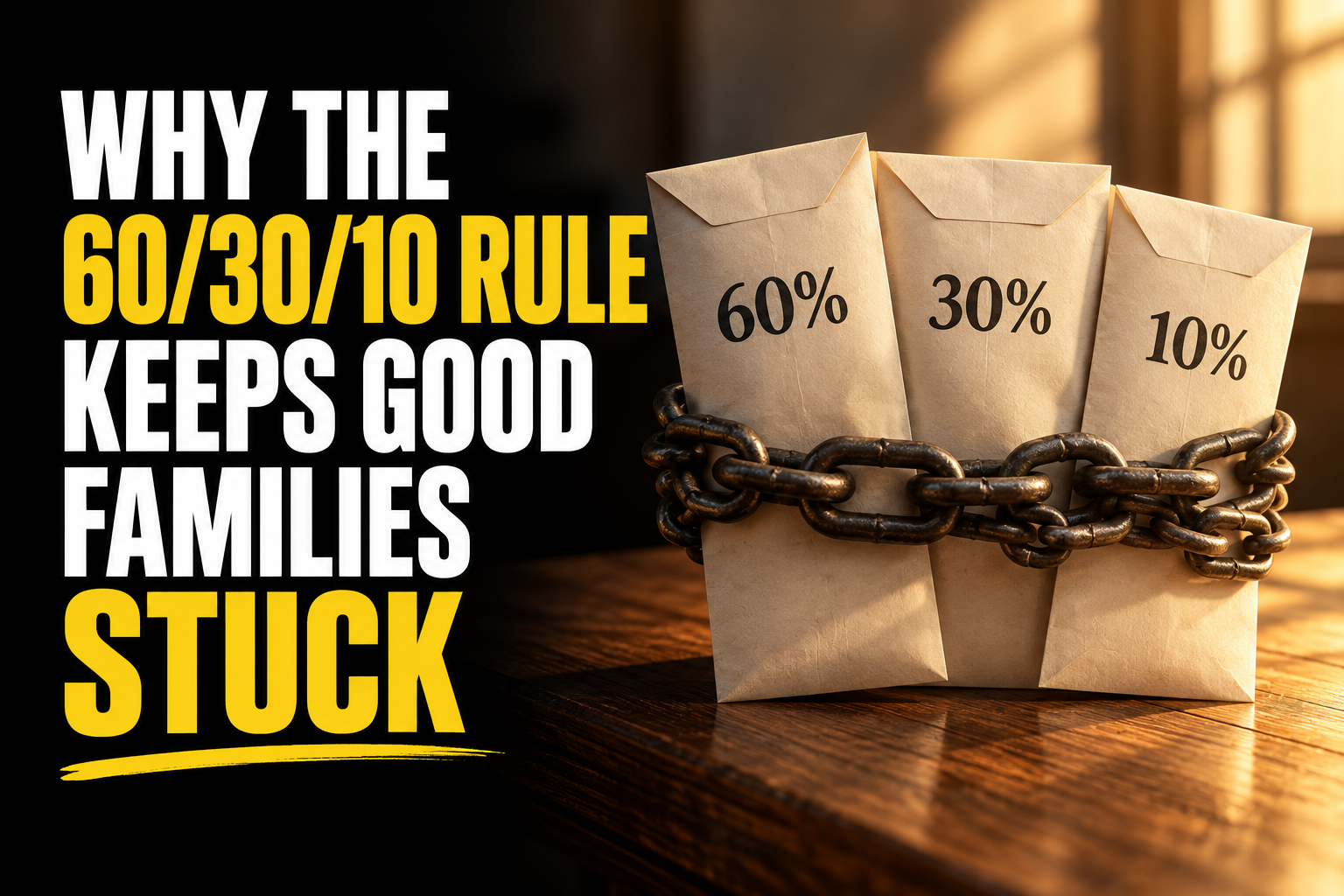
Let's not beat around the bush: the 60/30/10 rule sounds responsible. Sixty percent for needs, thirty for wants, ten for savings and debt. It's clean. It's easy to remember. It's also not built for how real families actually live.
If you've tried this rule and it hasn't worked, that's not on you. That's on the formula. Let's walk through why — and what actually gets a family free.
What the 60/30/10 Rule Says
The idea is straightforward:
- Needs (60%) — housing, groceries, utilities, transportation
- Wants (30%) — dining out, subscriptions, travel, hobbies
- Savings & Debt (10%) — emergency fund, retirement, debt payoff
On paper, it looks balanced. In real life, it rarely survives contact with an actual bill.
Why It Doesn't Hold Up
Sixty percent isn't enough for needs.
For most households, housing alone can eat 30–40% of take-home pay before groceries, utilities, or a car payment even enter the picture. By the time all four walls are covered, 60% is already gone — and often, it's not enough to cover them at all.
Ten percent for savings and debt is a setback, not a strategy.
This is the part that concerns me most. Debt is a thief. It steals time, peace, and future freedom. Ten percent split between savings and debt payoff isn't a plan — it's a slow leak. If you're carrying real debt, minimum payments alone can swallow that entire ten percent, leaving nothing behind it to build margin.
It treats debt and savings as equals.
They are not the same fight. Debt has to be attacked first and attacked hard. Saving while debt is active just means you're funding two goals at half-speed instead of one goal at full speed. Structure matters here — order matters here.
There's no decision-making built in.
A percentage sorts your spending. It doesn't ask you whether an expense belongs there in the first place. Real financial freedom comes from intention, not just categorization.
What To Do Instead
Freedom isn't found in a percentage. It's found in a plan where every dollar has a purpose before the month starts.
Here's the structure that actually works:
- Start with a small emergency fund. This isn't about comfort. It's protection, so one unexpected expense doesn't turn into new debt.
- Use the debt snowball method. Smallest balance first, regardless of interest rate. This builds real momentum and keeps you moving.
- Assign every remaining dollar a job. Rent, groceries, transportation, giving — every category planned on purpose, not guessed at the end of the month.
Biblical wisdom teaches that stewardship isn't about restriction — it's about being intentional with what's already in your hands. That's the foundation this is built on.
What This Means for You
If 60/30/10 hasn't worked for you, don't take that as a personal failure. Pull up your last bank statement. Add up what you actually spent on needs. For most families, it's closer to 70–80%, not 60%.
That number isn't a judgment. It's just where you're starting from — and now you know what you're really working with.
Conclusion
Here's what we covered:
- Sixty percent for needs rarely matches real housing and living costs.
- Ten percent for savings and debt isn't enough to make real progress on either.
- A structured plan — emergency fund, then debt snowball, then every dollar assigned — moves you further than any percentage formula ever will.
You're not behind because a formula didn't fit your life. You just needed a real plan instead of a ratio.
Here's your next step: Pull your last month's spending and give every dollar a job before next month begins. Start your debt snowball with the smallest balance on your list.
What's the smallest debt you could knock out this month if you started today? Let's build toward it.
Keep building,

Anthony O'Neal is a bestselling author, speaker and personal finance educator. He teaches families how to get out of debt and build real wealth on any income through The Escape Plan, his show The Table with AO, and the In the Black app.
more articles
Money Tips
October 23, 2026
The Weight Behind the Pulpit: What It Really Means to Steward a Church Well
Money Tips
October 23, 2026
Why Generosity Isn't About How Much You Have Left Over
Money Tips
October 22, 2026
Building a Stewardship Ministry That Actually Changes Lives: A 5-Step Guide for Pastors
Money Tips
October 22, 2026
A Smarter Way to Make Extra Money This Christmas Season
Money Tips
October 21, 2026
Extra Work Won't Save You If It Burns You Out First
Money Tips
October 21, 2026
15 Passive Income Streams You Can Actually Build in 2026 (Ranked by Effort)
Where this fits
The Escape Plan
Five phases, one plan. Find where you are, then take the next step.
In The Black
A coach in your pocket
Daily money assignments and real accountability, built around the Escape Plan. Know your next step every single day.
$59.99 a quarter or $179.99 a year
Get In The Black →Get the plan in your inbox.
Weekly money tips, real stories, and my free Wealth Checklist.
Free. Unsubscribe anytime.