

Key Takeaways
- Your statement balance is what you owed at the end of your last billing cycle.
- Your current balance is what you owe right now, including anything new since then.
- At minimum, pay the statement balance by the due date to avoid interest.
- If you're serious about freedom, pay the current balance to zero and stop using the card.
- Confusion about which balance to pay is often by design. Clarity protects you.
Quick Answer
Your statement balance is a snapshot — what you owed the moment your last billing cycle closed. Your current balance is a live number — what you owe this second, including anything you've charged since. Pay the statement balance to avoid interest. Pay the current balance to zero if you want out of the game completely.
This Isn't Confusing By Accident
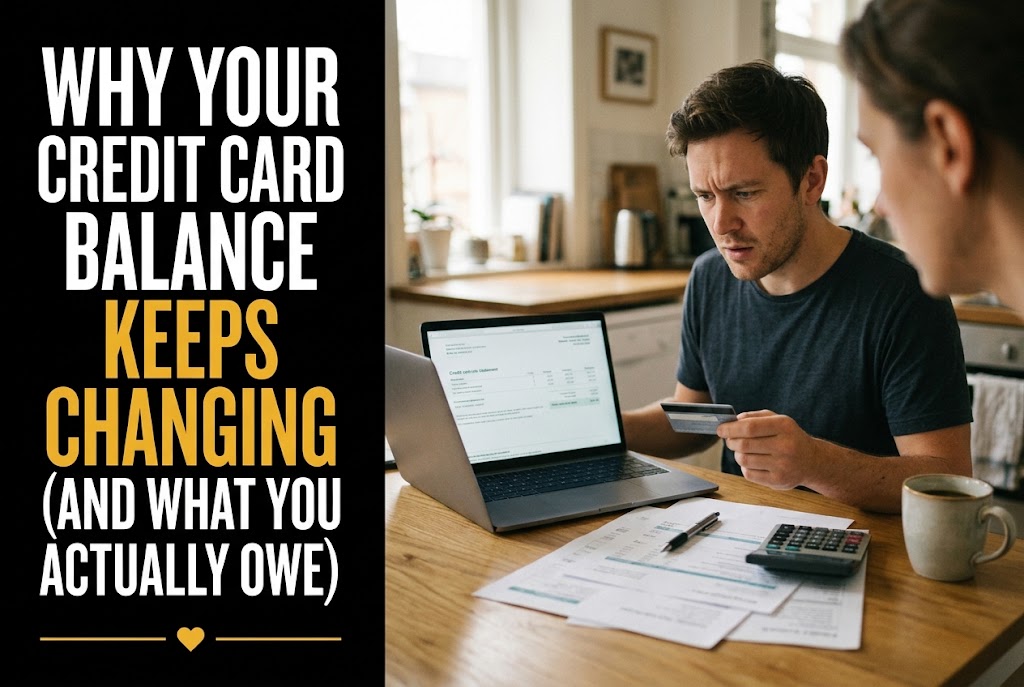
You open your credit card app and see two numbers. One says you owe $3,450. The other says $5,725. Same card. Same day. Two different answers.
That gap isn't a glitch. It's not even really about you not understanding your card.
It's a system built on confusion, because confusion keeps you carrying a balance. And a balance is where the money is made — just not by you.
Here's the truth: once you understand what you're looking at, the confusion disappears. And once the confusion disappears, you stop losing money to it.
Let's break it down.
What Is a Statement Balance?
Your statement balance is what you owed the moment your billing cycle ended. It includes every purchase from that cycle, plus any interest, fees, or balance you carried over from before.
This number doesn't move. It's locked in. You'll find it on your monthly statement, along with the date it's due.
Pay the statement balance in full by that due date, and you generally avoid being charged interest on those purchases.
What Is a Current Balance?
Your current balance is what you owe right now — today, this hour. It includes your statement balance plus anything you've charged since that billing cycle closed.
Unlike the statement balance, this number moves constantly. Every swipe adds to it. Every payment reduces it.
It's not your available credit either. Available credit is how much the card company will still let you borrow. Current balance is what you already owe them.
Why the Two Numbers Don't Match
Think about it this way.
Your October statement closes on October 30th with a balance of $3,450. That's locked in.
But it's November 5th now. You've already used that same card for gas, groceries, maybe a bill or two. So while your statement balance still reads $3,450, your current balance has climbed to $5,725.
Neither number is wrong. They're just answering different questions — one about the past, one about right now.
The problem isn't the math. The problem is a system designed to keep that math unclear, so you default to paying the smaller number and carrying the rest at a high interest rate.
Which One Should You Actually Pay?
At minimum, pay your full statement balance by the due date. That protects you from interest on last month's purchases.
But minimum isn't the goal. Minimum keeps you in the system longer than you need to be.
If you're ready to be done with this card altogether, pay the current balance down to zero. Not partially. Not "when it's convenient." Zero. Then stop using it.
Freedom isn't found in managing two balances well. It's found in not needing to track either one anymore.
What Happens If You Can't Pay It Off
If you can't pay the statement balance in full, pay at least the minimum by the due date. That protects your credit and keeps late fees off your account. But understand — you will still owe interest on whatever's left.
And credit card interest isn't small. Rates regularly sit above 20%. That's not a rounding error. That's a system quietly taking more of your future every month you carry a balance.
Scripture reminds us that the borrower is servant to the lender (Proverbs 22:7). That's not a guilt trip — it's just true. Every month you carry that balance, you're working for someone else's freedom instead of your own.
What This Means for You
This isn't about shame. Nobody taught most of us how these cards actually work. That's not your fault.
But now you know. And now you have a decision to make.
Here's the plan:
- Pull up your card today. Write down both numbers — statement balance and current balance.
- Commit to paying the full statement balance every month, no exceptions, starting now.
- Build a plan to pay the current balance to zero. Then close the account.
You don't need two balances to track. You need one number: zero.
Conclusion
We covered what your statement balance is, what your current balance is, and why the gap between them exists in the first place.
The real takeaway isn't which number to pay. It's this — confusion keeps people stuck, and clarity sets people free.
Your move: Open your account today. Know both numbers. Build the plan to get to zero.
Which balance has been tripping you up the most — the one you see first, or the one you actually owe? Let's talk about it.
Keep building,

Anthony O'Neal is a bestselling author, speaker and personal finance educator. He teaches families how to get out of debt and build real wealth on any income through The Escape Plan, his show The Table with AO, and the In the Black app.
more articles
Money Tips
November 7, 2026
The College Money System Nobody Taught You
Money Tips
November 7, 2026
The Single Mom's Guide to Building a Budget That Actually Holds
Money Tips
November 6, 2026
101 Free Ways to Build Memories With Your Kids Without Touching Your Budget
Money Tips
November 6, 2026
Debt Avalanche vs. Debt Snowball: Why Only One of These Actually Works
Money Tips
November 5, 2026
14 Low-Cost Valentine's Day Dates That Won't Wreck Your Budget
Money Tips
November 5, 2026
What Trump's Economic Plan Actually Means for Your Household Budget
Where this fits
The Escape Plan
Five phases, one plan. Find where you are, then take the next step.
In The Black
A coach in your pocket
Daily money assignments and real accountability, built around the Escape Plan. Know your next step every single day.
$59 a quarter or $179 a year
Get In The Black →Get the plan in your inbox.
Weekly money tips, real stories, and my free Wealth Checklist.
Free. Unsubscribe anytime.