


Let me be real with you for a second.
Most people don't have an income problem. They have a spending problem. And the painful part? Nobody taught us how to recognize it, let alone fix it.
I've talked to people making $80,000 a year who can't cover a $500 emergency. I've sat across from six-figure earners who are one missed paycheck away from crisis. The number on your check doesn't matter if the money keeps disappearing before you can do anything with it.
Real talk — overspending isn't a character flaw. It's a habit. And habits can be broken.
Today I'm giving you 17 practical, no-fluff ways to stop spending money you don't have — so you can start building the life God designed for you. Let's get to work.
1. Know Your Spending Triggers
Before you can fix the problem, you have to understand it.
Everyone has spending triggers — emotions, environments, or situations that make you reach for your wallet. Stress. Boredom. Loneliness. Celebration. Even scrolling social media at 11pm.
Ask yourself: When do I spend money I didn't plan to spend? The answer tells you everything. Awareness is the first weapon.
Action step: Write down the last 3 unplanned purchases you made. What were you feeling right before each one?
2. Build a Budget Before the Month Begins
A budget is not a punishment. It's a plan.
If you don't tell your money where to go, it will disappear — and you'll have no idea where it went. A zero-based budget means every dollar you earn gets assigned a purpose before the month starts. Giving. Saving. Bills. Groceries. Everything gets a job.
When your income minus your expenses equals zero, you are in control. Not your emotions. Not the algorithm. You.
Action step: Sit down before the 1st of every month and write out your budget. Every dollar, every category — no exceptions.
3. Set a Specific Money Goal
Discipline without direction doesn't last.
You need a target. Not a vague "I want to save more" — a real, specific goal. Pay off $8,000 in debt. Save $5,000 for a car. Build a 3-month emergency fund. When you have something concrete to work toward, every spending decision becomes a choice between your goal and the impulse.
Your children's children's children are counting on the decisions you make right now. Keep that in front of you.
Action step: Write your #1 financial goal on a sticky note and put it somewhere you'll see it every single day.
4. Track Every Dollar You Spend
Making a budget is step one. Actually tracking your spending is what makes it work.
Most people have no idea where their money goes. They budget $400 for groceries and spend $700 — and they're genuinely surprised. Tracking closes that gap. Every purchase, every transaction, every dollar — write it down or log it in an app.
When you see the numbers in real time, you make better decisions in real time.
Action step: Track every expense for the next 30 days. Every single one. No exceptions.
5. Try a No-Spend Challenge
Want to reset your relationship with money fast? Do a no-spend challenge.
Pick a week — or a full month if you're serious — and commit to buying only the bare necessities. No eating out. No online shopping. No impulse buys. Just the essentials.
It sounds hard. It is hard. But it will show you exactly what you can live without — and that knowledge is powerful.
Action step: Commit to a 7-day no-spend challenge starting this week. Tell someone so they can hold you accountable.
6. Stop Eating Your Paycheck
Food is one of the biggest budget leaks in America — and most people don't even realize it.
If you're spending $15 on lunch five days a week, that's $300 a month. Add a few dinner deliveries, weekend brunches, and coffee runs — and you're looking at $600 to $800 gone before you even blink. That's a car payment. That's a debt payoff. That's your emergency fund.
Eating out occasionally is fine. Eating out by default is a wealth destroyer.
Action step: Cook at home at least 5 days this week. Track what you save compared to last week.
7. Plan Your Meals Every Week
The reason most people eat out isn't hunger — it's lack of preparation.
When you don't have a plan, you default to convenience. And convenience is expensive. Meal planning doesn't have to be complicated. Pick 4 or 5 meals, make your grocery list, and stick to it. When you've got food at home, the drive-thru loses its power.
"We've got food at home" is one of the most powerful sentences in personal finance.
Action step: Plan next week's meals before you go to the grocery store. One week at a time.
8. Use the Cash Envelope System
There is something about handing over physical cash that changes your behavior.
When you swipe a card, the pain of spending is invisible. When you pull $40 out of an envelope and hand it over, you feel it. Research consistently shows people spend less with cash than with cards — because it's real and it's finite.
Label envelopes for your biggest spending categories — groceries, dining out, entertainment. When the envelope is empty, you're done. No exceptions.
Action step: Pull cash for your top 3 spending categories this week and use envelopes. See what changes.
9. Cut Debt Out of Your Life Completely
Debt is not a tool. It's a trap.
Every time you swipe a credit card for something you can't afford, you're borrowing from your future self — with interest. Debt steals your income before you ever get a chance to build with it. One purchase today can keep you in payments for months or years.
If you don't have the cash to pay for it right now, you can't afford it. Period.
Action step: Cut up your credit cards or freeze them. Take debt completely off the table and watch your spending habits change overnight.
10. Stop Using Shopping as Therapy
Real talk — spending money doesn't fix what's hurting you.
Retail therapy is real. We buy things to feel better, to celebrate, to cope, to fill a void. But the relief is temporary and the damage to your bank account is permanent. That package on your doorstep feels good for about 20 minutes — and then the anxiety comes right back.
When you feel the urge to spend emotionally, pause and ask: What am I actually feeling right now? Then find a healthier outlet — a walk, a phone call, a prayer, a workout.
Action step: The next time you feel the urge to shop impulsively, wait 24 hours. Then decide.
11. Don't Fall for Sales
A sale is only a deal if you were already going to buy it.
Retailers are experts at making you feel like you're saving money while you're actually spending it. "50% off" on something you never needed is still 100% wasted. Don't let a discount talk you into a purchase your budget didn't plan for.
If you see something on sale that wasn't already in your budget, leave it. If you still want it next month, plan for it then.
Action step: Before buying anything on sale, ask yourself: "Was I going to buy this before I saw the discount?" If the answer is no, walk away.
12. Get Off the Comparison Carousel
Social media is a highlight reel — not real life.
When you see someone in a new car, a new house, or a luxury vacation, you don't know if they paid cash or if they're drowning in debt. Most of the time, it's the latter. Don't let someone else's image steal your peace or your paycheck.
Your zip code doesn't decide your legacy. And neither does someone else's Instagram feed.
Action step: Unfollow 5 accounts this week that make you feel like you need to spend money to keep up. Protect your peace.
13. Always Shop With a List
Never walk into a store without a plan.
Stores are designed to make you spend more than you intended. The layout, the lighting, the placement of products — it's all engineered to pull money out of your pocket. A list is your defense. Stick to it. Get what you came for and leave.
If a store consistently tempts you to overspend, consider ordering online with a set list or sending someone else.
Action step: Write your grocery list before you leave the house — and commit to buying only what's on it.
14. Put Your Bills on Autopay
Late fees are a tax on disorganization.
When you forget to pay a bill, you get hit with a late fee. Those fees add up fast — and they're completely avoidable. Setting your regular bills on autopay means they get paid on time, every time, without you having to think about it.
Know your autopay dates, keep your account funded, and eliminate one more source of financial stress from your life.
Action step: Set up autopay for your top 3 recurring bills this week. One less thing to worry about.
15. Pause Before Every Purchase
This one habit alone can save you hundreds of dollars a month.
Before you buy anything that wasn't in your budget, stop and ask yourself three questions:
- Do I actually need this?
- When will I realistically use this?
- Is this worth delaying my financial goal?
Most of the time, the honest answer will save you from buyer's remorse. And if you still want it after 24 hours — and it fits the budget — then you can make a thoughtful decision instead of an emotional one.
Action step: Implement a 24-hour rule on every unplanned purchase over $20.
16. Use What You Already Have
Before you buy something new, look at what you already own.
We live in a culture that constantly tells us we need the newest, the latest, the upgraded version. But most of us have closets full of things we forgot we owned. Clothes with the tags still on. Kitchen gadgets still in the box. Books we never read.
Before you add anything to your cart, take inventory. Can you use what you have? Can you borrow it? Can you repurpose something? Contentment is a financial superpower.
Action step: Before your next purchase, spend 10 minutes looking for what you already own that could do the job.
17. Get an Accountability Partner
You were not designed to do this alone.
Tell someone your financial goal. A spouse, a friend, a mentor, a financial coach. Ask them to check in with you every week or every month. Knowing that someone is going to ask "how's the budget going?" is one of the most powerful motivators there is.
Community changes everything. Iron sharpens iron. And when you're trying to break old habits and build new ones, having someone in your corner makes all the difference.
Action step: Text one person today, share your financial goal, and ask them to hold you accountable. Do it right now.
Conclusion
Look, family — this is not about living a restricted, joyless life. It's about living a free one.
Every dollar you stop wasting is a dollar working toward your future. Your peace. Your legacy. The life God designed for you — not the one the credit card companies want you to live.
Here's your move: Pick three of these tips and start this week. Not all 17 at once — just three. Build the habit. Stack the wins. Keep going.
Now I want to hear from you — which of these 17 hit closest to home? Drop it in the comments below. Let's build together, family.
Keep building,

Anthony O'Neal is a bestselling author, speaker and personal finance educator. He teaches families how to get out of debt and build real wealth on any income through The Escape Plan, his show The Table with AO, and the In the Black app.
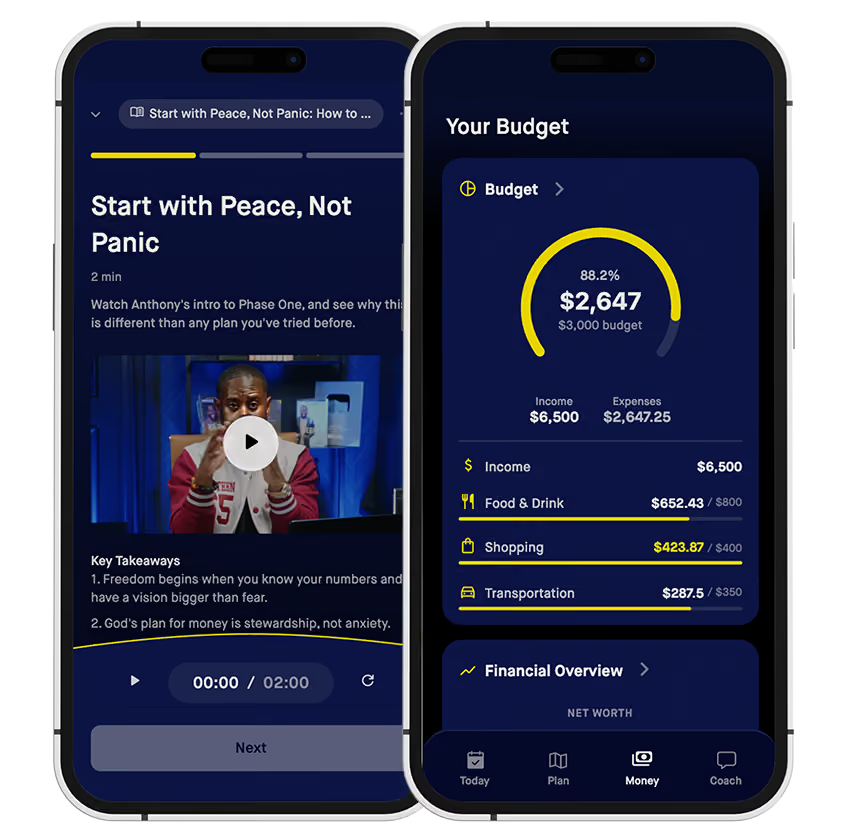
Find $516 you didn't know you had
Writing the budget is the easy part. In the Black tracks your spending against the plan and puts a money assignment in your pocket every morning. The average person finds $516 in their first 30 days.
Get startedIn the Black is my app.
Recommended for this topic
Find $516 you didn't know you had
Writing the budget is the easy part. In the Black tracks your spending against the plan and puts a money assignment in your pocket every morning. The average person finds $516 in their first 30 days.
Get startedIn the Black is my app.
more articles
Money Tips
October 23, 2026
The Weight Behind the Pulpit: What It Really Means to Steward a Church Well
Money Tips
October 23, 2026
Why Generosity Isn't About How Much You Have Left Over
Money Tips
October 22, 2026
Building a Stewardship Ministry That Actually Changes Lives: A 5-Step Guide for Pastors
Money Tips
October 22, 2026
A Smarter Way to Make Extra Money This Christmas Season
Money Tips
October 21, 2026
Extra Work Won't Save You If It Burns You Out First
Money Tips
October 21, 2026
15 Passive Income Streams You Can Actually Build in 2026 (Ranked by Effort)
Where this fits
The Escape Plan
Five phases, one plan. Find where you are, then take the next step.
In The Black
A coach in your pocket
Daily money assignments and real accountability, built around the Escape Plan. Know your next step every single day.
$59.99 a quarter or $179.99 a year
Get In The Black →Get the plan in your inbox.
Weekly money tips, real stories, and my free Wealth Checklist.
Free. Unsubscribe anytime.