

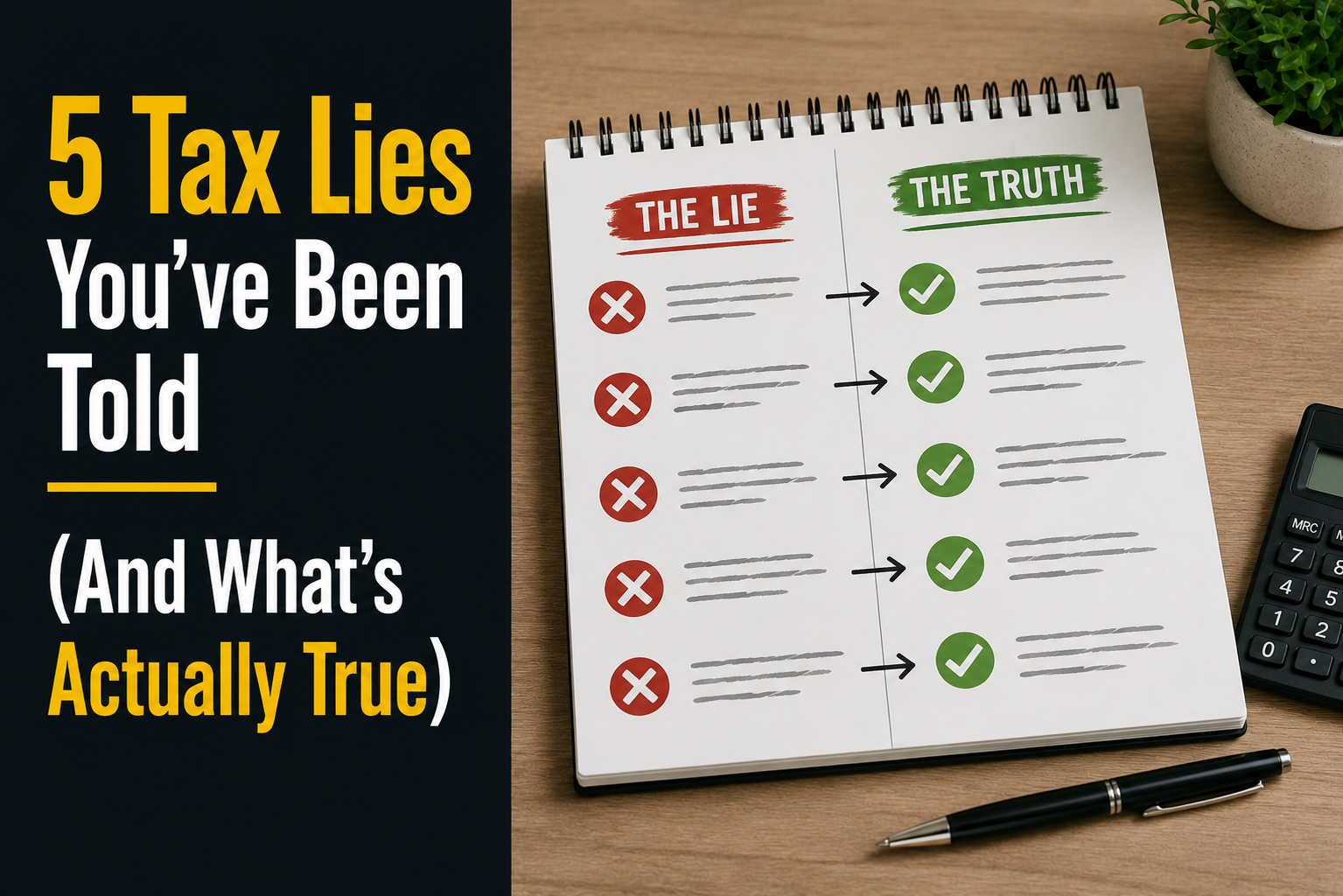
Listen, family — tax season has a way of bringing out everybody's "expert."
Your cousin at the cookout. That one coworker who swears they know a loophole. The random finance page you follow on Instagram. Everybody's got an opinion, and most of it is flat-out wrong.
Here's the problem: bad tax advice doesn't just cost you money this year. It can follow you for years — in penalties, missed opportunities, and a whole lot of unnecessary stress.
I've talked to thousands of people across this country, and the same tax myths keep coming up over and over again. Today we're shutting them down for good.
Here are 5 tax lies you've been told — and the truth that will actually set you free.
Let's get to work.
Tax Lie #1: Your Refund Is Free Money From the Government
I know. Getting that refund notification feels like a win. It feels like a bonus. It feels like the government finally did something nice for you.
But family, I need you to hear this clearly:
Your tax refund is not free money. It's your money — and they had it all year.
Here's what actually happened. Every paycheck, your employer withheld money from your pay and sent it to the IRS before it ever hit your bank account. If too much was withheld throughout the year, the government sends it back at tax time. That's your refund.
No interest. No bonus. No gift.
You essentially gave the federal government an interest-free loan for 12 months. And while they held your money, you couldn't use it to pay down debt, build your emergency fund, or invest for your future.
The goal is not a big refund. The goal is to get as close to zero as possible — meaning you don't owe them, and they don't owe you. That way, your money stays in your hands all year long, where it belongs.
Your move: Talk to your HR department or a trusted tax professional about adjusting your withholding. Getting an extra $100–$200 per paycheck is far more powerful than waiting on a lump sum in April.
Tax Lie #2: Moving Into a Higher Tax Bracket Will Cost You More Money
This myth has caused real people to turn down raises, avoid side income, and shrink back from opportunities — all because they were afraid of "moving into a higher tax bracket."
Family, that fear is costing you.
Here's the truth: the U.S. tax system is marginal, which means only the income above each threshold gets taxed at the higher rate — not all of your income.
Think of it like climbing stairs. Each step represents a bracket. When you earn more and step up, only the income on that new step gets taxed at the higher rate. Everything below it stays taxed exactly the same as before.
So if a raise pushes part of your income into a higher bracket, you are not losing money. You are making more money — and a slightly higher percentage of just that portion goes to taxes.
More income is always better. Don't let a misunderstood tax bracket talk you out of your next level.
Your move: Stop fearing the bracket and start focusing on increasing your income. Work with a tax professional to understand your effective tax rate — that's the real percentage you're actually paying — and plan accordingly.
Tax Lie #3: Keeping Debt Around Gives You a Great Tax Deduction
This one makes me want to flip a table.
Somewhere along the way, someone convinced people that staying in debt was actually a smart financial strategy because of the tax deduction. And people believed it.
Let me be direct: spending money on interest to save a fraction of it on taxes is not a strategy. It's a trap.
Here's the simple math. If you're paying thousands of dollars in mortgage or student loan interest every year, you might be able to deduct some of that from your taxable income. But the deduction only saves you a percentage of what you spent — not the full amount.
That means you're spending a dollar to save maybe twenty cents. On what planet does that make sense?
Debt is not a tool. Debt is a thief. It steals your income, your margin, and your peace of mind every single month. No tax deduction changes that reality.
Scripture reminds us that the borrower is slave to the lender. God's design for your finances was never built around finding creative ways to stay in bondage.
Your move: Pay off your debt as fast as possible using the debt snowball method. List your debts from smallest to largest and attack them one at a time. The freedom on the other side is worth far more than any deduction.
Tax Lie #4: If You Can't Pay, Just Don't File
I understand the logic. If you owe money and can't pay it, filing feels pointless — maybe even dangerous. So some people just... don't file. They push it off, avoid it, and hope it goes away.
It does not go away.
The IRS does not forget. And the penalty for not filing is far worse than the penalty for not paying.
Here's what most people don't know: the failure-to-file penalty can be up to ten times more expensive than the failure-to-pay penalty. So by avoiding the filing, you're actually making your situation significantly worse.
If you owe and can't pay the full amount, you still have options. File your return on time. Pay whatever you can by the deadline. Then set up a payment plan directly with the IRS. They have both short-term and long-term options, and you can apply online without sitting in a waiting room or being put on hold for hours.
The worst thing you can do is nothing. The IRS has more patience for people who show up than for people who disappear.
Your move: File your return on time — no matter what. If you owe and can't pay in full, send what you can and set up a payment plan at IRS.gov. Don't let fear make a manageable situation into a financial crisis.
Tax Lie #5: Taxes Are Too Complicated — Just Let Someone Else Handle It
Now, I want to be careful here because this one has two sides.
On one hand, yes — there are situations where a qualified tax professional is absolutely worth every penny. If you own a business, have multiple income streams, went through major life changes, or have investments outside of retirement accounts, please get professional help. That's wisdom, not weakness.
But on the other hand, too many people have been made to feel like taxes are completely beyond them — and that belief is being used to take advantage of them.
There are people paying hundreds of dollars for "tax preparation services" on simple returns that could be filed for free. There are people handing over their finances to someone they don't know, don't vet, and don't understand — and getting burned because of it.
You are smarter than you've been told. For straightforward tax situations, there are free and low-cost tools that walk you through every step. And even if you do use a professional, you should understand enough to ask the right questions and protect yourself.
Financial literacy is not just about budgeting and debt. It includes understanding your taxes — because what you don't know can absolutely cost you.
Your move: If your taxes are simple, explore free filing options first. If your situation is more complex, find a trusted, vetted tax professional — not just the cheapest option or someone a friend casually recommended. Know enough to stay informed either way.
Conclusion
Family, tax season doesn't have to be something you dread or something that defeats you.
But it does require truth — not myths, not cousin advice, not something you half-heard on social media.
Let's recap the five tax lies we just shut down:
- Your refund is free money from the government
- A higher tax bracket means you'll take home less
- Keeping debt is smart because of the tax deduction
- If you can't pay, don't bother filing
- Taxes are too complicated for you to understand
You now know better. And when you know better, you do better.
Here's your move: Pick the one lie that hit closest to home and take one action step this week. Adjust your withholding. File that return. Pay off a debt. Open a free filing account. Just one step.
That's how freedom starts — one decision at a time.
Now I want to hear from you: Which of these tax myths have you believed — or heard someone else repeat? Drop it in the comments below. Let's learn together.
Keep building,

Anthony O'Neal is a bestselling author, speaker and personal finance educator. He teaches families how to get out of debt and build real wealth on any income through The Escape Plan, his show The Table with AO, and the In the Black app.
more articles
Money Tips
October 20, 2026
Five Families, Five Different Paths to an Extra $1,000
Money Tips
October 20, 2026
Extra Income for Parents: How to Build Margin Without Sacrificing Family Time
Money Tips
October 16, 2026
The Monthly Paycheck Trap (And How to Beat It Every Single Time)
Money Tips
October 16, 2026
The Right Way to Use Multiple Bank Accounts Without Losing Track of Your Money
Money Tips
October 15, 2026
The Weekly Habit That Keeps Your Budget From Falling Apart
Money Tips
October 15, 2026
When Your Budget Falls Apart Mid-Month, Do This
Where this fits
The Escape Plan
Five phases, one plan. Find where you are, then take the next step.
In The Black
A coach in your pocket
Daily money assignments and real accountability, built around the Escape Plan. Know your next step every single day.
$59.99 a quarter or $179.99 a year
Get In The Black →Get the plan in your inbox.
Weekly money tips, real stories, and my free Wealth Checklist.
Free. Unsubscribe anytime.