
Overview
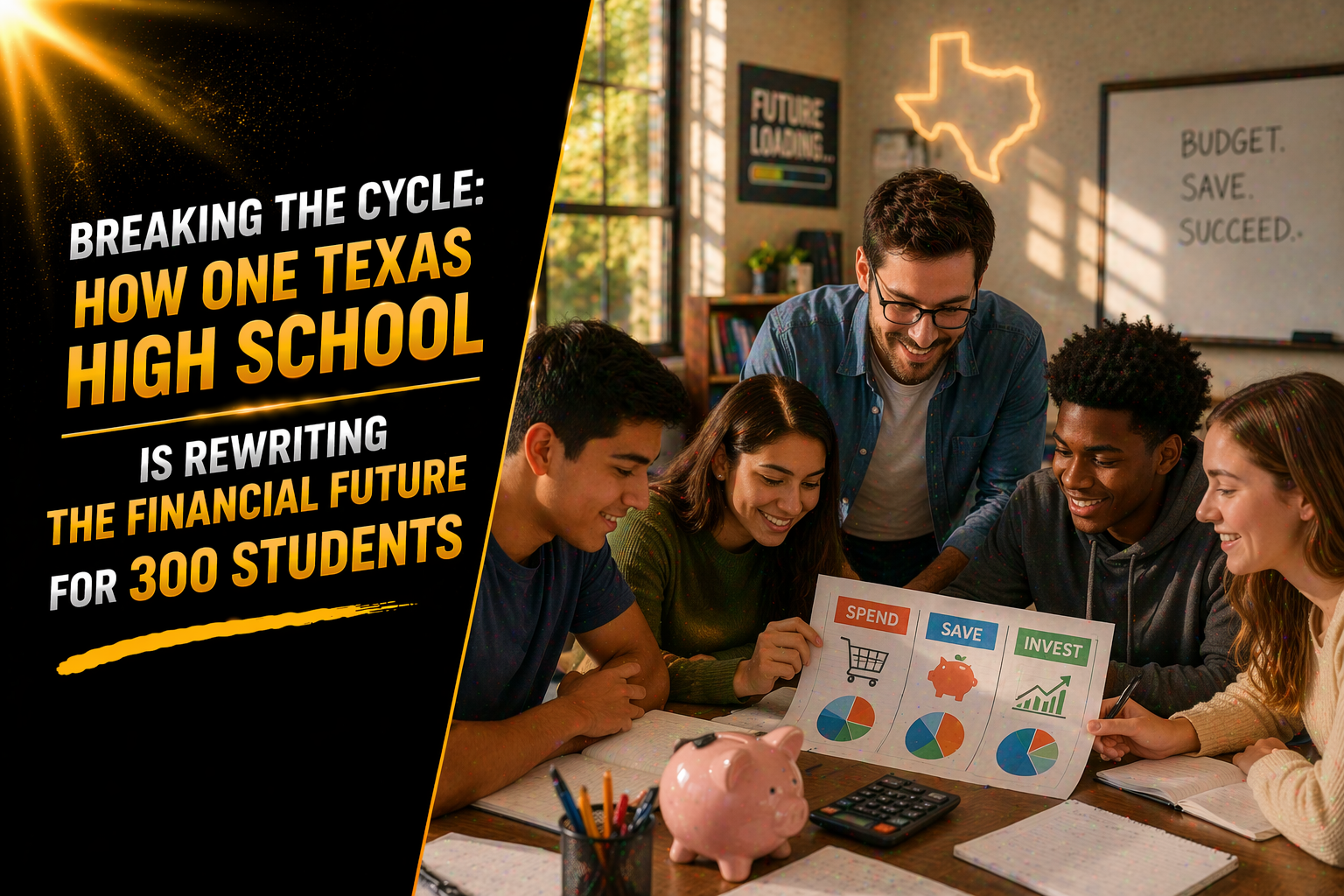
Listen, family — 77% of students at Somerset High School in Somerset, Texas come from low-income, economically disadvantaged households. Over half live in single-parent homes or with grandparents. These are kids who've never seen a budget. Never heard the word "compound interest" at the dinner table. Never had someone sit them down and say, "Here's how money actually works."
But something is shifting in Somerset. And it's not a government program. It's not a bailout. It's a classroom, a curriculum, and educators who refused to let zip codes decide legacies.
Somerset High School implemented the Foundations in Personal Finance curriculum by Ramsey Education — and the results are proving what I've been saying for years: when you give people the right information at the right time, they don't just learn — they transform.
"We pretty much live paycheck to paycheck. There's stuff we need that we cannot have because there's even more important stuff we need. The money goes to that." — Dania S., Student at Somerset High School
That quote right there. That's not just one student. That's 60% of American households talking.
The Challenge
Here's the reality that most people don't want to say out loud. When you grow up watching your family struggle with money — when debt is normal, when overdraft fees are just part of life, when nobody around you has ever invested a dollar — you start to believe that's just how it is.
Amy Quintanilla, an educator at Somerset, said it plainly. Students from financially unstable backgrounds face a "mental disadvantage because they feel this is going to be their future."
Read that again. They don't just lack money. They lack belief that anything different is even possible.
And that's the real enemy. Not the debt itself. The mindset that says this is all there is.
Most teens nationwide have never been challenged to learn how money really works. Not in school. Not at home. Not anywhere. And when you don't know how money works, money works against you. Every single time.
The educators at Somerset saw this. They saw students heading toward the same financial traps their parents fell into — payday loans, credit card debt, no savings, no plan. And they said, "Not on our watch."
"I could see my failures in my mentality of I get money, and I want to spend money already... and the more I got into this class, I understood how I had to change my spending so I could have a good future financially." — Dania S., Student at Somerset High School
That's a teenager talking. A teenager who recognized her own destructive patterns and decided to change. If she can do it, what's our excuse?
The Solution
Master Teacher Terry White had a vision that went beyond just checking a box for economics credit. He brought a proposal to district leadership for the Foundations in Personal Finance curriculum — and he didn't just pitch it as a class. He pitched it as a community transformation tool.
His argument was simple and powerful: teach students practical money habits — budgeting, saving, avoiding debt — and those students will carry that knowledge home. They'll teach their parents. They'll teach their siblings. One classroom changes one family. One family changes a block. One block changes a neighborhood.
That's generational thinking. That's kingdom building. That's what I'm talking about when I say your children's children's children.
And here's what made this curriculum different from some dusty textbook nobody reads:
It was built by teachers, for teachers. Real-world application. Behavior-driven learning. Not theory — action.
It was accessible. Every lesson, every activity, every quiz, every test — available in Spanish. For a school where language barriers could have been an excuse, they made sure it wasn't.
"One of the biggest selling points of the Ramsey curriculum, especially for us and where we are with our demographics, is that it already had Spanish included. It had everything we needed." — Terry White, Master Teacher
It met students where they were. The flexible format worked for all learners — including students in special education and dyslexia-coded programs. Cookie jar on the bottom shelf. That's how you teach. You make it accessible to everyone, not just the kids who already have advantages.
The budgeting exercises changed everything. This is where students connected the dots. Debt elimination. Saving strategies. Seeing their money on paper for the first time. Understanding that a budget isn't a restriction — it's permission to tell your money where to go instead of wondering where it went.
"I was really excited about the shift from traditional economics to personal finance literacy... because I saw that there was a need within our students to know how to open a bank account, to know how to manage their money, to know how to make a budget. I saw the need." — Amy Quintanilla, Teacher
The Results
300 students went through the program. Three hundred young people who, for the first time in their lives, understood how money actually works.
But here's what gets me. Here's the part that honestly makes me emotional.
This wasn't just about students learning to budget. They became the teachers.
They went home and started conversations their families had never had. They challenged habits that had been passed down for generations. They didn't just absorb information — they activated it.
And this story right here is why I do what I do:
"I happened to be in the class while this was happening. One young man came in and had a huge smile on his face, and he went up to Mrs. Quintanilla and goes, 'Guess what, Miss Q? I convinced my parents to stop doing payday loans. I showed them my savings journal and my dad has actually started a savings journal of his own.'" — Terry White, Master Teacher
Read that one more time. A teenager — a kid — convinced his parents to stop using payday loans. He showed them his savings journal. And his father started one of his own.
That's not a lesson plan. That's a legacy shift. That's a family tree being rewritten in real time.
"Now I know that debt is just a really bad thing. It's never a situation that I would necessarily want to be in. But now I feel with The Five Foundations learning about my budget, my savings, it's going to be a lot easier going into my future, knowing the problems, the consequences and the solutions." — Siara L., Student
These students aren't just learning how money works. They're starting to believe they can build a life they're proud of. Not chasing millions. Not flexing. Just the freedom to afford what they need without stress, save for what they want without guilt, and steer clear of debt with clarity.
That's real wealth. That's what freedom looks like.
What This Means for You
Family, I need you to sit with this for a second.
If a 16-year-old from a low-income household in Somerset, Texas can learn to budget, convince his parents to ditch payday loans, and start building financial habits that will change his entire family tree — what's stopping you?
It's not your income. It's not your zip code. It's not your past.
It's information. And now you have it.
Here's what Somerset proves:
- Financial literacy changes behavior. Not just knowledge — behavior. When people understand how money works, they make different decisions. Period.
- It only takes one person to shift a family. That young man didn't wait until he was 30 with a degree. He learned something in a classroom and brought it home that same day. You can do the same thing tonight.
- Your zip code doesn't have to decide your legacy. 77% of these students come from economically disadvantaged homes. And they're building budgets, starting savings journals, and teaching their parents about money. Don't let your zip code decide your legacy.
Conclusion
Look — this story isn't just about a school in Texas. This is about what's possible when someone cares enough to put the right information in front of people who've been told their whole lives that financial freedom isn't for them.
It is for them. It's for you. It's for all of us.
Here's your move this week:
- Start your own financial literacy journey. Use the free budgeting guide at anthonyoneal.com to get your money organized this week.
- Have the conversation at home. Sit down with your kids, your spouse, your family. Talk about money. Break the silence. Get financially naked with each other.
- Open a high-yield savings account. Go to anthonyoneal.com/savings and start building your emergency fund somewhere it actually grows.
- Use the debt calculator. Go to anthonyoneal.com/debt-calculator and see exactly where you stand. No more guessing. No more avoiding.
If 300 high school students in Somerset, Texas can rewrite their financial future, so can you. One class at a time. One family at a time. One decision at a time.
Which part of this story hit you the hardest? Drop it in the comments — let's build together.
Keep building,

Lorem ipsum dolor sit amet, consectetur adipiscing elit. Suspendisse varius enim in eros elementum tristique. Duis cursus, mi quis viverra ornare, eros dolor interdum nulla, ut commodo diam libero vitae erat. Aenean faucibus nibh et justo cursus id rutrum lorem imperdiet. Nunc ut sem vitae risus tristique posuere.