
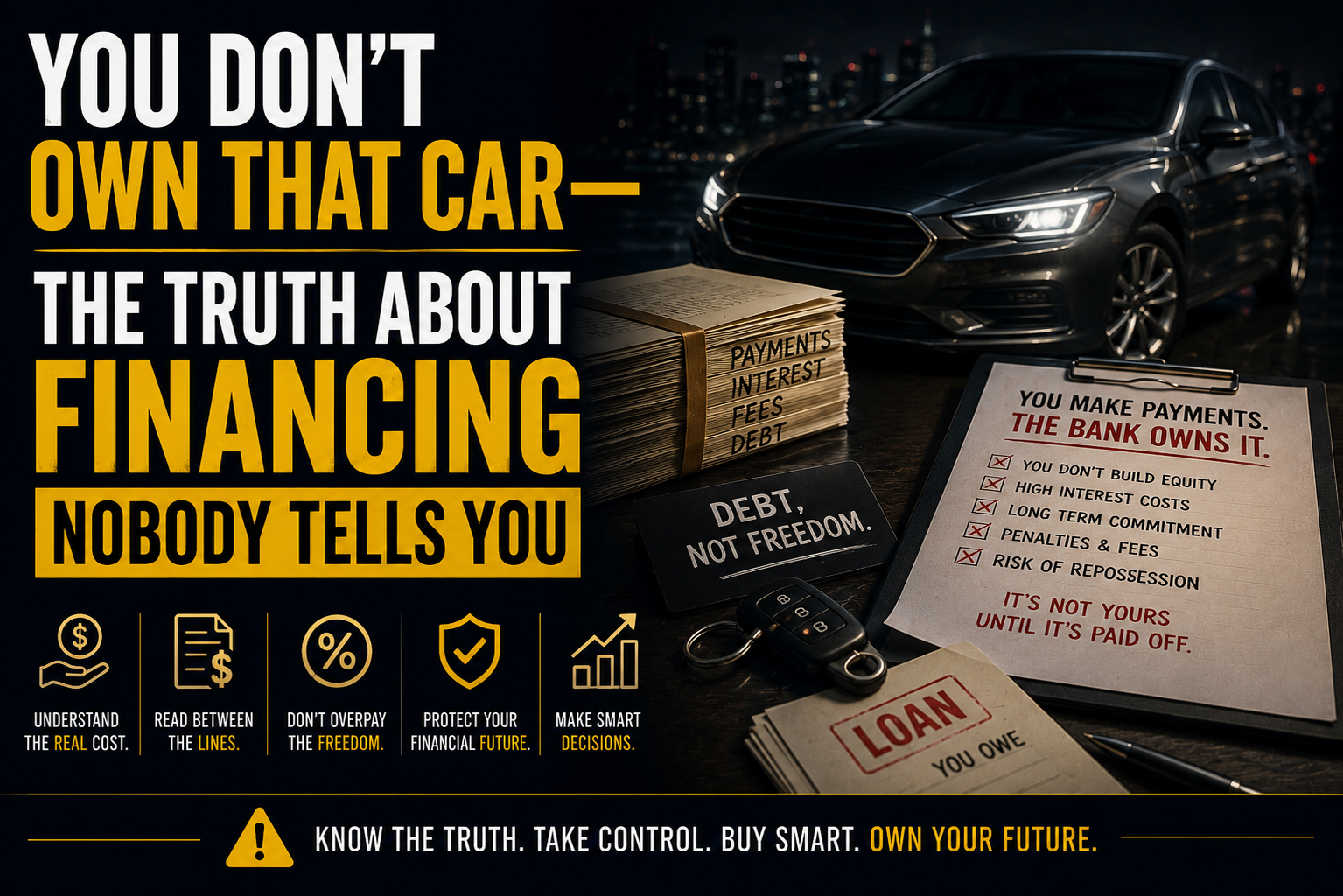
You Don't Own That Car — The Truth About Financing Nobody Tells You

3 min read
Let me ask you something straight up.
If you're making payments on a car right now, do you actually own it?
Most people would say yes. But the honest answer is no. The bank owns it. The dealership owns it. You just get to drive it — as long as you keep writing that check every single month.
That's the reality of financing a car. And most Americans have been so conditioned to accept it that they never stop to question whether it's actually a good deal.
Real talk — it's not. And today, I'm going to break down exactly what car financing is, how it works, and why it's one of the biggest traps keeping everyday families from building real wealth.
Let's get to work.
So What Does It Actually Mean to Finance a Car?
Financing a car means you borrow money to purchase a vehicle and agree to pay it back — with interest — over a set period of time.
Simple enough, right?
But here's what that smooth-talking salesman at the dealership won't tell you: because of interest, you will always pay more for a financed car than the price on the sticker. Always. No exceptions.
And while you're making those payments, the bank holds the title. Not you. If you miss payments, they can take that car back without blinking. You've been paying for something you don't even fully own.
That's not a car purchase. That's a lease with extra steps.
The Three Ways People Finance Cars
There are three main ways people finance a vehicle. None of them are great — but some are worse than others. Let's break them down.
Direct Financing — Going Through a Bank First
Direct financing is when you apply for a car loan through a bank, credit union, or online lender before you ever walk into a dealership.
If you get approved, you go to the lot, pick your car, negotiate the price, and sign the paperwork. Your monthly payment is based on three things: how much you borrowed, the interest rate, and how long you have to pay it back.
Here's where it gets real. Interest rates on car loans are not small. And most car loans run close to six years. That means you could be paying on a vehicle for longer than most people stay in a job — and by the time it's paid off, that car has already lost a massive chunk of its value.
You end up paying thousands of dollars more than the car is worth, for a car that's worth less every single day you drive it.
That's not a smart money move. That's a wealth leak.
Indirect Financing — Letting the Dealership Handle It
Indirect financing is when you skip the pre-approval process and apply for the loan right there at the dealership when you're ready to buy.
It sounds convenient. One stop, one place, done.
But here's the problem. The dealership works with a network of lenders — and they earn a commission for connecting you with one. That commission gets baked into your interest rate. So you're paying extra just for the "convenience" of doing it all in one place.
On top of that, you don't know what you're going to pay until you've already fallen in love with the car. And once your heart is set on something, it's a lot harder to walk away from a bad deal.
That's not an accident. That's by design.
Leasing — The Most Expensive Option of All
If direct and indirect financing are bad, leasing is worse.
A lease is when you pay to drive a car for a set period of time — usually two to three years — and then hand it back at the end. You never own it. You never build equity. You just pay, drive, and give it back.
Yes, the monthly payments are lower. But that's because you're not buying anything. You're renting. And at the end of that lease, you have nothing to show for every dollar you spent.
There are also mileage limits. Go over them and you pay penalties. Bring the car back with any wear and tear and you pay for that too.
Family, leasing a car is like paying rent on an apartment for three years and then being told to move out with nothing. You wouldn't do that with a house. Don't do it with a car.
What Does Your Credit Score Have to Do With It?
Here's something the finance industry loves to use against you — your credit score.
Your credit score affects the interest rate you're offered on a car loan. The lower your score, the higher your rate. The higher your rate, the more you pay over time.
But here's what they don't advertise: almost anyone can get a car loan. Even people with poor credit. Dealerships — especially "buy here, pay here" lots — will finance just about anybody.
That might sound like good news. It's not.
If your credit is low and you still get approved, you're likely getting hit with an interest rate that would make your head spin. And if you miss even one payment, the repo man shows up fast.
Just because someone is willing to lend you money doesn't mean you should take it. The fact that you can finance a car doesn't mean you should.
Is Financing a Car Ever a Good Idea?
I'm going to be straight with you.
No.
I know that's not what the commercials say. I know that's not what your coworker told you. But when you actually run the numbers, financing a car costs you more money, more stress, and more of your future than it's worth.
That monthly payment — whether it's $400, $600, or $800 — is money that is not going toward your emergency fund. It's not going into your retirement account. It's not building generational wealth for your children's children's children.
It's going to a bank. Every single month. For years.
And the car is losing value the entire time.
Scripture reminds us that the borrower is servant to the lender. That's not just a spiritual principle — it's a financial reality. Every car payment you make is another month you're serving someone else's bottom line instead of building your own.
What About Zero Percent Financing? Isn't That Different?
I hear this one all the time. And I understand why it sounds appealing.
Zero percent financing feels like a loophole. Like you found a way to beat the system.
But here's the truth: zero percent financing almost always comes with a higher purchase price. The dealer isn't giving you free money — they're just moving where the cost shows up. Instead of paying interest, you're paying more for the car itself.
Zero down just means a bigger loan. Zero interest usually means a bigger price tag. The math still doesn't work in your favor.
Don't let the marketing fool you. Dealerships are not in the business of giving things away.
The Real Way to Get a Car Without the Payment
Here's the good news. You don't need a car loan to drive a reliable vehicle. You need a plan.
This is how it works.
Start with what you have. Even if it's $2,000 or $3,000, that's enough to buy a dependable used car in cash. It won't be your dream car. That's okay. It gets you where you need to go — payment free.
Save like you have a car payment. Take whatever you would have been paying each month and put it aside. Every month. Without fail.
Upgrade with cash. After a year of saving, plus the trade-in value of your current car, you've got more to work with. Buy a better car. Still in cash.
Repeat the process. Keep doing this and within a few years, you'll be driving a car you actually own — no payments, no interest, no stress.
This is the system. It's not flashy. But it works. And it keeps your money working for you instead of for a lender.
Conclusion
Look, family — I'm not here to make you feel bad about where you are. If you've got a car payment right now, you're not alone. Most of America is right there with you.
But I need you to see it for what it is. A car payment is not normal. It's not necessary. And it is not helping you build the life you actually want.
You were not designed to be in financial bondage. God's design for your money is freedom — and that includes what you drive.
Here's your move: Pull up your budget today. Look at what you're spending on your car every month. Then ask yourself — what could that money do for my future if I wasn't handing it to a bank?
That question alone can change everything.
Now I want to hear from you — are you currently financing a car? What would it mean for your life to make that last payment and never go back? Drop it in the comments below. Let's build together.
Keep building,

Lorem ipsum dolor sit amet, consectetur adipiscing elit. Suspendisse varius enim in eros elementum tristique. Duis cursus, mi quis viverra ornare, eros dolor interdum nulla, ut commodo diam libero vitae erat. Aenean faucibus nibh et justo cursus id rutrum lorem imperdiet. Nunc ut sem vitae risus tristique posuere.
like what you’ve just read?
Make sure to share it with your tribe!
.webp)
like what you’ve just read?
Make sure to share it with your tribe!


