


Key Takeaways
- The average American spends roughly $370 per person per month on groceries — and that number is climbing.
- The USDA estimates $249–$313 per month for a single adult on the Thrifty Plan, and over $1,000 per month for a family of four.
- Food-at-home prices rose 2.4% in 2025, and the USDA projects another 3.1% increase in 2026.
- Your grocery budget is one of the biggest levers you have to free up money for debt payoff, investing, and building real wealth.
Real talk, family. What if I told you that one of the biggest reasons people stay broke has nothing to do with their income — and everything to do with what's in their grocery cart?
Let that sit for a second.
Most of us have never been taught how to budget for food. We just swipe the card, load up the bags, and hope the number at checkout doesn't make us flinch. But here's the truth: your grocery spending is quietly stealing from your future. Not because eating is wrong — you got to eat. But because most of us are spending way more than we realize, and that margin could be going toward your emergency fund, your debt snowball, or your first investment.
Today, I'm breaking down exactly what the average American spends on groceries, what you should be spending based on your family size, and how to take back control of your food budget so your money starts working for you.
Let's get to work.
How Much Are Americans Actually Spending on Groceries?
The national average grocery cost is about $370 per person per month. For a household, that number jumps to roughly $1,080 per month according to recent spending data.
And it's getting worse. The Bureau of Labor Statistics reported that food-at-home prices rose 2.4% in 2025. The USDA is projecting another 3.1% increase in 2026.
That means if you spent $1,000 a month on groceries this year, you could be looking at $1,031 next year — without buying a single extra item.
Family, inflation is real. And it's eating your lunch. Literally.
What the USDA Says You Should Spend
The USDA publishes Food Plans that break down estimated grocery costs by budget level: Thrifty, Low-Cost, Moderate-Cost, and Liberal. These aren't what people are spending — they're guidelines for what a nutritious diet could cost.
Here's what the numbers look like:
Single Adult (Ages 20–50)
Plan Monthly Cost
Thrifty $249–$313
Low-Cost $323–$372
Moderate-Cost $394–$467
Liberal $501–$569
Family of Four (Two Adults, Two Children Ages 6–11)
Plan Monthly Cost
Thrifty ~$1,000
Low-Cost ~$1,003
Moderate-Cost ~$1,510
Liberal ~$1,834
Source: U.S. Department of Agriculture, 2025–2026 Food Plan Reports.
Look at those numbers. Even on the Thrifty Plan, a family of four is spending over $1,000 a month just on groceries. That's $12,000 a year. And on the Liberal Plan? Over $22,000 a year on food alone.
That's a down payment on a rental property. That's a fully funded emergency fund. That's 15% of a $100K salary going straight into your retirement account.
You see where I'm going with this?
Why Your Grocery Budget Matters More Than You Think
Listen, I'm not here to tell you to eat beans and rice forever. Y'all know me — I believe in the beans and rice season, not the beans and rice life. But here's what I need you to understand:
Your grocery bill is one of the biggest controllable expenses in your budget.
You can't negotiate your rent overnight. You can't snap your fingers and lower your car insurance tomorrow. But you can change what goes in your cart this week.
When I was broke at 25, living in my car, I wasn't thinking about organic avocados. I was thinking about survival. And when I finally got serious about my money, food was one of the first places I found hidden cash. Not by starving — by being strategic.
"It's not about how much you make. It's about what you do with what you have."
Every dollar you save on groceries is a dollar that can go toward:
- Paying off debt using the debt snowball method
- Building your emergency fund inside a high-yield savings account
- Investing into your future and your children's children's children
6 Ways to Cut Your Grocery Bill Without Eating Ramen Every Night
1. Check Your Pantry Before You Shop
Before you step foot in that store, look at what you already have. I can't tell you how many times people buy duplicates of stuff sitting in the back of their cabinet. Get creative. Use what you've got first.
2. Meal Plan Like Your Wealth Depends on It
Because it does. Sit down for 15 minutes on Sunday. Plan your meals for the week. Write a list. Stick to the list. When you walk into the store without a plan, you walk out with $200 worth of stuff you didn't need.
3. Switch to Store Brands
Real talk — most generic brands taste the same as name brands. Studies show store brands cost 5–72% less than their name-brand counterparts. Your taste buds won't know the difference, but your bank account will.
4. Shop at Cheaper Stores
Where you shop matters. A lot. Stores like ALDI, Costco, and Walmart consistently beat traditional grocery stores on price. Yeah, you might have to bag your own groceries. That's a small trade for big savings.
5. Buy What's in Season
Produce that's in season is cheaper and tastes better. Strawberries in December? Expensive. Strawberries in June? Half the price and twice the flavor. Let the calendar guide your cart.
6. Stop Impulse Buying
This is the big one. Those end-cap displays and checkout lane snacks are designed to get you to spend more. Stick to your list. Get in, get out, and keep your money where it belongs — working for you.
How to Set Your Grocery Budget (Step by Step)
Step 1: Look at What You're Actually Spending
Pull up your bank statements from the last three months. Add up every grocery purchase. Divide by three. That's your real monthly average. Don't guess — know.
Step 2: Budget for Your Other Four Walls First
Before you finalize your grocery number, make sure you've covered the other essentials: utilities, shelter, and transportation. Food is critical, but so is keeping the lights on and a roof over your head.
Step 3: Set a Realistic Number and Adjust
Based on the USDA guidelines and your actual spending, pick a number. If you've been spending $1,200 and the Moderate Plan says $1,000 for your family size, aim for $1,100 this month. Then $1,000 next month. Progress, not perfection.
Step 4: Put the Savings to Work
Here's where it gets good. Every dollar you shave off your grocery bill needs a job. Don't let it float into random spending. Assign it:
- Debt snowball payment — knock out that smallest debt faster
- Emergency fund — get to 3–6 months of your net pay
- Investing — even $50 a month into an index fund changes your trajectory
Where Your Grocery Savings Should Go
Your money is sitting in a regular savings making pennies while inflation is eating your lunch. That emergency fund, that extra cash you just freed up from your grocery budget — it should be working for you, not just sitting there.
Go to anthonyoneal.com/savings and compare the top high-yield savings accounts. We update this list regularly with accounts paying 4% to 5%+ APY — no minimums, no hidden fees, and your money is still FDIC insured.
If you've got $10,000 sitting in a regular savings account at 0.01%, you're losing money to inflation. In a high-yield savings account, that same $10,000 could earn you $400–$500 a year. That's your grocery savings paying you back.
And once your emergency fund is solid? Open a brokerage account at anthonyoneal.com/invest and start putting your money into index funds. You can start with as little as $5. The first step isn't how much you invest — it's that you take the step.
Conclusion
Look, family — this isn't about deprivation. It's about discipline for a season so you can live free for a lifetime.
Here's what we covered:
- The average American spends $370/month per person on groceries — and prices are rising
- The USDA Thrifty Plan puts a family of four at over $1,000/month
- Your grocery budget is one of the biggest wealth-building levers you control
- Simple swaps like store brands, meal planning, and cheaper stores can save you hundreds
- Every dollar saved needs a job — debt payoff, emergency fund, or investing
The truth is, you're not too far behind. You're not too broke. You're just one grocery trip away from making a smarter decision with your money.
Here's your move: This week, pull up your last three months of grocery spending. Get the real number. Then set a budget that's $100 less than your average and put that $100 toward your smallest debt or your emergency fund. Start there.
Now I want to hear from you: What's your biggest grocery budget struggle? Is it impulse buying? Eating out too much? Not having a plan? Drop it in the comments — let's figure this out together.
Keep building,

Lorem ipsum dolor sit amet, consectetur adipiscing elit. Suspendisse varius enim in eros elementum tristique. Duis cursus, mi quis viverra ornare, eros dolor interdum nulla, ut commodo diam libero vitae erat. Aenean faucibus nibh et justo cursus id rutrum lorem imperdiet. Nunc ut sem vitae risus tristique posuere.
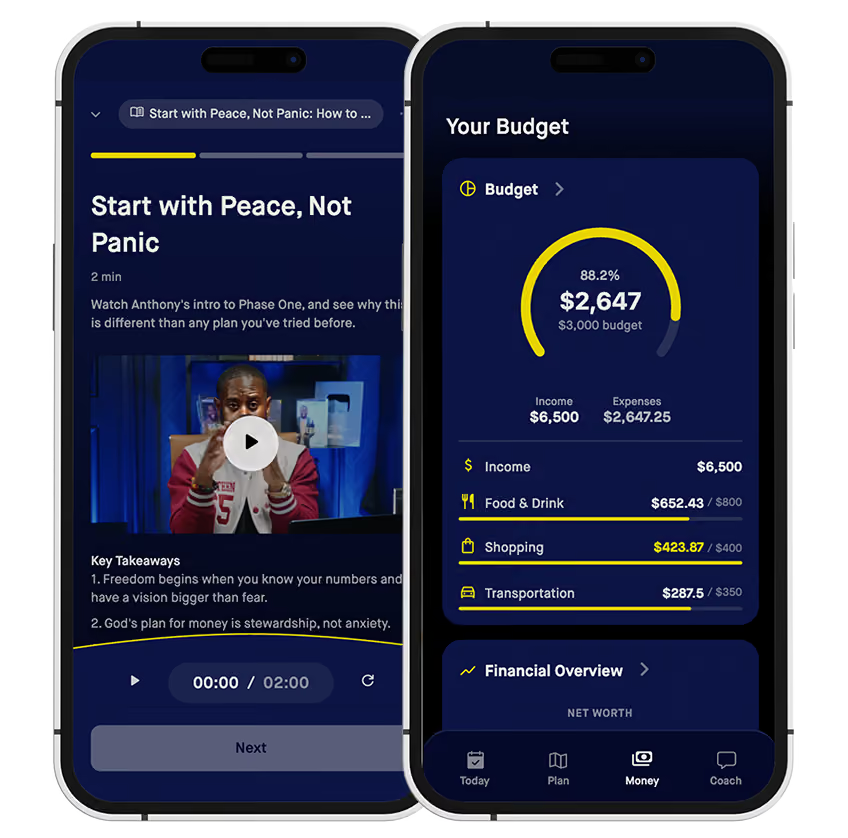
Find $516 you didn't know you had
Writing the budget is the easy part. In the Black tracks your spending against the plan and puts a money assignment in your pocket every morning. The average person finds $516 in their first 30 days.
Start In the Black freeIn the Black is my app.
Recommended for this topic
Find $516 you didn't know you had
Writing the budget is the easy part. In the Black tracks your spending against the plan and puts a money assignment in your pocket every morning. The average person finds $516 in their first 30 days.
Start In the Black freeIn the Black is my app.