
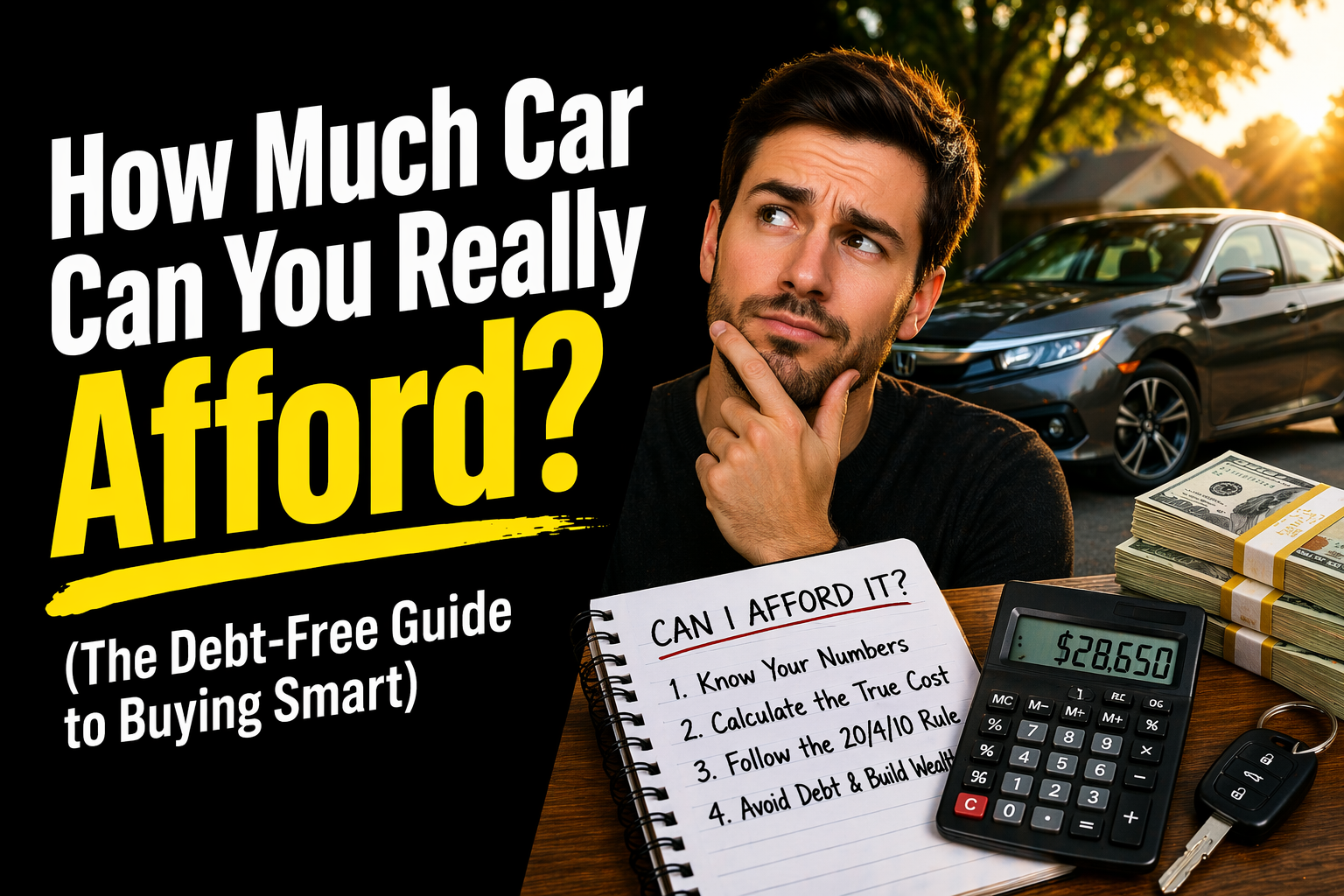
How Much Car Can You Really Afford? (The Debt-Free Guide to Buying Smart)

3 min read
Key Takeaways
- How much you should spend on a car depends on your income, savings, and where you are on your financial journey.
- The total value of all your vehicles should never exceed half your annual household income.
- If your net worth isn't at least $1 million, skip the dealership's new car lot.
- Always pay cash. No car payments. No exceptions.
- Use Anthony's free Debt Calculator to see where you stand before making any big purchase.
What if I told you that the average car payment in America right now is $734 a month? Let that satisfying number sink in for a second. That's $8,808 a year going straight to a lender — not to your emergency fund, not to your retirement, not to your children's children's children.
Real talk, family. That car payment is one of the biggest wealth killers in America. And most of us don't even realize it because we've been taught that a monthly payment is just "how you buy a car."
It's not. There's a better way. And today, I'm going to walk you through exactly how to figure out how much car you can actually afford — without going into debt, without stress, and without that sinking feeling every time the first of the month rolls around.
Let's get to work.
First Things First: Where Are You Financially?
Before we even talk about cars, I need you to be honest with yourself. Where are you on your financial journey right now?
Because here's the truth — and I say this with love — if you still have consumer debt, you have no business upgrading your car.
I don't care if your current ride has 200,000 miles on it. I don't care if the AC blows warm air in July. If you're still paying off credit cards, student loans, or other consumer debt, that car can wait.
Here's the order:
- Get consumer debt-free first (using the debt snowball method — smallest balance to largest, one win at a time)
- Build your emergency fund — 3 to 6 months of your net pay sitting in a high-yield savings account
- Start investing 15% of your income into retirement
- Then — and only then — do we talk about upgrading your ride
If you're not there yet, that's okay. You're not behind. You're just one decision away from a new story. But don't skip steps. The car will be there when you're ready.
Step 1: Pay Cash — No Exceptions
Most people believe they only have two options when buying a car: finance it or lease it.
Both are wrong.
The best way to buy a car is with cash. Period. Point blank. Simple.
No monthly payment hanging over your head. No interest quietly draining thousands out of your bank account. No lender owning a piece of your vehicle.
"But Anthony, nobody pays cash for a car."
That's not true. Wealthy people do it all the time. And that's exactly the habit I need you to build. You see, the difference between people who build wealth and people who stay broke isn't income. It's behavior.
When you pay cash:
- You own the car outright — day one
- You negotiate from a position of power
- You never pay a dime in interest
- You sleep better at night knowing nobody can repossess your vehicle
Does that mean you might need to save longer? Probably. Does that mean you might drive something less flashy for a season? Maybe. But beans and rice for a season leads to steak and lobster for a lifetime.
Step 2: Set Your Budget Using the 50% Rule
Here's the rule I live by and teach every single person who asks me this question:
The total value of all your vehicles should never be more than half your annual household income.
Why? Because cars lose value fast. The moment you drive off that lot, depreciation starts eating your money alive. You do not want too much of your net worth tied up in something that's dropping in value every single day.
Let me break it down with real numbers:
Your Annual Income Max Total Vehicle Value
$40,000 $20,000
$60,000 $30,000
$80,000 $40,000
$100,000 $50,000
So if you're making $60,000 a year, the total value of every vehicle you own should not exceed $30,000. If you and your spouse both have cars, that $30,000 is split between both vehicles.
Here's what you need to do right now:
- Check your savings. How much cash do you have available — without touching your emergency fund?
- Factor in your trade-in. Use Kelley Blue Book to get a ballpark of what your current car is worth. Selling it yourself usually gets you more, but trading it in is less hassle. Pick what works for your situation.
- Set your max number. Include taxes, fees, registration — everything. That number is your ceiling. Do not budge.
- Test drive your budget first. Before you buy, spend 2 to 3 months setting aside what you'd spend on the car — including insurance, gas, and maintenance. See how that number feels in real life.
This isn't just about today's purchase. Think about the bigger picture. If you're planning to buy a home in the next few years, make sure your car budget leaves plenty of breathing room for that goal.
Step 3: Buy Used — Skip the New Car Lot
Listen, I know you want that brand new car with the new car smell. I get it. But unless your net worth is at least $1 million, a new car is one of the fastest ways to throw money out the window.
Here's why:
- Depreciation is brutal. A new car loses about 20% of its value in the first year alone. That's $6,000 gone on a $30,000 car before you even hit 12 months of ownership.
- Used cars are reliable. There are thousands of dependable used vehicles out there. You just have to shop smart.
- Real life happens. If you've got kids, juice boxes and sticky fingers don't care if your car is new or used.
- Total cost matters. Some brands cost significantly more to repair — especially imports with expensive parts. That SUV might look great, but if it's a gas guzzler and you've got a long commute, your wallet will feel it every single week.
Pro tip: Look for cars that are 2 to 4 years old with low mileage. Someone else already took the depreciation hit. You get a solid, reliable vehicle at a fraction of the original price.
Don't forget to factor in:
- Insurance premiums (higher for new cars)
- Maintenance and repair costs
- Fuel efficiency for your daily commute
- Registration and taxes in your state
Think about the whole cost of driving the car — not just the sticker price.
Step 4: Plan Your Timeline
You've got your budget. You know the kind of car you can get. Now the question is — when are you buying?
If your car just broke down and you need wheels now:
Use whatever cash you have available from Step 2. If you haven't saved enough yet, decide if it's worth dipping into your emergency fund — or if it's smarter and cheaper to repair your current car instead of replacing it.
Sometimes a $1,500 repair is a better financial decision than a $15,000 replacement. Be honest with yourself.
If your car still runs — even if it's not your dream car:
Keep driving it. Use the extra time to stack cash for the next one. Here's how:
- Research the price of the car you want
- Set a time frame — 6 months, 12 months, whatever works
- Divide the total cost by the number of months
- That's your monthly savings goal
Unlike a car payment, this is you paying yourself. Interest-free. No lender. No stress. Just discipline and patience.
Set up an automatic transfer into your high-yield savings account so the money moves before you can spend it. Out of sight, out of mind — but growing every single month.
The Real Cost of a Car Payment
I want to show you something that might change how you think about car payments forever.
Let's say instead of making a $734 monthly car payment for 6 years, you invested that same amount into an index fund averaging 10% annual returns.
- After 6 years: $72,228
- After 10 years: $150,517
- After 20 years: $551,010
- After 30 years: $1,622,286
Read that last number again. $1.6 million. That's what car payments could be costing you over your lifetime.
That's not just a car. That's generational wealth. That's your children's children's children having a different starting point in life.
Every time a dealer tries to hook you with "only $734 a month," I need you to see that $1.6 million number in your head. Because that's the real price tag.
What About Electric Vehicles?
I get this question a lot, so let me address it directly.
Don't assume electric vehicles will save you money. Yes, you'll spend less on gas. But:
- Battery replacements can cost $5,000 to $15,000
- Repair costs are often higher due to specialized technology
- Insurance premiums tend to be higher
- The upfront cost is typically more than a comparable gas vehicle
If an EV fits your budget and you're paying cash, go for it. But don't buy one thinking it's a money-saving hack. Do the full math first.
Conclusion
Look, family — this isn't about driving a beat-up car forever. This is about being strategic for a season so you can enjoy freedom for a lifetime.
Here's what we covered:
- Get your financial foundation right before you even think about a car upgrade
- Pay cash — no financing, no leasing, no exceptions
- Follow the 50% rule — total vehicle value stays under half your annual income
- Buy used — let someone else eat the depreciation
- Plan your timeline — save up, be patient, and pay yourself instead of a lender
You're not too far behind. You're not too broke. You're just one decision away from doing this the right way.
Here's your move: Before you do anything else, go check your current financial picture. Use the free Debt Calculator at anthonyoneal.com to see exactly where you stand. Then open a high-yield savings account and start stacking cash for your next ride.
The next time a dealer tries to hook you with a monthly payment, you can smile, pull out your cash, and say, "No thanks — I'm paying in full."
Now I want to hear from you: What's the biggest mistake you've made buying a car? Drop it in the comments — let's learn from each other and build together.
Keep building,

Lorem ipsum dolor sit amet, consectetur adipiscing elit. Suspendisse varius enim in eros elementum tristique. Duis cursus, mi quis viverra ornare, eros dolor interdum nulla, ut commodo diam libero vitae erat. Aenean faucibus nibh et justo cursus id rutrum lorem imperdiet. Nunc ut sem vitae risus tristique posuere.
like what you’ve just read?
Make sure to share it with your tribe!
.webp)
like what you’ve just read?
Make sure to share it with your tribe!


