

Key Takeaways
- Servant leadership isn't about being soft — it's about being strategic with how you serve the people you lead.
- Educators who lead with empathy, humility, and structure create classrooms and schools where students actually thrive.
- Financial literacy is one of the most powerful ways a servant leader can serve the next generation — because nobody taught most of us this stuff.
- When you lead by serving first, you don't just change a classroom. You change a family tree.
Let me be real with you.
Most educators didn't sign up to be "leaders." You signed up because you care. You saw a kid who needed help. You remembered a teacher who changed your life. You wanted to be that person for somebody else.
But here's the truth nobody tells you — the moment you step into a classroom, a principal's office, or a counseling center, you became a leader. And the kind of leader you choose to be will determine whether the people around you just survive or actually thrive.
That's where servant leadership comes in. And family, this one hits close to home for me.
What Is Servant Leadership and Why Does It Matter in Education?
Servant leadership is simple but powerful. It's the idea that the best leaders don't lead from the top down. They lead from the ground up. They serve first. They lead second.
Now, let me put this on the bottom shelf for you. Traditional leadership in schools often looks like this — policies handed down, compliance expected, and teachers left feeling like they're just another number. Servant leadership flips that. It asks one question: How can I help the people I lead do their best work?
That's not weakness. That's wisdom.
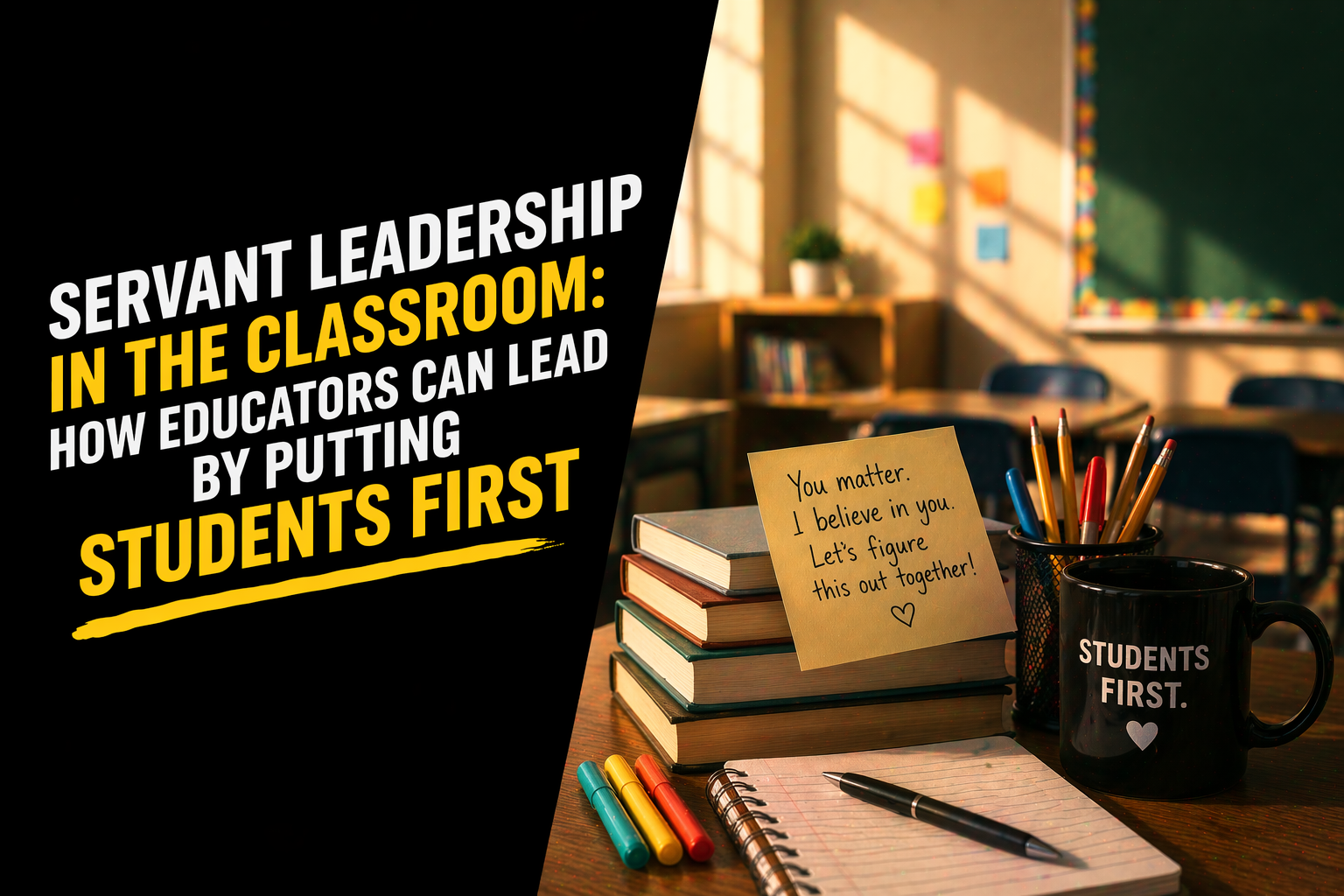
When I think about the educators who changed my life, they weren't the ones barking orders. They were the ones who sat down with me, looked me in the eye, and said, "I see you. I believe in you. Now let's get to work." That's servant leadership.
And here's what the research tells us — schools led by servant-hearted leaders have higher teacher retention, stronger student outcomes, and healthier cultures. Period.
6 Traits of a Servant Leader in Education
So what does this actually look like? Let me break it down for you. These are the six traits I believe every educator needs to lead well and serve the people in their building.
1. Empathy Before Authority
A servant leader takes time to understand what their teachers, staff, and students are actually going through. You can't lead someone you don't understand. Before you correct, connect. Before you direct, listen.
2. Humility Over Ego
Real talk — the best leaders I've ever been around are the ones who say, "I don't have all the answers, but I'm committed to finding them with you." Humility doesn't make you look weak. It makes people trust you.
3. Structure That Serves
Servant leadership is not about letting people do whatever they want. It's about creating systems and structures that set people up to win. Clear expectations. Consistent follow-through. That's love in action.
4. Vision That Inspires
People don't follow titles. They follow vision. A servant leader casts a picture of where the school is going and then says, "I need you to help us get there." That's how you get buy-in — not by demanding it, but by earning it.
5. Courage to Have Hard Conversations
Listen, serving your team sometimes means telling them what they need to hear, not what they want to hear. A servant leader doesn't avoid accountability. They deliver truth with clarity and care. You can be direct and compassionate at the same time.
6. A Heart for Legacy
This is the one that separates good leaders from great ones. Servant leaders aren't just thinking about this semester. They're thinking about the lives their students will live 10, 20, 30 years from now. They're thinking about your children's children's children. That's legacy thinking.
How to Practice Servant Leadership Every Day
Knowing the traits is one thing. Living them out is another. Here are some practical steps you can start this week.
- Ask your team one question every Monday: "What do you need from me this week to do your best work?" Then actually follow through.
- Celebrate wins publicly. When a teacher does something great, don't just tell them privately. Let the whole building know. Recognition builds culture.
- Invest in your own growth. You can't pour from an empty cup. Read. Get a mentor. Go to therapy if you need to. Your mental health is your leadership health.
- Teach what matters beyond the textbook. This is where I get passionate. If you're an educator and you're not finding ways to teach financial literacy, life skills, and stewardship to your students, you're missing one of the greatest opportunities you have. Nobody taught most of us how to budget, how to stay out of debt, or how to build wealth. You can be the one who breaks that cycle.
- Protect the culture. Every decision you make either builds trust or breaks it. Guard the environment you're creating because your students are watching how the adults in the building treat each other.
Why This Matters More Than You Think
I'll be honest with you. I didn't have a lot of servant leaders in my life growing up. I had people who told me what to do but never showed me how. I had people in authority who used their position for power, not for service.
And when I was broke at 25, living in my car, nobody sat me down and said, "Here's the plan. Here's how you get out. I believe in you." I had to figure that out on my own.
But here's what I know now. One servant-hearted leader — one teacher, one principal, one counselor — can change the entire trajectory of a young person's life. You might be the only person in that student's world who says, "You're not too far gone. You're just one decision away from a new story."
That's not just education. That's ministry. That's mission.
Conclusion
Family, servant leadership isn't a strategy. It's a lifestyle. It's choosing every single day to put the people you lead ahead of your own comfort, your own ego, and your own agenda.
Here's what we covered:
- Servant leadership means serving first and leading second
- The six traits — empathy, humility, structure, vision, courage, and legacy
- Practical steps you can start this week
- Why financial literacy and life skills are part of the servant leader's mission
The truth is, the students sitting in your classroom right now are somebody's future. They're future business owners, future parents, future community leaders. And the way you lead them today will echo for generations.
Here's your move: Pick one of those six traits and focus on it this week. Just one. Start there. And if you're looking for ways to bring financial literacy into your classroom or school, visit anthonyoneal.com for free tools and resources that can help your students start winning with money before they even graduate.
Now I want to hear from you — which of those six servant leadership traits do you need to grow in the most? Drop it in the comments. Let's build together.
Keep building,

Lorem ipsum dolor sit amet, consectetur adipiscing elit. Suspendisse varius enim in eros elementum tristique. Duis cursus, mi quis viverra ornare, eros dolor interdum nulla, ut commodo diam libero vitae erat. Aenean faucibus nibh et justo cursus id rutrum lorem imperdiet. Nunc ut sem vitae risus tristique posuere.