

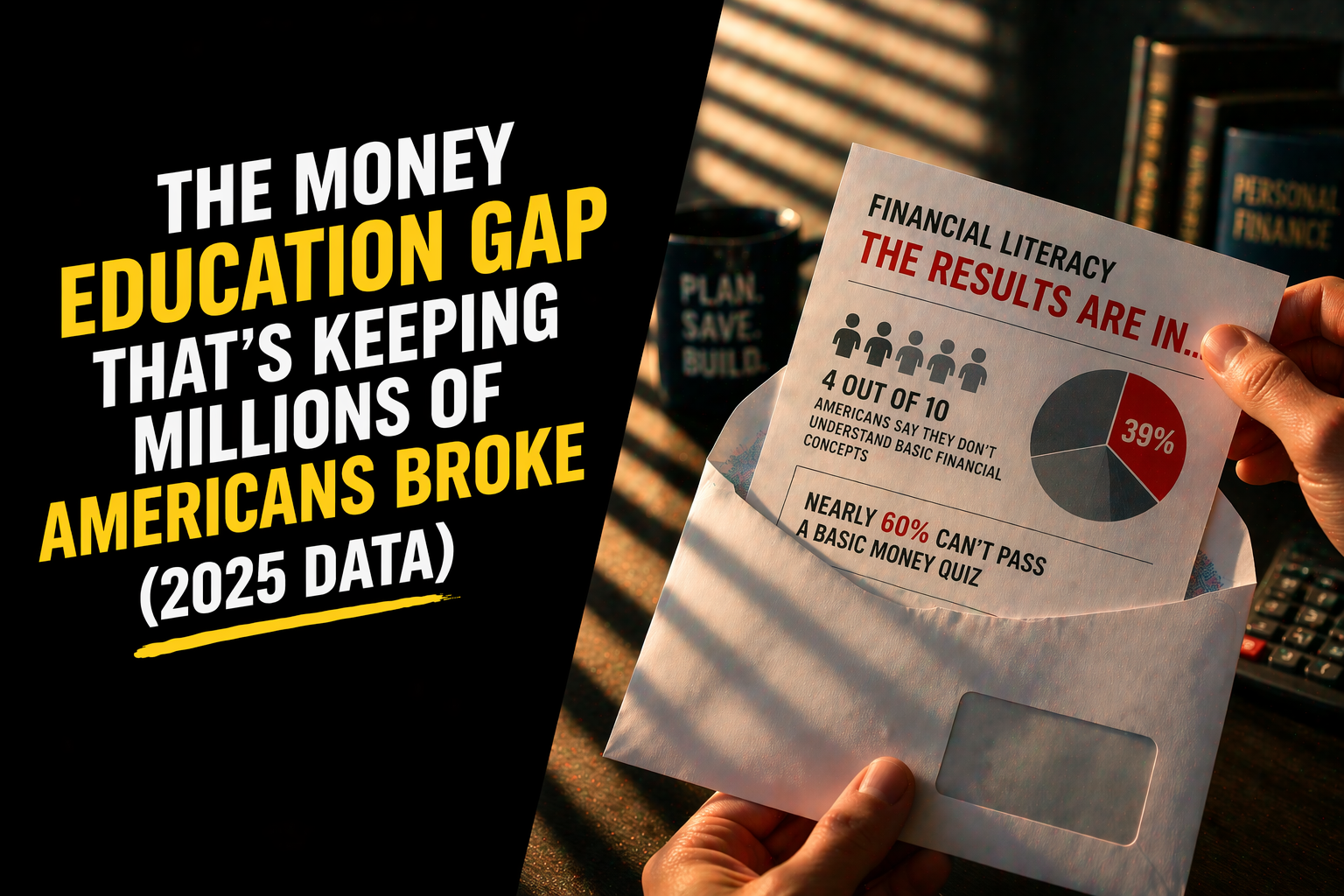
What if I told you that 87% of adults in this country said high school did not prepare them to handle money in the real world?
Let that sit for a second. That's not a guess. That's not my opinion. That's a nationally representative study from Ramsey Solutions, published in 2025, surveying over 1,000 U.S. adults.
Nearly 9 out of 10 people left high school without the tools to budget, save, invest, or even understand how debt works. And then we wonder why 60% of Americans are living paycheck to paycheck.
Family, this is not a coincidence. This is a crisis. But here's the good news — it's fixable. And today I'm breaking down exactly what the data says, why it matters for our community, and what you can do about it starting right now.
Let's get to work.
The Numbers Don't Lie: America Has a Money Education Problem
Here's what the 2025 Financial Literacy Crisis in America report found:
- 87% of U.S. adults said high school did not leave them "fully prepared" for handling money in the real world.
- Nearly 1 in 3 adults said they "often" felt stress because of money in the years after high school.
- Only 19% of adults said they took a personal finance class in high school.
- 73% of adults said they would be further ahead financially today if they had taken a personal finance class.
- 72% said they would have made fewer money mistakes.
- 71% said they would have felt less stress around money.
Read those numbers again. Slowly.
Nearly 8 out of 10 Americans are saying, "If someone had just taught me about money when I was young, my life would look different right now."
That's not regret for the sake of regret. That's millions of people who are carrying financial stress, consumer debt, and generational poverty — not because they're lazy or irresponsible, but because nobody gave them the playbook.
It's not your fault no one taught you this. But it is your responsibility to learn it now.
Why This Hits the Black Community Even Harder
Real talk. This data is about all Americans. But when I look at these numbers, I think about our community specifically.
Because here's what the report doesn't say but we all know — financial literacy was not a conversation in most of our households growing up. Not because our parents didn't love us. They did. They worked two and three jobs to keep the lights on. But they were surviving, not strategizing.
Nobody sat us down and said, "Here's how compound interest works." Nobody explained the debt snowball. Nobody told us that a high yield savings account could make our emergency fund work for us while we sleep.
And so what happened? We learned about money the hard way. Credit card debt. Car notes we couldn't afford. Student loans with no plan to pay them off. Living paycheck to paycheck and thinking that was just normal.
It's not normal. It's a system that was never designed to teach us how to win.
But we can change that. Starting with us. Starting today.
One Class Can Change Everything
Here's the part of the report that honestly gave me chills.
U.S. adults who took a personal finance class in high school are five times more likely to say they graduated fully prepared to handle money in the real world.
Five times.
One class. One semester. That's the difference between someone who graduates confident about money and someone who spends the next 10 to 15 years stressed, confused, and drowning in debt.
And the data shows the tide is starting to turn. Gen Z is the most likely generation to have taken a personal finance course — 35% compared to just 10% of baby boomers. That's progress. But only 29 states currently require a personal finance course for high school graduation.
That means in 21 states, kids are still walking across that stage with a diploma and zero understanding of how money works.
This is exactly why I went back to school. This is why I teach Consumer Economics at Virginia Union University. This is why I get up every single week and create content for this community. Because I've seen what happens when someone finally gets the right information.
They stop drowning. They start breathing. They start building.
What This Means for You Right Now
Listen, I can't go back in time and put a personal finance class in your high school. Neither can you. But here's what we can control — what we do from this moment forward.
Because the data is clear. Financial education changes outcomes. Not just feelings. Not just confidence. Actual, measurable, life-changing outcomes.
Less debt. Less stress. More wealth. More freedom.
So here's your move. And I'm keeping this cookie jar on the bottom shelf simple.
Step 1: Get Clear on Where You Stand
Pull up your bank account tonight. Look at your debt. Look at your savings. Look at your income. No judgment. Just clarity. You can't fix what you won't face.
If you need help mapping it out, go to anthonyoneal.com/getmyplan and book a free 15-minute financial plan session.
Step 2: Start Your Own Financial Education
You didn't get it in high school. Fine. Get it now. Subscribe to this newsletter. Watch the videos. Read the articles. Use the free budgeting guide on my website. Treat your financial education like the investment it is — because it pays you back for the rest of your life.
Step 3: Teach Someone Else
This is the part most people skip. But Scripture reminds us that we are called to be good stewards — not just of our own resources, but of the knowledge God gives us.
Talk to your kids about money. Have the conversation with your spouse. Share this article with a friend who's struggling. Break the cycle of financial silence in your family.
Because generational wealth doesn't start with a stock pick. It starts with a conversation.
The Bigger Picture: This Is About Legacy
I want to zoom out for a second.
This report isn't just about statistics. It's about real people. Real families. Real futures that are being shaped right now by whether or not someone has the right financial knowledge.
When I was 25, I was broke and living in my car. Nobody had taught me about money. I didn't know what a budget was. I didn't know what an emergency fund was. I didn't know that debt was a trap designed to keep me stuck.
But when I finally got the education — when someone finally put the information on the bottom shelf where I could reach it — everything changed.
I went from broke to debt-free. From debt-free to building wealth. From building wealth to now helping millions of people do the same thing.
That's not because I'm special. It's because information plus action equals transformation.
And that's available to every single one of you reading this right now.
Conclusion
Family, the financial literacy crisis in America is real. The data proves it. 87% of us left high school unprepared. Only 19% ever took a personal finance class. And the majority of Americans say their lives would be different if someone had just taught them about money.
But here's what I need you to hear — you're not too far behind. You're not too broke. You're just one decision away from a new story.
The system didn't teach us. Fine. We'll teach ourselves. We'll teach our kids. We'll teach our communities. And we'll build the kind of generational wealth that our children's children's children will benefit from.
Here's your move this week: Pick one step from above and take action on it before Sunday. Open that high yield savings account. Book that free financial plan. Have that money conversation with your family. Just start.
Which step are you taking first? Drop it in the comments — let's build together.
Keep building,

Lorem ipsum dolor sit amet, consectetur adipiscing elit. Suspendisse varius enim in eros elementum tristique. Duis cursus, mi quis viverra ornare, eros dolor interdum nulla, ut commodo diam libero vitae erat. Aenean faucibus nibh et justo cursus id rutrum lorem imperdiet. Nunc ut sem vitae risus tristique posuere.