
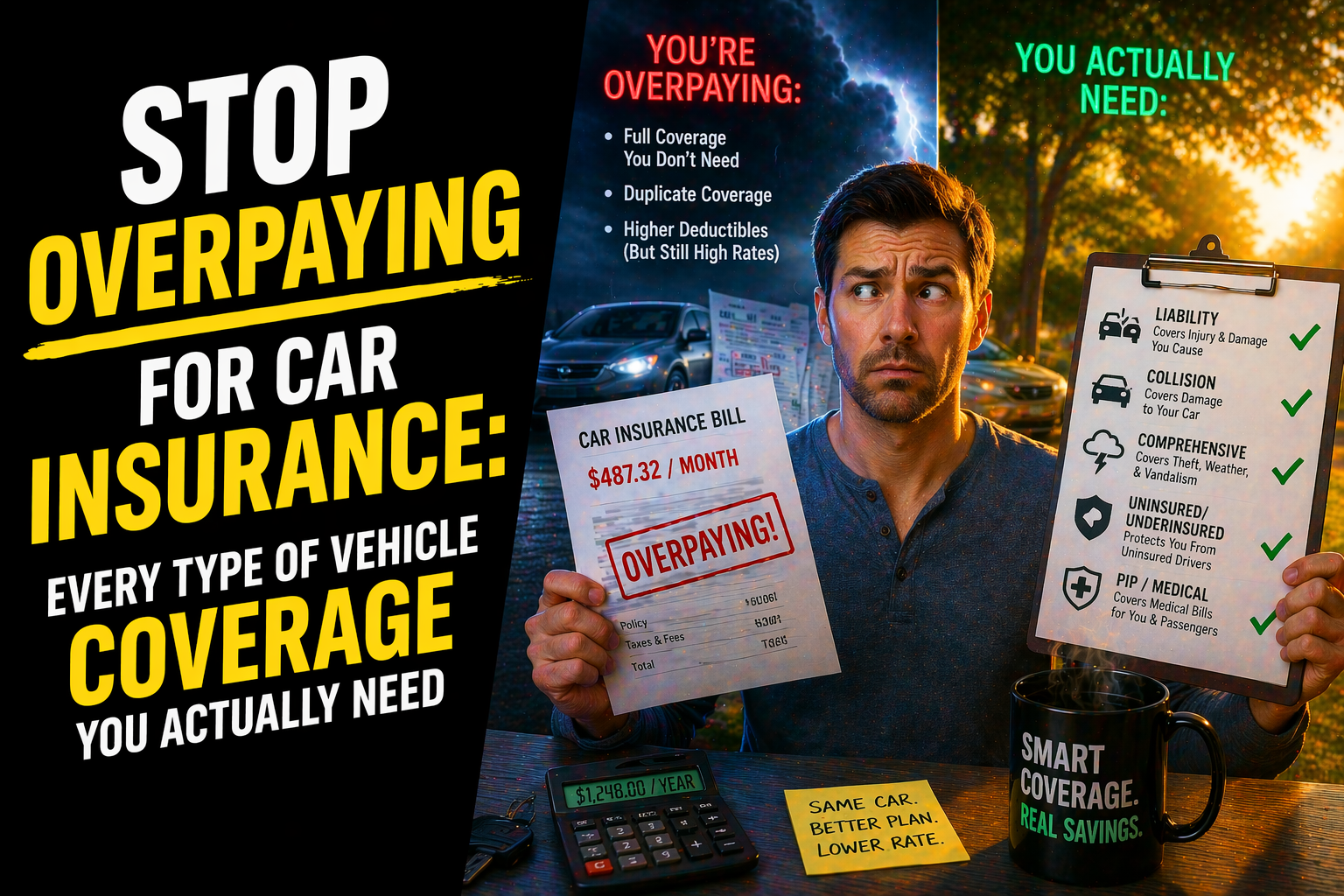
Stop Overpaying for Car Insurance: Every Type of Vehicle Coverage You Actually Need

3 min read
Key Takeaways
- Car insurance isn't one-size-fits-all. The type of coverage you need depends on what you drive, what you own, and where you are financially.
- Liability, collision, and comprehensive are the big three — but most people either have too much or too little of each.
- If your car is paid off, your insurance strategy should look completely different than someone still making payments.
- Specialty vehicles like motorcycles, RVs, and classic cars need their own policies with unique coverage.
- The right independent insurance agent can save you hundreds — sometimes thousands — per year. Stop being loyal to companies that aren't loyal to your wallet.
Let me ask you something. When's the last time you actually looked at your car insurance policy? Not just paid the bill — but actually read what you're paying for?
If you're like most Americans, the answer is probably "I don't even remember." And that's exactly how insurance companies want it. You sign up, you set it on autopilot, and every month they quietly take your money for coverage you might not even need.
Here's the truth. 64% of Americans are overpaying for car insurance right now. That's money that could be going toward your emergency fund, your investments, or paying off debt. And the worst part? Most people don't even know what their policy covers.
Today, I'm breaking down every type of vehicle insurance so you know exactly what you need, what you don't, and how to stop throwing money away. Cookie jar on the bottom shelf. Let's get to work.
Why Understanding Your Coverage Matters
Listen, family. Insurance isn't exciting. I get it. But here's what is exciting — keeping an extra $200 to $400 a month in your pocket because you stopped overpaying for coverage you don't need.
The average American spends over $2,300 a year on car insurance. That's almost $200 a month. For some of you, that's a car payment on top of a car payment. And if you're driving a paid-off vehicle? You might be paying for coverage that only makes sense when you have a loan.
Insurance is about protecting your wealth, not draining it. So let's make sure your policy is actually working for you.
Standard Auto Insurance Coverage
These are the core types of coverage that make up a typical car insurance policy. Every driver needs to understand what each one does and whether it belongs on your plan.
Liability Insurance
This is the foundation. Every state requires some form of liability coverage, and for good reason. If you cause an accident, liability insurance pays for the other person's medical bills and property damage.
There are two parts:
- Bodily injury liability: Covers medical expenses, lost wages, and legal fees if you injure someone in an accident.
- Property damage liability: Covers repairs or replacement of the other person's vehicle or property.
Here's my recommendation. Most states require minimum coverage, but minimums are not enough. If you cause a serious accident and your coverage maxes out at $25,000, guess who's paying the rest? You. Out of pocket. That could wipe out your emergency fund and then some.
Who needs it: Every single driver. No exceptions. And carry more than the state minimum.
Collision Coverage
This pays to repair or replace your car if you hit another vehicle or object — regardless of who's at fault. Ran into a guardrail? Collision covers it. Someone rear-ended you and they don't have insurance? Your collision coverage steps in.
Now here's where it gets strategic. If your car is paid off and it's worth less than $5,000, you need to ask yourself: is the premium worth it? Because you might be paying $600 a year to insure a car that's only worth $4,000.
Who needs it: Anyone with a car loan or lease (your lender requires it). If your car is paid off, do the math. If the annual premium is more than 10% of your car's value, consider dropping it.
Comprehensive Coverage
This covers everything that isn't a collision. Theft, vandalism, hail damage, a tree falling on your car, hitting a deer — all of that falls under comprehensive.
I'll be honest with you. This is one of those coverages that feels unnecessary until you need it. One bad hailstorm and you're looking at $3,000 to $5,000 in damage. If you live in an area prone to severe weather, theft, or flooding, comprehensive coverage is worth every penny.
Who needs it: Anyone with a car loan or lease. If your car is paid off but still has significant value, keep it. If your car is older and worth very little, weigh the cost.
Additional Coverage Options
Beyond the big three, there are several add-on coverages that can protect you in specific situations. Some are worth it. Some are a waste of money. Let's break it down.
Uninsured/Underinsured Motorist Coverage
This one is critical. About 14% of drivers on the road right now have no insurance at all. If one of them hits you, who's paying for your medical bills and car repairs? Without this coverage, you are.
Uninsured motorist coverage protects you when the other driver has no insurance. Underinsured motorist coverage kicks in when their policy isn't enough to cover your damages.
My take: Get this coverage. Period. It's usually inexpensive and it protects you from other people's bad decisions. You can't control what other drivers do, but you can control whether you're protected.
Medical Payments Coverage (MedPay)
This covers medical expenses for you and your passengers after an accident, regardless of who's at fault. It can cover hospital visits, surgeries, X-rays, and even dental work from an accident.
If you have solid health insurance, you might not need a high limit here. But if your health insurance has a high deductible, MedPay can fill that gap.
Who needs it: Anyone with limited health coverage or a high-deductible health plan.
Personal Injury Protection (PIP)
Similar to MedPay but broader. PIP covers medical expenses plus lost wages, childcare costs, and other expenses if you're injured in an accident. Some states require it.
Who needs it: Check your state requirements. If it's required, you need it. If it's optional and you have strong health insurance and disability coverage, you may be able to skip it.
Gap Insurance
Here's one that most people don't think about until it's too late. If you total your car and you owe more on the loan than the car is worth, gap insurance covers the difference.
Let's say you owe $25,000 on your car but it's only worth $18,000. You total it. Your insurance pays you $18,000. Without gap insurance, you still owe $7,000 on a car you can't even drive. That's a nightmare.
Who needs it: Anyone who financed a car with little or no down payment, or anyone who's upside down on their loan. And real talk — if you're in this situation, let's have a bigger conversation about how you're buying cars.
Roadside Assistance
Covers towing, flat tires, lockouts, and jump starts. It's convenient, but before you add it to your policy, check if you already have it through your car manufacturer, a membership like AAA, or even your credit card.
Who needs it: Anyone who doesn't already have roadside coverage elsewhere. Don't pay for it twice.
Specialty Vehicle Insurance
Not everything on the road — or the water — is a Honda Civic. If you own something unique, you need coverage designed for it.
Motorcycle Insurance
Motorcyclists were 28 times more likely to die in a crash than people in cars in 2023. That stat alone should tell you that coverage is non-negotiable. Motorcycle policies typically cover the bike plus liability, collision, and comprehensive — similar to auto insurance but tailored to the risks of riding.
Your cost will vary based on the type of bike, how often you ride, and where you live. Sport bikes cost more to insure than cruisers. Weekend riders pay less than daily commuters.
Classic Car Insurance
If you've got a classic car — something 25+ years old that you keep as a collector's item — standard auto insurance doesn't make sense. Classic car policies use "agreed value" coverage instead of actual cash value. You and the insurer agree on what the car is worth upfront, and that's what you get if it's totaled.
These policies usually have mileage limits since you're not daily driving a 1967 Mustang to the grocery store. And they often cover the higher cost of specialty parts and repairs.
RV Insurance
Before you hit the open road in that Airstream, you need RV-specific coverage. These policies cover the vehicle and the living space. Coverage varies based on whether you use your RV full-time or recreationally, and the size class of your motor home.
Boat Insurance
If you own a watercraft under 27 feet — pontoon boats, speedboats, fishing boats — you need boat insurance. It covers liability, damage, theft, and medical payments, similar to auto insurance but for the water. Your cost depends on the size, type, and location of your boat.
Temporary and Situational Coverage
Sometimes you need coverage for a car you don't own or a situation that's temporary. Here's what to know.
Rental Car Insurance
The rental car agent is going to push hard for you to buy their coverage. Before you say yes, check your existing auto policy. In most cases, your personal auto insurance covers you in a rental car the same way it covers your own vehicle.
The exception? If you don't have your own auto policy, or if you're renting something exotic or oversized that your policy excludes. In those cases, the rental coverage makes sense.
Non-Owner Car Insurance
This is for people who regularly drive cars they don't own — frequent rental car users, rideshare drivers, or someone borrowing a vehicle long-term. It primarily provides liability coverage. If you're just borrowing a friend's car for a few days, their policy likely covers you. This is for extended situations.
What This Means For Your Money
Here's the real talk. Insurance is supposed to protect your wealth, not destroy it. If you're paying $300 a month for coverage you don't need on a car that's worth $8,000, that's money you could be investing.
If you're still in debt:
- Carry the coverage your lender requires
- Shop around every 6 to 12 months for better rates
- Raise your deductible to lower your premium (but make sure you can cover that deductible from your emergency fund)
If your car is paid off:
- Reassess collision and comprehensive based on your car's value
- Keep strong liability and uninsured motorist coverage
- Drop gap insurance — you don't need it anymore
If you're building wealth:
- Increase your liability limits to protect your assets
- Consider an umbrella policy for additional protection
- Work with an independent agent who shops multiple carriers for you
Conclusion
Family, this isn't about cutting corners. This is about being a good steward of your money.
Every dollar you overpay on insurance is a dollar that's not going toward your emergency fund, your investments, or your children's future. And every dollar you underpay is a risk that could wipe out everything you've built.
The goal is the right coverage at the right price. Not the cheapest. Not the most expensive. The right one for where you are right now.
Here's your move: Pull up your current auto insurance policy this week. Compare what you're paying to what you actually need based on what we just covered. Then go get quotes. It takes 10 minutes and could save you hundreds.
Which type of coverage surprised you the most? Drop it in the comments — let's talk about it.
Keep building,

Lorem ipsum dolor sit amet, consectetur adipiscing elit. Suspendisse varius enim in eros elementum tristique. Duis cursus, mi quis viverra ornare, eros dolor interdum nulla, ut commodo diam libero vitae erat. Aenean faucibus nibh et justo cursus id rutrum lorem imperdiet. Nunc ut sem vitae risus tristique posuere.
like what you’ve just read?
Make sure to share it with your tribe!
.webp)
like what you’ve just read?
Make sure to share it with your tribe!


