
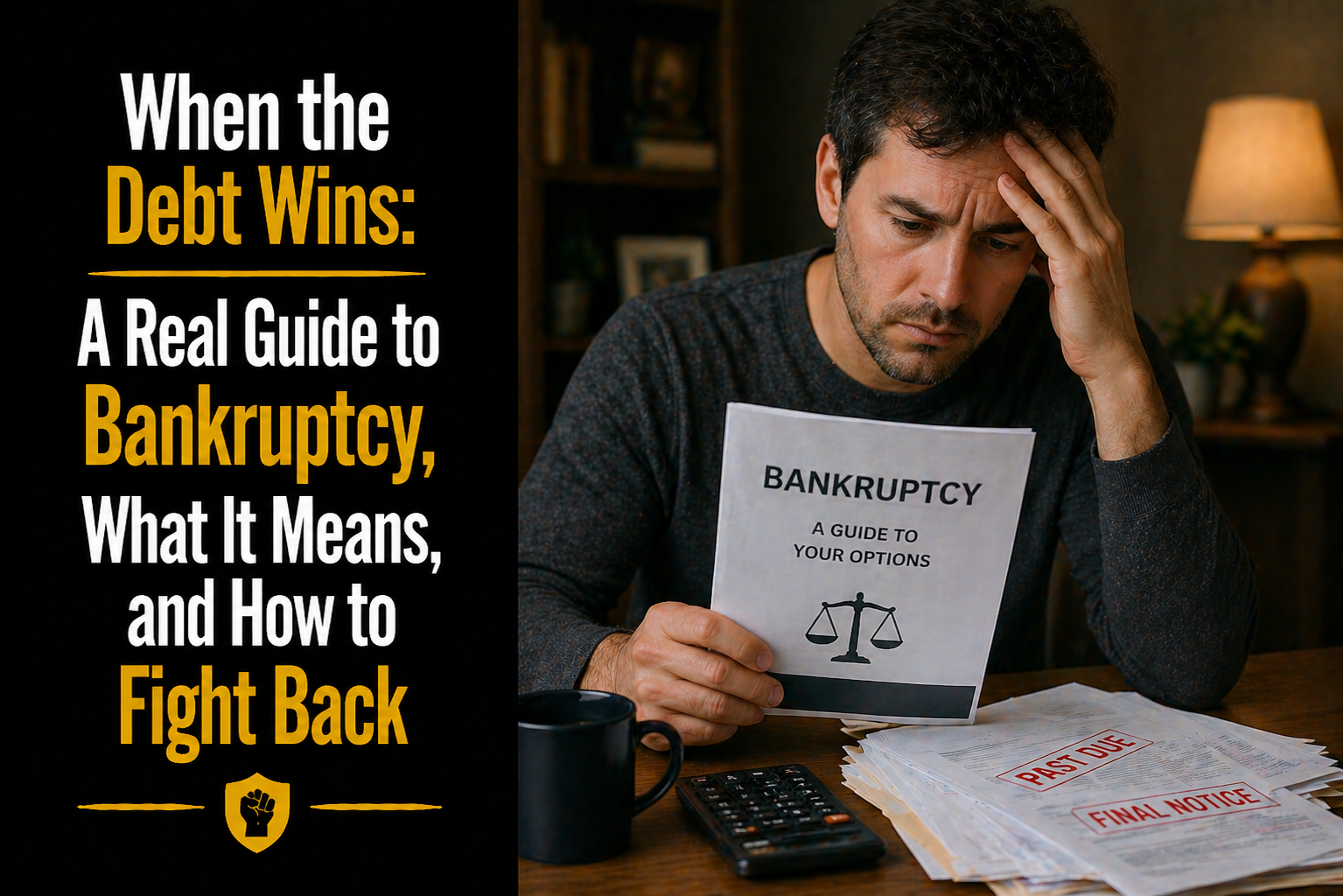
When the Debt Wins: A Real Guide to Bankruptcy, What It Means, and How to Fight Back

3 min read
Key Takeaways
- Bankruptcy is a federal legal process where a court decides which of your debts get erased and which ones you still have to pay back.
- Most bankruptcy cases require you to sell assets to repay creditors — you don't just get to walk away with everything intact.
- Certain debts like student loans, tax debt, child support, and alimony are never erased by bankruptcy.
- There are six types of bankruptcy — Chapter 7 and Chapter 13 are the most common for individuals.
- Bankruptcy is a last resort. There are real alternatives that can help you avoid it entirely.
If you're reading this, you might be in one of the hardest seasons of your financial life.
Maybe the calls won't stop. Maybe you've fallen behind on everything. Maybe someone told you bankruptcy is your only way out — and now you're trying to figure out if that's actually true.
I want to help you understand exactly what bankruptcy is, what it does, what it doesn't do, and what your real options are before you make a decision that follows you for the next decade.
This isn't about shame. It's about truth. And the truth is — bankruptcy is not the clean slate most people think it is.
Let's break it all the way down.
What Is Bankruptcy?
How Bankruptcy Works
Does Bankruptcy Clear All Debt?
The 6 Types of Bankruptcy
What Happens When You File?
The Real Downsides of Bankruptcy
Should You Declare Bankruptcy?
5 Alternatives to Bankruptcy
Bankruptcy FAQ
What Is Bankruptcy?
Bankruptcy is a legal process — handled through the federal court system — where you declare that you cannot pay your debts, and a judge decides which debts get discharged (erased) and which ones you're still responsible for.
It's not a loophole. It's not a trick. And it is not free.
Bankruptcy can offer some temporary relief — like stopping debt collectors from calling and pausing a foreclosure. But it comes with serious, long-lasting consequences that most people don't fully understand until they're already in the middle of it.
This should always be your last option — not your first move when things get hard.
How Bankruptcy Works
When you file for bankruptcy, the federal court assigns you a trustee — someone who reviews everything you own (your assets) and everything you owe (your liabilities).
If the court determines you genuinely cannot repay what you owe, a judge may discharge some or all of your debt. But here's what most people don't realize:
In most cases, you will be required to sell your assets to pay back your creditors first. This is called liquidation.
Bankruptcy is not a way to erase all your debt and keep all your stuff. If you have secured debt — meaning debt tied to an asset like a car or a house — you either sell the asset or you keep making the payments. There is no third option.
The entire process runs through the federal court system and can take anywhere from four months to five years, depending on the type of bankruptcy you file and the laws in your state.
Does Bankruptcy Clear All Debt?
No. And this is one of the biggest misconceptions out there.
Unsecured debt — like medical bills and credit card balances — can often be discharged. But there is a long list of debts that bankruptcy will never touch.
Bankruptcy does NOT erase:
- Student loans
- Federal and state tax debt, fines, or government penalties
- Child support and alimony
- Secured debts like your home mortgage or car loan (you keep the debt if you keep the asset)
- Large purchases made right before filing — like jewelry, electronics, or luxury items
- Court-ordered restitution or criminal fines
If you're carrying student loan debt or back taxes, bankruptcy will not save you from those. You need a different plan for those — and I can help you build one.
The 6 Types of Bankruptcy
There are six types of bankruptcy under U.S. law. Most individuals will only ever deal with two of them — but here's the full picture so you know what you're looking at.
Chapter 7 — Liquidation Bankruptcy
This is the most common type for individuals. In a Chapter 7, non-exempt assets are sold off to pay creditors. The process typically wraps up in a few months — but the record stays on your credit report for 10 years.
To qualify, you have to pass what's called the means test — proving your income is low enough that you genuinely cannot repay your debts.
Chapter 13 — Reorganization Bankruptcy
Chapter 13 is for individuals with a higher income who can repay debt — just not all at once. Instead of liquidating assets, you follow a court-approved repayment plan that lasts 3 to 5 years.
This option lets you keep more of your property, but it requires consistent payments over years. It stays on your credit report for 7 years after filing.
Chapter 11 — Business Reorganization
Chapter 11 is primarily for businesses. It allows a company to keep operating while restructuring its debt under court supervision. Some high-income individuals use it too, but it's complex and expensive.
Chapter 12 — Family Farms and Fisheries
Chapter 12 is specifically designed for family farmers and commercial fishermen. It allows them to restructure debt and avoid foreclosure on their property through a repayment plan.
Chapter 9 — Municipal Bankruptcy
Chapter 9 is for cities, towns, school districts, and other government entities. Individuals cannot file Chapter 9. This is what cities like Detroit used when they hit financial collapse.
Chapter 15 — International Cases
Chapter 15 handles cross-border bankruptcy cases involving foreign companies or individuals with assets in multiple countries. It's rare and highly specialized.
What Happens When You File?
The moment you file for bankruptcy, a federal court order called an automatic stay goes into effect immediately. Here's what that means in real time:
- Creditors must stop all collection activity — no more calls, letters, or lawsuits
- Foreclosure on your home is paused
- Your car cannot be repossessed
- Wage garnishment stops — meaning creditors can no longer take money directly from your paycheck
- A 341 meeting is scheduled — this is a hearing where the trustee and creditors can review the facts of your case and potentially negotiate repayment terms
The automatic stay feels like relief. And it is — temporarily. But it is not a solution. It's a pause. The real work is still ahead of you.
The Real Downsides of Bankruptcy
Family, I'm not going to sugarcoat this. Bankruptcy is one of the most financially damaging decisions a person can make — and the effects last far longer than most people expect.
Your Financial Life Becomes Public Record
When you file for bankruptcy, your name and the details of your case go into public court records. That means potential employers, landlords, banks, and business partners can access it. For some people, that affects job opportunities and housing options for years.
Filing Costs Money You Probably Don't Have
The filing fees alone are $335 for Chapter 7 and $310 for Chapter 13. Add attorney fees — which can easily run into the thousands — and you're spending a significant amount of money just to declare that you can't pay your bills.
It Hits Your Credit Hard — and Stays There
- Chapter 7 stays on your credit report for 10 years
- Chapter 13 stays on your credit report for 7 years
That's a long time to carry that weight. And while we don't worship the credit score around here, it does affect your ability to rent an apartment, get a mortgage, or even land certain jobs.
Homeownership Gets Pushed Back
If buying a home is part of your vision — and it should be — bankruptcy can delay that dream by 1 to 4 years. Mortgage lenders see bankruptcy as a major red flag, and most won't touch your application until enough time has passed and you've rebuilt your financial foundation.
It Doesn't Fix the Root Problem
This is the one that matters most. Debt is a symptom. The habits, the system, the lack of financial education that created the debt — bankruptcy doesn't address any of that. Without changing the behavior, many people find themselves right back in the same situation within a few years.
Should You Declare Bankruptcy?
I'm not going to make that call for you. Only you, your family, and possibly a trusted attorney can make that decision based on your specific situation.
What I will tell you is this: bankruptcy should be your absolute last resort — not your first move when things get hard.
For some people, it genuinely is the only path forward. If you're buried under an impossible amount of unsecured debt with no realistic way out, bankruptcy may be the tool that gives you a fighting chance. I understand that. And there is no shame in being in a hard place.
But here's what I've seen over and over again: many people who believe they need bankruptcy can actually pay off their debt faster than they think — with the right plan, the right support, and the right mindset.
Before you file, try everything else first.
5 Alternatives to Bankruptcy
1. Negotiate Directly With Your Creditors
Pick up the phone and call. Creditors would rather receive something than risk getting nothing in a bankruptcy proceeding. Ask about hardship programs, reduced interest rates, or modified payment plans. If you're behind on your mortgage, ask your loan servicer about forbearance or loan modification. You have more leverage than you think.
2. Build a Real Budget and Stick to It
You cannot fight debt without a budget. A budget is not a punishment — it's a plan. It tells your money where to go before the month starts. Use a tool like EveryDollar or a simple spreadsheet. Know your numbers. That's where freedom starts.
3. Cut Your Expenses to the Bone
Cover your four walls first — food, utilities, shelter, and transportation. Everything else is on the table. Subscriptions, dining out, entertainment — cut it. Not forever. Just for a season. The sacrifice is temporary. The freedom is permanent.
4. Sell Everything You Can
If you file bankruptcy, you may lose your assets anyway. So take control now. Sell what you don't need — online, at a garage sale, through Facebook Marketplace. Put every dollar straight toward your debt. You stay in charge of the process instead of a court trustee.
5. Increase Your Income
Take on extra hours. Start a side hustle. Deliver groceries. Drive for a rideshare. Do what it takes — for a season — to throw more money at your debt. This is war. Treat it like one. The extra income won't last forever, but the freedom it buys you will.
Get Help Before You Make This Decision
You do not have to walk through this alone.
If you're staring down a mountain of debt and wondering if bankruptcy is your only option, I want you to hear me clearly: you are not too far gone. You are one decision away from a different story.
But you need a real plan — not just hope. Connect with a financial coach who can look at your specific situation and help you map out a path forward. Talking about money is hard. But it's a lot easier than walking into a courtroom and having your entire financial life laid out for a judge to decide.
Get help now. Before it gets to that point.
Conclusion
Family, bankruptcy is real. For some people, it may be the only way through an impossible situation. I'm not here to judge anyone for where they are financially. Life happens. Systems fail people. And sometimes the debt wins — for a season.
But I need you to know the full truth before you make this decision:
- Bankruptcy is not a clean slate
- It follows you for 7 to 10 years
- It doesn't erase all debt
- It costs money to file
- And it doesn't fix the root problem
Before you go that route, try everything else. Budget hard. Cut deep. Sell what you can. Negotiate with your creditors. Increase your income. And get with someone who can help you build a real plan.
You were not designed to stay stuck in debt. God didn't bring you this far to leave you buried.
Here's your next step: Use the free debt calculator at anthonyoneal.com to see exactly where you stand. Then come back and tell me — what's the one thing standing between you and financial freedom right now?
Drop it in the comments below. Let's build together.
Keep building,

Lorem ipsum dolor sit amet, consectetur adipiscing elit. Suspendisse varius enim in eros elementum tristique. Duis cursus, mi quis viverra ornare, eros dolor interdum nulla, ut commodo diam libero vitae erat. Aenean faucibus nibh et justo cursus id rutrum lorem imperdiet. Nunc ut sem vitae risus tristique posuere.
like what you’ve just read?
Make sure to share it with your tribe!
.webp)
like what you’ve just read?
Make sure to share it with your tribe!


