

Let me be real with you for a second, family.
You've been doing the right thing. You've been saving. You've been disciplined. You've been putting money aside every month — and your bank has been quietly paying you almost nothing in return.
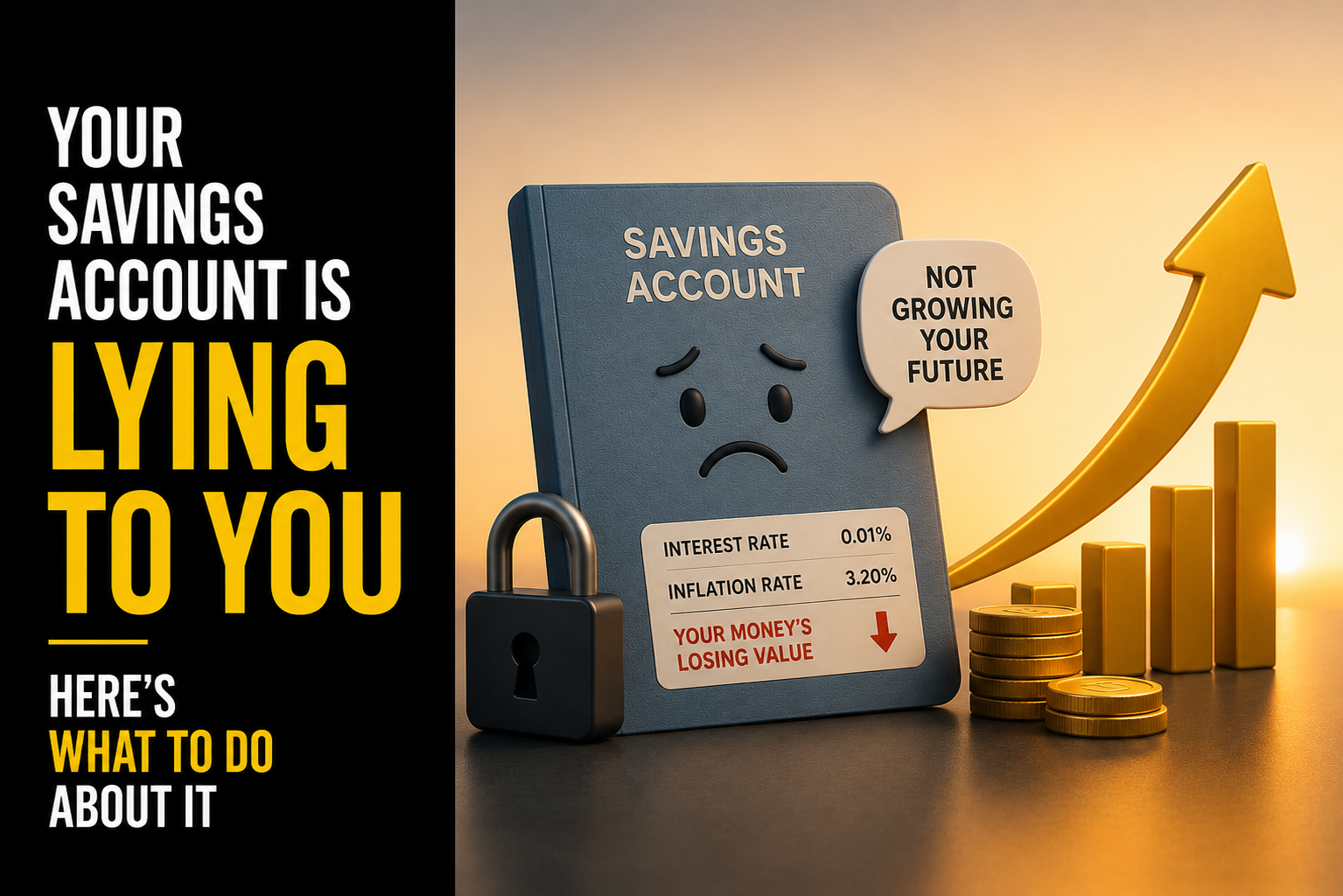
The average traditional savings account pays around 0.39% interest. That means if you've got $5,000 saved up, your bank is handing you back about $19 a year. Nineteen dollars. That's not a reward — that's an insult.
But here's the good news: there's a better option, and most people have never heard of it. It's called a High-Yield Savings Account — and today I'm going to break it all the way down for you. Cookie jar on the bottom shelf. Let's get to work.
What Exactly Is a High-Yield Savings Account?
A High-Yield Savings Account — you'll hear it called an HYSA — is a type of savings account that pays you a dramatically higher interest rate than what your traditional bank is offering.
While most big banks are sitting at 0.39%, a high-yield savings account can offer anywhere from 3% to 5% APY (Annual Percentage Yield). That's nearly 10 times more interest on the same money you already have saved.
Same discipline. Same deposit. Just a smarter place to keep it.
Most HYSAs are offered through online banks. Because they don't have physical branches to maintain — no rent, no lobby, no overhead — they pass those savings directly to you through higher interest rates. And before you ask: yes, your money is still FDIC-insured up to $250,000, just like any traditional bank. It's safe.
How Does a High-Yield Savings Account Actually Work?
Let me show you the math, because numbers don't lie.
Say you've got $10,000 saved — maybe it's your emergency fund, maybe it's a down payment you're building toward.
In a traditional savings account at 0.39%, after one full year you've earned about $39.
In a high-yield savings account at 4%, after one full year you've earned about $400.
That's over $360 more — just for moving your money to the right account. No extra risk. No extra work. Just a smarter decision.
The interest in most HYSAs compounds daily or monthly, which means your money is growing on top of itself over time. It's not going to make you a millionaire — but it's going to make sure your savings aren't sitting flat while inflation quietly eats away at them.
The Real Pros of a High-Yield Savings Account
Family, let me give you the honest breakdown of why these accounts are worth your attention.
You earn significantly more interest.
This is the whole point. Getting 10 times the interest rate of a traditional savings account is not a small deal — especially when you're building an emergency fund or saving for a specific goal.
Your money is safe.
FDIC insurance protects your deposits up to $250,000. That means even if the bank went under tomorrow, your money is backed by the federal government. You're not taking on any risk here.
You can access your money anytime.
Unlike some investments where pulling your money out is complicated or penalized, a high-yield savings account lets you access your funds whenever you need them. That makes it a perfect home for your emergency fund — money that needs to be available at a moment's notice.
It's a great fit for short-term goals.
Saving for a car? A vacation? A down payment on a house? A HYSA is the right tool. Your money grows faster, stays liquid, and stays safe while you work toward that goal.
The Honest Cons You Need to Know
I'm not going to sell you something without giving you the full picture. That's not how I operate.
It is not a long-term investment.
I need you to hear this clearly. A high-yield savings account earning 4% or 5% cannot compete with a well-diversified mutual fund that has historically returned 10–12% over decades. If you're building for retirement — for your children's children's children — you need to be investing, not just saving. A HYSA is not a substitute for a Roth IRA or a 401(k).
The interest rate can change.
Banks can adjust their rates at any time. The 4.5% you sign up for today might be 3% six months from now. The rate is variable, not guaranteed. That's why this is a short-term tool, not a long-term strategy.
It's usually online only.
Most high-yield savings accounts are offered through online banks, which means no physical branch to walk into. If you prefer face-to-face banking, that's something to consider. But for most people, managing an account through an app or website is no problem at all.
Who Actually Needs a High-Yield Savings Account?
Let me make this simple. A HYSA is the right move if:
- You are building or storing your emergency fund (this is the best use)
- You are saving for a short-term goal — a car, a trip, a down payment
- You want your cash to work harder without taking on any investment risk
- You are currently keeping your savings in a traditional account earning next to nothing
If you're still paying off debt, you can still open one for your starter emergency fund of one month of take-home pay. Once you're debt-free and building that full 3–6 month emergency fund, a HYSA is exactly where that money should live.
What to Look for When Choosing One
Not every high-yield savings account is worth your time. Here's what matters:
A competitive interest rate. Look for accounts offering 4% APY or higher. Compare a few options before you commit.
No monthly maintenance fees. Fees will eat into your interest earnings. Find an account with zero monthly charges.
No high minimum balance requirements. You shouldn't be penalized for starting small. Look for accounts with low or no minimums.
FDIC or NCUA insurance. This is non-negotiable. Make sure your money is federally protected.
Easy access to your funds. You should be able to transfer money in and out without jumping through hoops or waiting days to access your own cash.
How to Open One — It Takes Less Than 15 Minutes
Opening a high-yield savings account is one of the easiest financial moves you'll ever make. Here's how:
Step 1 — Do your research.
Search online for FDIC-insured high-yield savings accounts and compare current rates. Look for the criteria listed above.
Step 2 — Choose your bank.
Pick an online bank or credit union that offers a competitive rate, no fees, and easy access to your money.
Step 3 — Provide your information.
You'll need a government-issued ID — a driver's license or passport — along with your Social Security number.
Step 4 — Make your first deposit.
Transfer funds from your existing checking or savings account to get started. Some accounts let you open with as little as $1.
That's it. Four steps. Less than 15 minutes. And your money starts working harder immediately.
The Bottom Line
Here's what I need you to walk away with today, family.
A high-yield savings account is not going to make you wealthy on its own. But it is going to make sure that the money you've already worked hard to save is not sitting idle while your bank profits off of it.
Use it for your emergency fund. Use it for short-term savings goals. Use it as a smarter parking spot for cash you're not ready to invest yet.
And when it's time to build real, long-term wealth — get that money into mutual funds, max out your Roth IRA, and start investing with intention. That's where generational wealth is built.
But right now? If your savings are sitting in a traditional account earning 0.39%, this is your sign to make the switch.
Here's your move: This week, open a high-yield savings account and transfer your emergency fund into it. Stop letting your bank keep the interest that belongs to you.
Now I want to hear from you — are you currently using a high-yield savings account, or has your money been sitting in a traditional account all this time? Drop it in the comments below. Let's talk about it.
Keep building,

Anthony O'Neal is a bestselling author, speaker and personal finance educator. He teaches families how to get out of debt and build real wealth on any income through The Escape Plan, his show The Table with AO, and the In the Black app.
more articles
Money Tips
October 22, 2026
Building a Stewardship Ministry That Actually Changes Lives: A 5-Step Guide for Pastors
Money Tips
October 22, 2026
A Smarter Way to Make Extra Money This Christmas Season
Money Tips
October 21, 2026
Extra Work Won't Save You If It Burns You Out First
Money Tips
October 21, 2026
15 Passive Income Streams You Can Actually Build in 2026 (Ranked by Effort)
Money Tips
October 20, 2026
Five Families, Five Different Paths to an Extra $1,000
Money Tips
October 20, 2026
Extra Income for Parents: How to Build Margin Without Sacrificing Family Time
Where this fits
The Escape Plan
Five phases, one plan. Find where you are, then take the next step.
In The Black
A coach in your pocket
Daily money assignments and real accountability, built around the Escape Plan. Know your next step every single day.
$59.99 a quarter or $179.99 a year
Get In The Black →Get the plan in your inbox.
Weekly money tips, real stories, and my free Wealth Checklist.
Free. Unsubscribe anytime.