
Half of America Is Broke and Hopeful at the Same Time — Here's What the Data Really Says About Your Money in 2026

3 min read
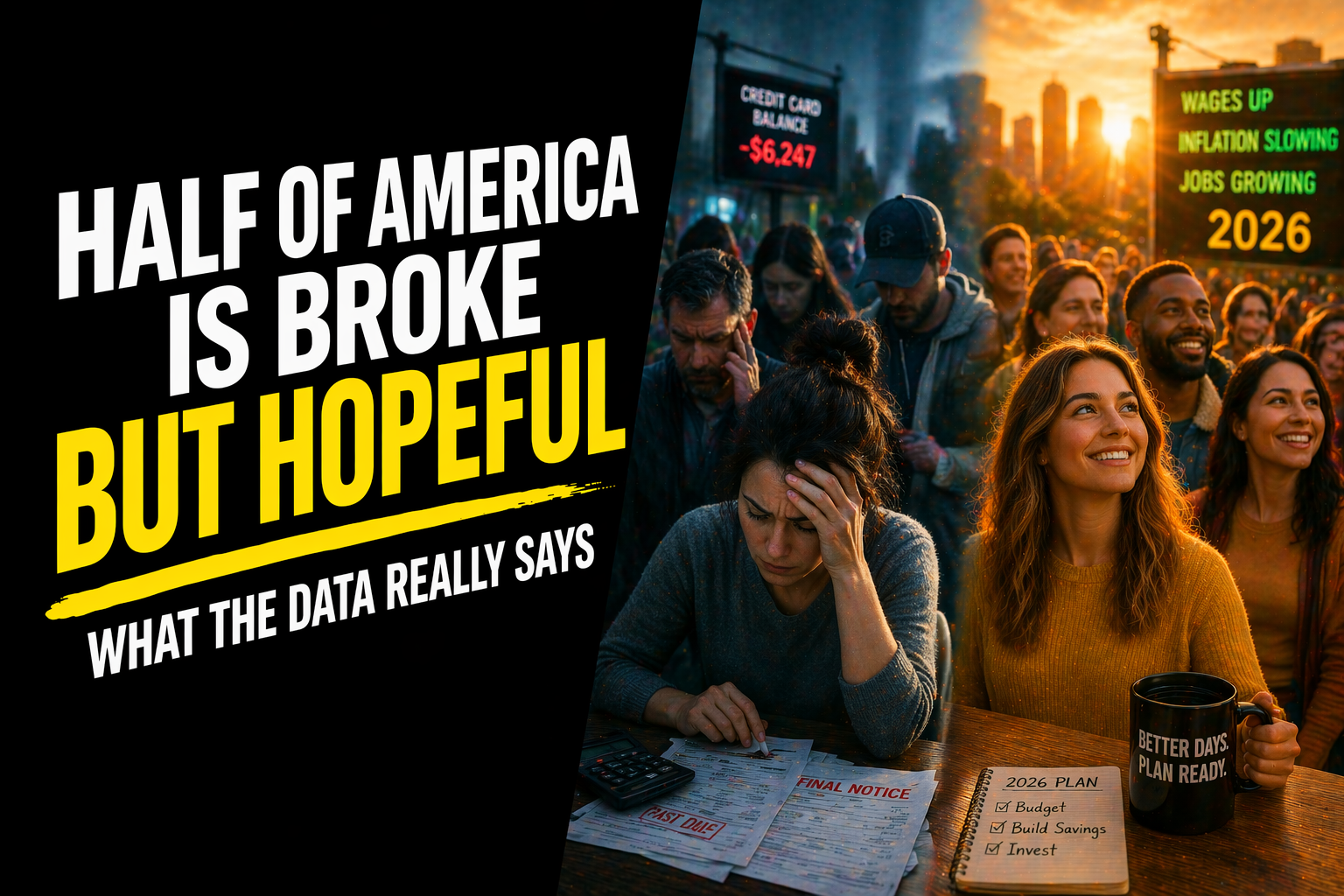
What if I told you that 51% of Americans are living paycheck to paycheck right now, but 79% say they're optimistic about their financial future?
Let that sit for a second.
Half the country can't survive a missed paycheck, but almost 8 out of 10 people believe things are going to get better. That's not just a contradiction. That's a crisis hiding behind a smile.
Listen, family. Hope is powerful. I believe in hope. But hope without a plan is just a wish. And wishes don't pay bills, build emergency funds, or create generational wealth for your children's children's children.
Today, I'm breaking down the real numbers behind where Americans stand with money heading into 2026 — and more importantly, what you need to do about it right now. Because the data doesn't lie, and some of these stats should shake you awake.
Let's get to work.
America Is Split Right Down the Middle
The latest research from Ramsey Solutions' State of Personal Finance Q4 2025 report paints a picture that honestly looks like two different countries living side by side.
On one side, you've got people who are making progress. They're saving. They're investing. They're sleeping at night.
On the other side, you've got families who are one car repair away from a financial meltdown.
Here's what the numbers actually say:
- 51% of Americans are living paycheck to paycheck
- 48% say they're happy with their personal finances — but that means 52% are not
- Only 20% feel like they're actually getting ahead with money
- 35% feel trapped in a cycle of debt
- 34% say they are struggling or in crisis financially
Real talk. When only 1 in 5 people feel like they're making progress, we have a systemic problem. And it's not just about income. It's about behavior, structure, and discipline.
"It's not about how much you make. It's about what you do with what you have."
The Worry Is Real — But It's Getting Slightly Better
Here's something interesting buried in the data. About 52% of Americans worry daily about their finances. Daily. That means every single morning, more than half the country wakes up stressed about money before their feet even hit the floor.
But there's a small win hiding in here.
34% of Americans say they've lost sleep over money in the past three months — and that's actually the lowest number in five years. Five years. So while the worry is still heavy, fewer people are tossing and turning at 2 a.m. over their bank account.
Progress is progress, family. Even small wins matter.
But let me be direct with you. If you're in that 52% who worries daily, that stress isn't just uncomfortable. It's destructive. Financial stress affects your health, your relationships, your job performance, and your mental clarity.
You can't think strategically about building wealth when your brain is consumed with survival.
That's why getting a plan isn't optional. It's urgent.
The Emergency Fund Problem Nobody Wants to Face
This stat right here should concern every single one of us.
Only 45% of Americans are "very confident" they could handle a $1,000 emergency expense.
A thousand dollars. That's a car repair. A medical bill. A busted water heater. That's not some catastrophic event. That's just life happening.
And more than half the country isn't confident they could cover it.
Here's what else the data shows:
- 45% of adults report some difficulty paying bills
- 37% have difficulty providing food
- 1 in 3 paid a bill late in the last three months
- 57% of renters have had difficulty making rent recently — a 15-point jump in just two quarters
Family, this is why I talk about the emergency fund until I'm blue in the face. Before you invest a single dollar, before you think about stocks or real estate or side hustles, you need 3 to 6 months of your net pay sitting in a high yield savings account.
Not 3 to 6 months of expenses. Your net pay. Because when life hits — and it will hit — you need a cushion thick enough to absorb the blow without sending you into debt.
Here's your move: If you don't have a high yield savings account yet, go open one today. Not tomorrow. Today. Most of these accounts are paying between 4% and 5% right now. Your money should be working while you sleep, not sitting in a traditional bank earning 0.01%.
Cookie jar on the bottom shelf — just open the account and start with whatever you have. Even $50. The habit matters more than the amount.
Younger Generations Are Getting Hit the Hardest
If you're a millennial or Gen Z watching this, I need you to pay close attention.
The data shows that younger Americans are struggling more than any other group:
- 67% of Gen Z say they live paycheck to paycheck
- 63% of millennials say the same
- 65% of Gen Z have the most trouble with bills
- 54% of millennials have paid a bill late recently
Listen, I'm not saying this to shame anyone. It's not your fault that nobody taught you this stuff in school. Financial literacy wasn't on the curriculum. But it is your responsibility to learn it now.
The system wasn't designed for us to win. But that doesn't mean we can't beat it.
If you're in your 20s or 30s and you're reading this, you actually have the most powerful wealth-building tool on your side — time. The earlier you start, the more compound interest works in your favor. But you've got to start. You've got to get out of the red and into the black.
Overspending Is Quietly Killing Our Progress
Here's a stat that connects a lot of dots.
38% of Americans say they spent more than they planned last month.
That correlates almost perfectly with the 34% who say they're struggling or in crisis. Coincidence? Not even close.
Overspending is the silent wealth killer. It doesn't feel dangerous in the moment. It's $20 here, $50 there, another subscription you forgot about, another impulse buy that felt good for 10 minutes.
But those small leaks sink big ships.
And here's the thing the data confirms — Americans with debt are twice as likely to be struggling as those who are debt-free. Twice.
Debt doesn't just cost you money. It costs you peace. It costs you options. It costs you the ability to say yes when an opportunity shows up.
This is why I teach the debt snowball method. Not the avalanche. The snowball. Because getting out of debt isn't just math. It's behavior. You need quick wins to build momentum. You need to feel that first debt disappear so you believe the next one can too.
Your move: List every single debt you have from smallest to largest. Attack the smallest one first with everything you've got while making minimum payments on the rest. When that first one is gone, roll that payment into the next one. One win at a time. That's how you build freedom.
Money and Relationships — We've Got to Do Better
Now let me talk about something that hits close to home for a lot of us.
The data shows that 56% of married couples never had a serious conversation about money before getting married.
More than half. They said "I do" without ever getting financially naked with each other.
And here's what's wild — married adults who rated their marriages as "great" were significantly more likely to have had money conversations before the wedding.
Money is the number one thing couples fight about. It destroys marriages. It builds resentment. It creates secrets and shame.
But it doesn't have to.
Some other interesting findings:
- 63% of Americans would rather have a financially stable partner than a romantic one who's bad with money
- 73% of women chose financial stability over romance
- 34% believe the man should pay on a first date
What does this tell us? People value financial responsibility. They want a partner who has their money together. But then over half of couples skip the money conversation entirely before marriage.
That's a disconnect we have to fix.
If you're in a relationship right now, have the conversation. Tonight. Talk about debt. Talk about dreams. Talk about how you want to build together. It might be uncomfortable for 30 minutes, but it could save your marriage for 30 years.
The Good News — Hope Is Not Dead
I don't want to leave you heavy, family. Because there is real hope in this data too.
When asked to describe their financial outlook for 2026 in one word:
- 32% said "hopeful"
- 26% said "confident"
The number one New Year's resolution for 2026? Saving money — for the second year in a row. That beat out eating healthier, exercising, and losing weight.
55% of Americans say they plan to save more money in 2026. And 1 in 4 plan to increase their charitable giving.
That tells me something. People want change. People are ready. They just need the right plan and the right information.
And here's what I believe with everything in me — winning with money is 80% behavior and 20% head knowledge. You don't need a finance degree. You don't need to understand every stock ticker. You need discipline, a plan, and the willingness to sacrifice for a season so you can live free for a lifetime.
Beans and rice for a season. Then enjoy life.
The Faith Factor Nobody Talks About
I can't write this article and not mention this.
One of the things that separates my approach from a lot of financial voices out there is that I believe faith and money work together. They're not in conflict.
Scripture reminds us that we are stewards, not owners. Everything we have — every dollar, every opportunity, every breath — belongs to God. And when we manage it well, when we're generous, when we tithe and give back, something shifts.
I'm not promising you that tithing will make you rich overnight. That's not how it works. But I've never seen God let a generous person go broke. Not once.
If you're looking for a wealth secret that most people skip over, try this — give God the first 10% and watch what happens with the other 90%. It doesn't make sense on paper. But faith moves mountains that math can't measure.
Biblical wisdom teaches us that stewardship, generosity, and discipline are the foundations of true wealth. Not just financial wealth. Peace. Freedom. Legacy.
Conclusion
Look, family — the data is clear. America is split right down the middle. Half of us are making progress. Half of us are stuck.
Here's what we covered:
- 51% are living paycheck to paycheck — but it doesn't have to stay that way
- Only 45% can handle a $1,000 emergency — your emergency fund is non-negotiable
- Debt doubles your likelihood of struggling — get on the snowball and attack it
- 56% of couples skip money talks before marriage — have the conversation now
- Younger generations are hurting the most — but time is on your side if you start today
- Hope is high — 79% are optimistic, and saving money is the top resolution
The truth is, you're not too far behind. You're not too broke. You're just one decision away from a new story.
Here's your move this week: Pick one action from this article. Just one. Open that high yield savings account. List your debts smallest to largest. Have that money conversation with your partner. Take the first step.
Because the people who will build wealth in 2026 aren't the ones who made the most money. They're the ones who were positioned — debt-free, margin in the bank, mentally clear, and ready to move.
Which stat from this article hit you the hardest? Drop it in the comments below. Let's talk about it and build together.
Keep building,

Lorem ipsum dolor sit amet, consectetur adipiscing elit. Suspendisse varius enim in eros elementum tristique. Duis cursus, mi quis viverra ornare, eros dolor interdum nulla, ut commodo diam libero vitae erat. Aenean faucibus nibh et justo cursus id rutrum lorem imperdiet. Nunc ut sem vitae risus tristique posuere.
like what you’ve just read?
Make sure to share it with your tribe!
.webp)
like what you’ve just read?
Make sure to share it with your tribe!


