
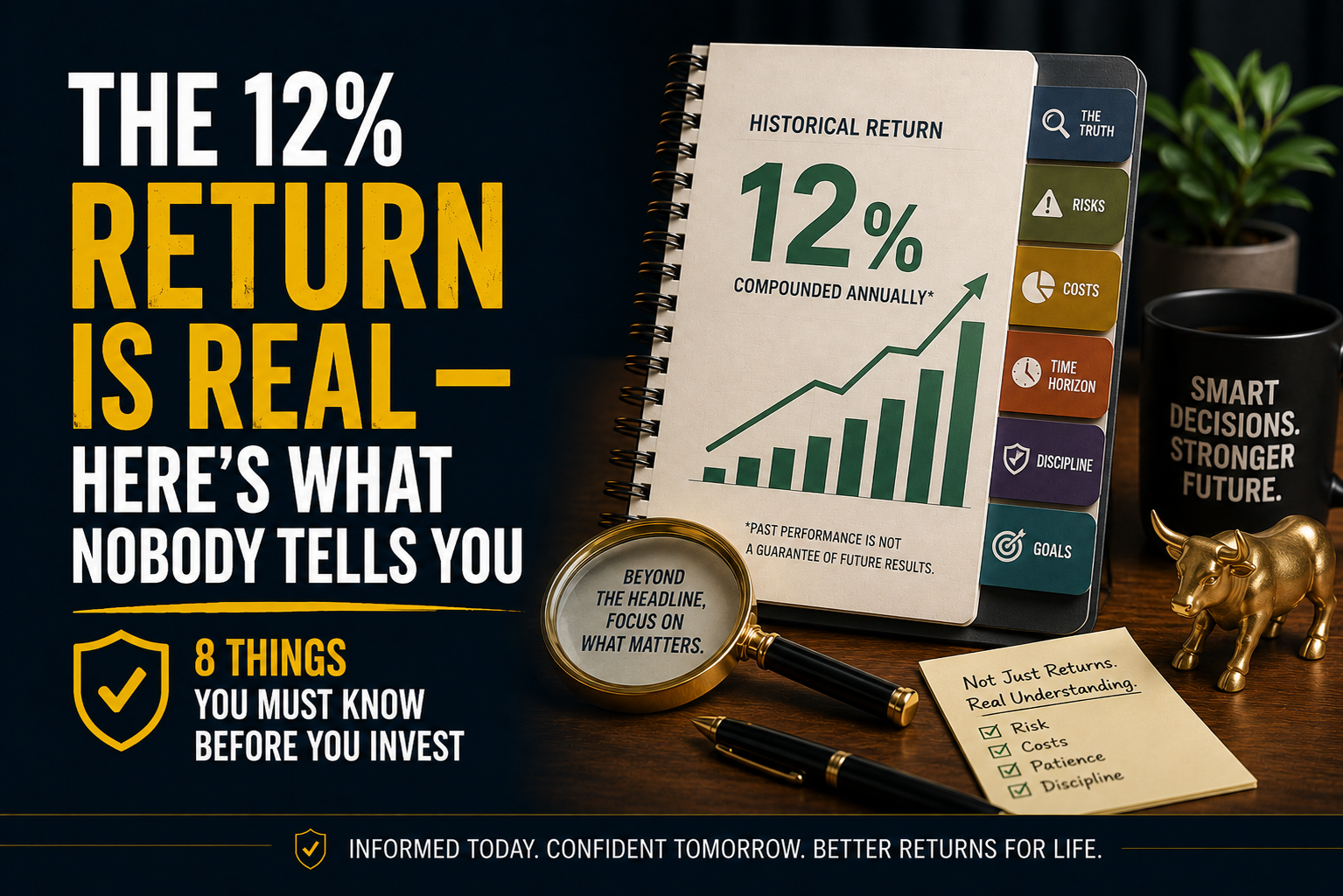
The 12% Return Is Real — Here's What Nobody Tells You

3 min read
Key Takeaways
- The S&P 500 has historically averaged 10–12% annual returns over the long term.
- One bad year in the market does not define your investment future — stay the course.
- Your savings rate matters more than chasing the perfect return.
- Investing 15% of your income consistently is the move that builds real, generational wealth.
- You don't need to be rich to start — you just need to start.
Every time someone brings up a 12% return on investments, somebody in the comments wants to argue about it.
"That's not realistic."
"That's too good to be true."
"You're setting people up for disappointment."
Family, I hear you. And I get it — when you've been lied to by the system, by predatory lenders, by people who were supposed to teach you about money and didn't, skepticism makes sense.
But here's what I need you to understand: the 12% return isn't a fantasy. It's history.
And today, I'm going to break it all the way down — cookie jar on the bottom shelf — so you can stop doubting and start building.
Let's get to work.
Where Does the 12% Number Actually Come From?
It's not made up. It's not a sales pitch. It comes from the S&P 500 — a stock market index that tracks hundreds of the largest publicly traded companies in the United States. Think of it as a report card for the overall U.S. economy.
Here's the real talk: the historical average annual return of the S&P 500 going back nearly 100 years sits right around 11–12%.
Now, I know what you're thinking — "Anthony, that's old data. What about now?"
Fair question. Even looking at more recent 30-year windows, the numbers hold up. From the mid-1980s through 2015. From the mid-1990s through 2025. Consistently, the long-term average lands in that 10–12% range.
That's not luck. That's the power of a market that — despite recessions, pandemics, and political chaos — has always recovered and grown over time.
But What About the Bad Years?
Real talk — yes, there are bad years. I'm not going to sugarcoat it.
In 2022, the market dropped nearly 18%. That stings. But in 2023, it came roaring back with over 26% growth. And in 2020 — one of the most chaotic years in modern history — the market still ended up returning over 18%.
Here's the lesson: you cannot judge your investment strategy by a single year.
The people who panicked in 2008 and pulled their money out? They locked in their losses permanently. The people who stayed the course? They watched their portfolios recover and grow beyond where they started.
This is why I always say — investing is not a sprint. It's a marathon. You need endurance, patience, and a plan you can trust.
What About the "Lost Decade"?
You may have heard people reference the 2000s as the "Lost Decade" — a 10-year stretch where the market barely moved due to the dot-com crash, 9/11, and the 2008 recession.
And yes, that period was rough. The average annual return during those 10 years was close to 1%.
But here's what those same people conveniently leave out:
The decade right before it — the 1990s — averaged close to 19% annually.
Put those two decades together and you're still sitting at a solid 10% average. That's why your investment horizon matters. If you're investing for 20, 30, or 40 years, one rough decade doesn't derail your future. It's just part of the journey.
The market has never permanently failed the long-term investor. That's not a promise about the future — but it is the consistent story of the past.
Here's What Matters More Than the Return
I need to stop you right here, because this is the part most people miss.
The 12% return is real. But you know what matters even more than your rate of return?
How much you're actually investing every month.
Studies consistently show that your savings rate — the percentage of your income you're putting into retirement accounts — is the single biggest factor in whether you retire with dignity or desperation.
Let me show you what I mean.
If you invest 15% of a $50,000 salary from age 25 to 65, assuming a 12% average annual return, you could retire with over $7 million.
Even if we cut that return in half — down to 6% — you'd still retire a millionaire with over $1.2 million saved.
The math doesn't lie, family.
But none of that math works if you never start. A 12% return on $0 is still $0.
The Faith Piece Nobody Talks About
Scripture says in Proverbs 21:5, "The plans of the diligent lead to profit as surely as haste leads to poverty."
Investing is an act of diligence. It's not gambling. It's not greed. It's stewardship — taking what God has given you and being responsible with it so that your children's children's children have a foundation to stand on.
God's design was never for you to work until you're 70 and still have nothing to show for it. Biblical wisdom supports building, saving, and leaving a legacy.
Investing is part of that plan.
How to Actually Get Started
Here's the step-by-step, no-fluff version:
Step 1: Get out of debt first.
You can't build wealth while you're drowning in payments. Use the debt snowball method — smallest balance first — and knock it out.
Step 2: Build your emergency fund.
Three to six months of expenses, sitting in a high-yield savings account. This is your protection so you never have to touch your investments in a crisis.
Step 3: Invest 15% of your gross income.
Once you're debt-free with an emergency fund, start putting 15% of your income into tax-advantaged retirement accounts — your 401(k), Roth IRA, or both.
Step 4: Diversify across four types of mutual funds.
Look for growth stock mutual funds spread across these categories:
- Growth
- Growth and income
- Aggressive growth
- International
Step 5: Stay the course.
Don't panic when the market dips. Don't chase hot stocks. Don't let fear make your financial decisions. Stay invested, stay consistent, and let time do the heavy lifting.
You Don't Have to Figure This Out Alone
One of the biggest reasons people never start investing is because they feel like they don't know enough. They're waiting until they understand everything perfectly before they take a single step.
Family, that day will never come if you keep waiting.
That's why I always recommend connecting with a trusted financial advisor — someone who can look at your specific situation, help you choose the right funds, and keep you grounded when the market gets scary.
You don't need to be an expert. You just need to be consistent and have the right people in your corner.
Conclusion
Look, family — the 12% return is not a myth. It's not a trick. It's the historical reality of what the market has done for long-term, consistent investors over decades.
But the return means nothing if you're not in the game.
Here's your move: Start with the debt snowball if you're still carrying debt. Build your emergency fund. Then commit to investing 15% of your income every single month — no excuses, no delays.
Your future self is counting on you. Your kids are counting on you. Your legacy is counting on you.
You're not too late. You're not too broke. You're just one decision away from a new story.
Now I want to hear from you — what's been your biggest fear or hesitation when it comes to investing? Drop it in the comments below. Let's work through it together.
Keep building,

Lorem ipsum dolor sit amet, consectetur adipiscing elit. Suspendisse varius enim in eros elementum tristique. Duis cursus, mi quis viverra ornare, eros dolor interdum nulla, ut commodo diam libero vitae erat. Aenean faucibus nibh et justo cursus id rutrum lorem imperdiet. Nunc ut sem vitae risus tristique posuere.
like what you’ve just read?
Make sure to share it with your tribe!
.webp)
like what you’ve just read?
Make sure to share it with your tribe!


